The wrapping up has been done; not the Christmas presents, but the greenhouse. All nicely bubble-wrapped against the frost, at least the walls are; the roof proved just too tricky (and I ran out of bubble-wrap). We had had one frosty night, and the brugmannsia was looking very peaky, so it had to be time to turn on the heating, and make the greenhouse as draught-proof as reasonably possible. I'm quite pleased with the result, and the temperature in there is now about 7C. A couple of hardy seedlings have been put out in the cold frame but the rest are benefitting from the extra warmth, especially the sweet peas, which are germinating much better with a little extra heat.
The frost was something of a one-off, though, and it has been more a case of battening down than wrapping up. The wind got up the other day and it has been quite blustery from time to time (and more of the same is forecast - a windy Christmas rather than a white one). The relatively mild and damp weather is tempting a few flowers to come into bloom - there's an honesty plant with a flower truss under the hedge, and there are a few flowers on the bergenia. Tellingly, some weed seedlings are showing in places - always a sign of warmish soil.
The bullfinch has been around several times, and today was accompanied by his lady bullfinch. They are very partial to the sweet rocket seeds, and - given that they're quite stocky birds - are quite acrobatic in working over such spindly and fragile stems. I had thought of clearing the dead stems away, but now I'm glad I didn't. The goldfinches, on the other hand, have been feeding on the seeds of the Big Yellow Thing (bupthalmum?). The mistle thrush has been a rather noisy presence all week, and occasional pheasants and partridges wander in at times, especially when there's shooting going on in the surrounding estates. I haven't seen the sparrowhawk this week, though I'm sure it won't have gone away.
Thursday, 19 December 2013

Thursday, 12 December 2013
Red in tooth and claw
When mentioning the sparrowhawk in my last post, I almost added that we haven't actually seen it catch anything. Presumably it does, otherwise it wouldn't hang about here so much; and it may be responsible for some of the little piles of feathers that appear from time to time about the garden. Yesterday, however, I witnessed it striking lucky. I was in the new greenhouse (having a ponder about greenhousy things) when a woodpigeon flew onto the wall under the rowan, looking hunched, slow and unhappy. This usually means that it knows its time has come, and in such circumstances pigeons tend to find a sheltered spot on the ground in which to sit down and expire. After a few minutes it flew onto the lawn and laboriously made its way towards the border under the dining room window. It never made it, though, because the sparrowhawk appeared from nowhere, landed on it and dispatched it with considerable efficiency, then tucked into a generous supper. Other birds of course made themselves scarce, except for a hen blackbird who had been picking over the soil among the raspberry canes and who opted to crouch down behind a clump of grass, doing a very convincing impression of a clod of earth. After a while a male pheasant turned up to scavenge for seeds dropped under the feeder, and actually wandered over to see what the hawk was doing, getting within about 15 feet of it; either it was a very dim pheasant, or it worked out that the hawk had quite enough food for the moment and wasn't about to attack anything else for a bit. The meal was still going on when dusk fell, so I left the hawk to get on with it with a view to clearing up after it in the morning. I was actually very keen for it to leave as little behind as possible, both because I don't much like having to deal with dismembered remains and also because of the difficulty of finding somewhere in this garden, with its shallow soil, to dig a deep enough hole to bury something the size of a woodpigeon. I had to do that last year, when a sick pigeon expired on the patio, and I had to excavate a shallow grave for it.
This morning, however, there was only a pile of feathers on the lawn; not even a wing or tail, let alone the bones. Down in the damson hedge at the bottom of the garden I found more feathers - but I doubt if the hawk had taken the carcass there; it would have had to drag it at ground level, which is more the action of an animal than a bird, and it would have had to eat all the bones. So my guess is that the hawk left the carcass, which was picked up, and devoured (bones and all) in the shelter of the hedge, by a four-legged predator - perhaps a cat but also possibly a fox. At least the poor pigeon had a swift end, and nature dealt with the body in its own efficient way. And no need for another shallow grave.
More cheerfully, a little flock of long-tailed tits passed through the garden this afternoon, all trying to get onto the peanut container for a quick snack before flitting off into the neighbouring gardens. This week's partridge tally was 20, all wandering off in a long line past the back door, over the drive and out on to the road. We also have two dunnocks feeding together; already paired up in preparation for spring. And the mistle thrush has been around, as has a male bullfinch.
The weather is still mild, and there has been little rain, but the air is very damp and the lawn is now much too wet for cutting. There has been some fog but no frost; and rain is coming in the next few days.
The plant picture has changed little, but walking down the garden one day I was stopped in my tracks by a trace of scent; yes, the winter honeysuckle on the other side of the garden had put out two tiny flowers. It's remarkable how the fragrance carries. It's an ungainly shrub, but I can forgive it a lot for its winter flowers.
This morning, however, there was only a pile of feathers on the lawn; not even a wing or tail, let alone the bones. Down in the damson hedge at the bottom of the garden I found more feathers - but I doubt if the hawk had taken the carcass there; it would have had to drag it at ground level, which is more the action of an animal than a bird, and it would have had to eat all the bones. So my guess is that the hawk left the carcass, which was picked up, and devoured (bones and all) in the shelter of the hedge, by a four-legged predator - perhaps a cat but also possibly a fox. At least the poor pigeon had a swift end, and nature dealt with the body in its own efficient way. And no need for another shallow grave.
More cheerfully, a little flock of long-tailed tits passed through the garden this afternoon, all trying to get onto the peanut container for a quick snack before flitting off into the neighbouring gardens. This week's partridge tally was 20, all wandering off in a long line past the back door, over the drive and out on to the road. We also have two dunnocks feeding together; already paired up in preparation for spring. And the mistle thrush has been around, as has a male bullfinch.
The weather is still mild, and there has been little rain, but the air is very damp and the lawn is now much too wet for cutting. There has been some fog but no frost; and rain is coming in the next few days.
The plant picture has changed little, but walking down the garden one day I was stopped in my tracks by a trace of scent; yes, the winter honeysuckle on the other side of the garden had put out two tiny flowers. It's remarkable how the fragrance carries. It's an ungainly shrub, but I can forgive it a lot for its winter flowers.
Tuesday, 3 December 2013
Under glass
My new greenhouse is now fully in place - :)). Today I bought it a heater, and some bubble-wrap, to prepare it for the winter. The more tender plants have been sheltering in there for a couple of weeks while the greenhouse was being finished (long story there....) and they seem happy, but the temperatures have been relatively mild on the whole so far and they'll need a little heat to tide them over the winter months. The sweet peas have been put in there too, and seem to be coming up better than they were doing in the cold frame (which has been relocated next to the greenhouse door); this could be because of the better light, slightly better warmth or the fact that they're now out of the reach of slugs and snails (there are a couple of truncated shoots that look as if they've been nibbled off). I have good intentions of better-organised sowing for next year ....
The weather has not only been on the mild side, with only a few frosts, but also quite dry. We're wondering whether we might actually manage to cut the lawn, which is looking decidedly shaggy. Colder weather is forecast for next week, but that leaves me time to get my tulips planted: a Sarah Raven collection of Prinses Irene, Couleur Cardinal and Havran (a deep purple). They will go in the bottom bed under the big tree, where I hope they'll make a good splash of colour. I haven't managed to organise the pots this year; they still contain last year's bulbs, which probably won't do well, but maybe that will make me more willing to dig them out after flowering so that summer bedding can go in.
The yellow chrysanths are still blooming, a little shabbily now, but otherwise it's winter colour only - the viburnums, winter jasmine and, if you look closely, a few cyclamen. The holly berries have all been eaten by the birds (but we managed to pick some for Christmas decorations before they all went).
We do have a lot of blackbirds this year. A large flock of small birds has been in the top of the ash tree a few times; it's hard to see what they are (finches? buntings?). A wren has been around, which is encouraging after our run of hard winters. And one day we had at least 50 partridges in the garden; they just kept on coming. They seem to be finding food in the veg plot; this must be weed seeds (there isn't anything else there at the moment other than the leeks and garlic, which are ok) so I'm happy to leave them to it. The sparrowhawk still visits occasionally, although the closest shave in the last few days was when a cat - a new, blue-grey one - pounced on some birds feeding on the patio (they all escaped, fortunately).
The weather has not only been on the mild side, with only a few frosts, but also quite dry. We're wondering whether we might actually manage to cut the lawn, which is looking decidedly shaggy. Colder weather is forecast for next week, but that leaves me time to get my tulips planted: a Sarah Raven collection of Prinses Irene, Couleur Cardinal and Havran (a deep purple). They will go in the bottom bed under the big tree, where I hope they'll make a good splash of colour. I haven't managed to organise the pots this year; they still contain last year's bulbs, which probably won't do well, but maybe that will make me more willing to dig them out after flowering so that summer bedding can go in.
The yellow chrysanths are still blooming, a little shabbily now, but otherwise it's winter colour only - the viburnums, winter jasmine and, if you look closely, a few cyclamen. The holly berries have all been eaten by the birds (but we managed to pick some for Christmas decorations before they all went).
We do have a lot of blackbirds this year. A large flock of small birds has been in the top of the ash tree a few times; it's hard to see what they are (finches? buntings?). A wren has been around, which is encouraging after our run of hard winters. And one day we had at least 50 partridges in the garden; they just kept on coming. They seem to be finding food in the veg plot; this must be weed seeds (there isn't anything else there at the moment other than the leeks and garlic, which are ok) so I'm happy to leave them to it. The sparrowhawk still visits occasionally, although the closest shave in the last few days was when a cat - a new, blue-grey one - pounced on some birds feeding on the patio (they all escaped, fortunately).
Wednesday, 20 November 2013
Autumn leaves
We returned, in early November, from more than two weeks away, to find rather more leaves still on the trees than I had been
expecting. There were plenty on the
lawn, but still more to come, even though there had been a lot of wind at the
end of October. Apparently the second
half of October was mild, which has delayed leaf-fall. A trip through the Slad Valley early last
week showed the beech trees still in magnificent golden leaf, and even now in
our garden most of the leaves are still to fall from the apple and hazel
trees. Two big leaf piles are now gently
and slowly rotting down, helped by the addition of handfuls of comfrey leaves.
It may have been mild in October, but after our two weeks in
Mediterranean temperatures, November’s chill and damp was a bit of a shock. Daytime temperatures are currently in low
single figures, with occasional frosts at night; enough for a thin layer of ice
on the pond but not persisting during the day, even in the shade. A mix of blue skies and murky chill.
The garden is somewhere between late autumn and early
winter. The last of the Nerines were
still in good condition on our return; they’ve been in a vase since and are
only now fading. The only flowers still
really performing now are the yellow chrysanthemums, although the pinks and the
Choisya ternata have had a late flush of flowers, and there are odd late
blooms on the Calendulas, Gaura and a couple of other plants. The winter shrubs are starting to flower: Viburnum
‘Dawn’ and the winter jasmine. We’ve
also had a good crop of toadstools in the lawn, which suggests a warm and damp
autumn; and the lawn is badly in need of cutting, but it's probably too late for enough dry weather to make that possible.
The beans and squashes have been harvested (as I thought,
the winter squash plant succumbed before its fruits could come to anything) and
composted. There were a few usable broad
beans even last week. All the eating
apples are now picked, before the birds could start on them, as well as most of
the cooking apples; the fieldfares and redwings are here for the winter, and
the fieldfares are happily feeding on the remaining cookers. We have a lot of blackbirds as well, so any
apples left out are being pecked quite quickly; even a few left on the back
doorstep weren’t safe.
The sparrowhawk has been around quite a lot, though without
actually catching anything that we’ve seen.
The birds are in full winter mode, tucking into any food we put out for
them. Today we had a wren, robin,
dunnock, sparrows, starlings, blackbirds, fieldfares, redwings, coal/blue/great
tits, green/gold/chaffinches, lots of collared doves, woodpigeons, a couple of
magpies, spotted woodpecker and a hen pheasant – not a bad total. Sadly, no sign of our lame pigeon since our return.
Monday, 14 October 2013
A dish of strawberries
All right, a very small dish. Of very small strawberries (the alpine strawberry 'Baron Solemacher'). But not at all bad for the middle of October. I spotted a couple of lovely ripe ones on a plant that has self-seeded into a sunny corner near the pond, and it prompted me to go searching under the leaves; I collected a good little portion for supper, all on accidental plants rather than those in the 'proper' place. I think that tells me that I need to get plants settled in in the autumn instead of waiting until spring, which is probably too late. It's an obliging little plant, growing happily in shade if necessary and not fussy about soil, but the plants do need replacing every three years or so.
Given the time of year, I managed quite a reasonable harvest from the garden at the weekend. Besides the strawberries, I picked three types of bean (the last of the French and runner beans, and some broad beans), courgettes, cooking and dessert apples (the Ashmead's Kernels are just starting to be ready), some radicchio leaves and a couple of spring-onion sized leeks (they were never thinned!); the potatoes and garlic are already in store, and I have had a couple of hazelnuts, although the squirrel has been seen attending to those. Not bad given the very haphazard planting this year.
The leaves have started to fall, and the leaf-raking season has begun. The old leaf-mould has been spread on the new bed under the ash tree where the soil is extremely dry and thin. I hope that will help the plants along a bit. The only flower colour in there at the moment is from the 'Bowles' Mauve' wallflower, which has flowered on and off all year, and from the sedums; the perovskia does have a (single) flower spike on it, but you wouldn't notice it (it was only planted this year, so I'm hopeful that it will put on more of a show next year). Elsewhere, there are still flowers here and there; the purple aster has started blooming, the dianthus seem to be getting second wind and there are still a few roses about, the sweet peas and phlox are tailing off. The little cyclamen are looking good, though. And the echium is beginning to fade; it will be cut down before it can seed too much.
The weather has been more autumnal - cooler, with wet and windy spells, but with some sunshine; Saturday was almost warm, but it has been wet since.
There are still a good number of sparrows about, and the occasional starling and dunnock; the robins are tick-ticking in the background but coming less often for food. I disturbed a partridge the other day, and the odd pheasant has wandered in. A green woodpecker has been heard close by but not seen. I wonder if he's staking out the cooking apples again?
P.S. Further examination of the cooking apple tree reveals a large apple next to a convenient perching branch with big beak-holes in it. My money's on the woodpecker.
I had been going to say that the butterflies have all disappeared, but not quite; just down from the pecked apple was another apple with a comma sunning itself on it. Probably the last of the year, I fear.
Given the time of year, I managed quite a reasonable harvest from the garden at the weekend. Besides the strawberries, I picked three types of bean (the last of the French and runner beans, and some broad beans), courgettes, cooking and dessert apples (the Ashmead's Kernels are just starting to be ready), some radicchio leaves and a couple of spring-onion sized leeks (they were never thinned!); the potatoes and garlic are already in store, and I have had a couple of hazelnuts, although the squirrel has been seen attending to those. Not bad given the very haphazard planting this year.
 |
| Cyclamen hederifolium |
 |
| Bees on the echium |
There are still a good number of sparrows about, and the occasional starling and dunnock; the robins are tick-ticking in the background but coming less often for food. I disturbed a partridge the other day, and the odd pheasant has wandered in. A green woodpecker has been heard close by but not seen. I wonder if he's staking out the cooking apples again?
P.S. Further examination of the cooking apple tree reveals a large apple next to a convenient perching branch with big beak-holes in it. My money's on the woodpecker.
I had been going to say that the butterflies have all disappeared, but not quite; just down from the pecked apple was another apple with a comma sunning itself on it. Probably the last of the year, I fear.
Sunday, 6 October 2013
Season of mists
Is it really a month since I posted last? Not much has happened in the garden since then, and non-garden things have rather taken over. Autumn is still coming gently, with some lovely sunny days like today but some very misty or downright foggy mornings and short spells of wet or windy weather to remind us of what's to come. Some of the autumn colours are in evidence, although we're still waiting for the main show. The mellow fruitfulness is also here - plenty of apples, although they're on the small side this year, and courgettes and beans still cropping nicely. The single surviving winter squash is at last producing female flowers; I had despaired of any fruit at all, although it'll have to get a move on if it's to produce anything worth eating. And today I planted the garlic - the earliest crop to go in the ground - and sowed the sweet peas, orlaya, ammi and larkspur.
This year's sweet peas have also taken a while to get going but are producing a nice little posy a week. The phlox is just starting to tail off, while the Japanese anemones are producing occasional flowers and the nerines are just starting. There's a good display of cyclamen under the holly tree and a few in my little spring patch. The buddleia is virtually finished for the year, and the bees, which have been enjoying it greatly, have transferred their attention to a self-sown echium (viper's bugloss) on the patio. This plant is the result of some seeds I sowed a number of years ago; it's a bit of a seeder, with a fearsomely deep taproot so difficult to get out, and they're uncomfortably hairy plants to handle, but the flowers are lovely and they do attract the insects. I've dropped a few seeds from this plant into the bit of verge by the drive entrance which I've cleared in the hope of making a sort-of wildflower patch for the bees; it's sunny and should suit the echium well if I can get it to establish there.
Also in flower is the blue echeveria which is spending the summer on the patio; it's either very happy or thinks it's going to die and wants to set seed! It will have to be brought indoors soon, along with the brugmansia and the cordyline. I had had ideas of putting these in a big pot for the summer, as an exotic-themed planting, but the tulips took so long to die back that no summer bedding ever went in. The first of the winter bedding - pansies in the windowbox - is in place and looking quite settled.
The butterfly count has picked up. Red admirals came late this year, and we've had some speckled woods about. There are also at least three commas in the garden at the moment; I found them together enjoying a fallen apple which was rotting in the grass (although by the time I got the camera out only two were still there). The apple is obviously very much to their liking; every time I passed it today there was a comma perched on it.
The usual birds are around but not all the time, so there's obviously plenty of food for them out and about. We have a woodpigeon with a bad leg who has been coming regularly for a few weeks now; he likes to pick up the seeds dropped from the feeder, and to soak in the birdbath, which we assume eases his leg. He seems quite accustomed to us. We've also had a vole visiting the patio occasionally, especially when we put bits of cheese out for the birds! He hides under the lady's mantle, scooting out for food and scooting quickly back in again.
 |
| Echeveria in flower |
Also in flower is the blue echeveria which is spending the summer on the patio; it's either very happy or thinks it's going to die and wants to set seed! It will have to be brought indoors soon, along with the brugmansia and the cordyline. I had had ideas of putting these in a big pot for the summer, as an exotic-themed planting, but the tulips took so long to die back that no summer bedding ever went in. The first of the winter bedding - pansies in the windowbox - is in place and looking quite settled.
 |
| Comma butterflies enjoying a rotten apple |
The usual birds are around but not all the time, so there's obviously plenty of food for them out and about. We have a woodpigeon with a bad leg who has been coming regularly for a few weeks now; he likes to pick up the seeds dropped from the feeder, and to soak in the birdbath, which we assume eases his leg. He seems quite accustomed to us. We've also had a vole visiting the patio occasionally, especially when we put bits of cheese out for the birds! He hides under the lady's mantle, scooting out for food and scooting quickly back in again.
Tuesday, 3 September 2013
Sliding gently towards autumn
The day after my last post was the first morning of condensation on the windows and heavy dew outside - autumn not far off. There are the first hints of leaves starting to turn in the woods, and the plum tree is starting to turn too. Ah well, much to enjoy until winter comes! The weather is still good, having turned very warm in the last few days though it isn't going to last.
The butterfly count has perked up a bit. We've had quite a few peacocks and tortoiseshells, and a painted lady (but no red admirals that I've seen). The bird tally has been reasonably good too. One morning we had a couple of bullfinches at the last tatty remnants of the raspberries, and two warblers apparently picking up the flies. And another morning saw a male yellowhammer, resplendently golden, tentatively staking out the patio. The robin is still about and getting territorial, and there are still young blackbirds not fully in their adult plumage. Judging from the sounds coming from the roof area, there are still baby sparrows to come. They've had a bumper year. And there are still house martins and swallows about (the swifts left in early August).
The late summer plants are only just starting - phlox, echinacea and the like. Lilium henryi is just finishing. In the veg plot the beans are starting to crop quite satisfactorily, and there are a lot of apples but very small ones. The plums are coming to the end; this is easily the latest they have ever cropped!
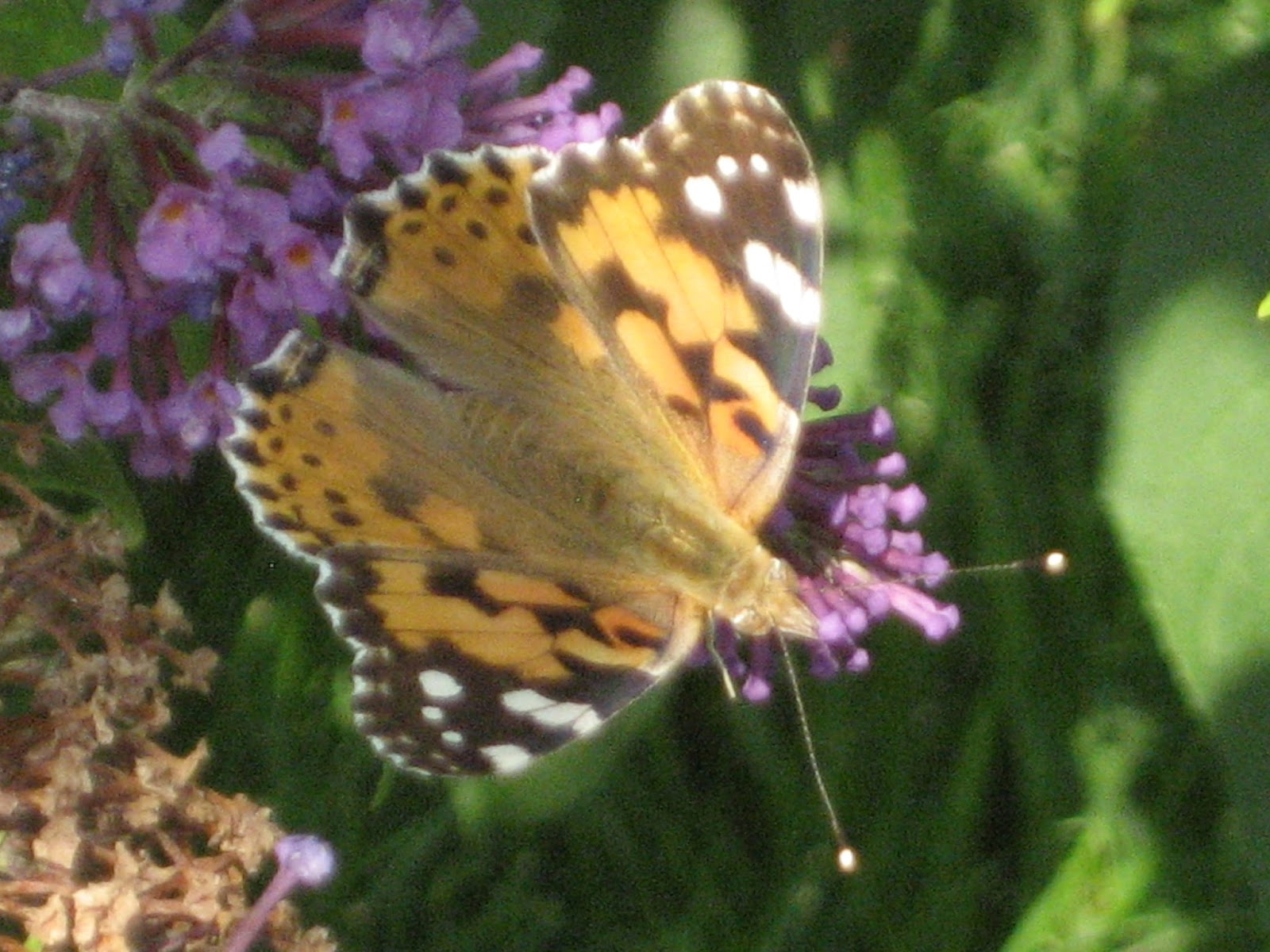 |
| Painted Lady |
The late summer plants are only just starting - phlox, echinacea and the like. Lilium henryi is just finishing. In the veg plot the beans are starting to crop quite satisfactorily, and there are a lot of apples but very small ones. The plums are coming to the end; this is easily the latest they have ever cropped!
Subscribe to:
Posts (Atom)