Thursday, 16 November 2017

Preparing for winter

Storm Brian passed us by, and October was overall quite mild, even warm occasionally.  But November has brought a few night frosts and some chilly days - nothing too severe yet, and there has even been some pleasant sunshine, but it has been enough to start me thinking about preparing for winter, especially as colder weather is forecast.  I put the greenhouse bubblewrap up before the end of October, unusually early for me, but the greenhouse heater is already on and the half-hardies are sheltering inside, except for a very few plants still in mixed plantings in pots outside.  One of those is the ginger lily, which isn't showing any ill effects yet; it's sharing a pot with a dahlia, and the dahlias haven't yet blackened as they are supposed to before you dig them up.  The blue echeveria is also still outside, but tucked up against the house wall; it has overwintered there before now, but I'll keep an eye on it and move it if it gets really cold.  The other echeveria, or rather its remains, is now in the greenhouse.  That plant has had a tough life; D found it, years ago, unwanted, uncared-for and unwatered, on top of an office cupboard, and brought it home for nursing.  It responded well, and flowered, although it eventually grew into a rather ungainly plant.  For the last couple of years it has been in the greenhouse, but in the spring it had an accident: while preparing the greenhouse for our month-long absence I knocked it over, scattering its compost, breaking off most of the stems and leaving it in a pretty hopeless state.  I had no time left to repot it, so the pot and its half-uprooted contents (with hardly any compost) were dumped unceremoniously outside.  When I came to examine it last week I found that the plant had broken into four tiny pieces, all of them rooted; they have been potted up properly and are now on the greenhouse staging where I can keep an eye on their progress.  Most of the other plants are down underneath the staging where they can be watered as required, but the echeveria will need to be kept drier.

Given the lateness of the season, I'm quite pleased with the edibles coming out of the garden at the moment.  In the veg plot are kales and cabbages (the latter rather tattered, but fine for stir-fries), a couple of sprouting broccoli plants (must keep the pigeons off those), two stems of tiny brussels sprouts, leaning at an alarming angle thanks to too-low-level netting over them, leeks (but too small still to be of much use), and even a very few, very small, mangetout from a very late sowing.  In the greenhouse there are a few small lettuces, some even smaller carrots in a trough, and various salad leaves - pea shoots, rocket and mustard leaves.  And of course there are the cooking apples, of which there is a large store in the greenhouse and a few still on the tree, where the starlings have been enjoying them.  Coming along for later, there are some salad leaves germinating in one of the old growbags, and some winter lettuce seedlings planted out into the other - so there should be some greens for late winter/early spring.

Dahlias and chrysanths
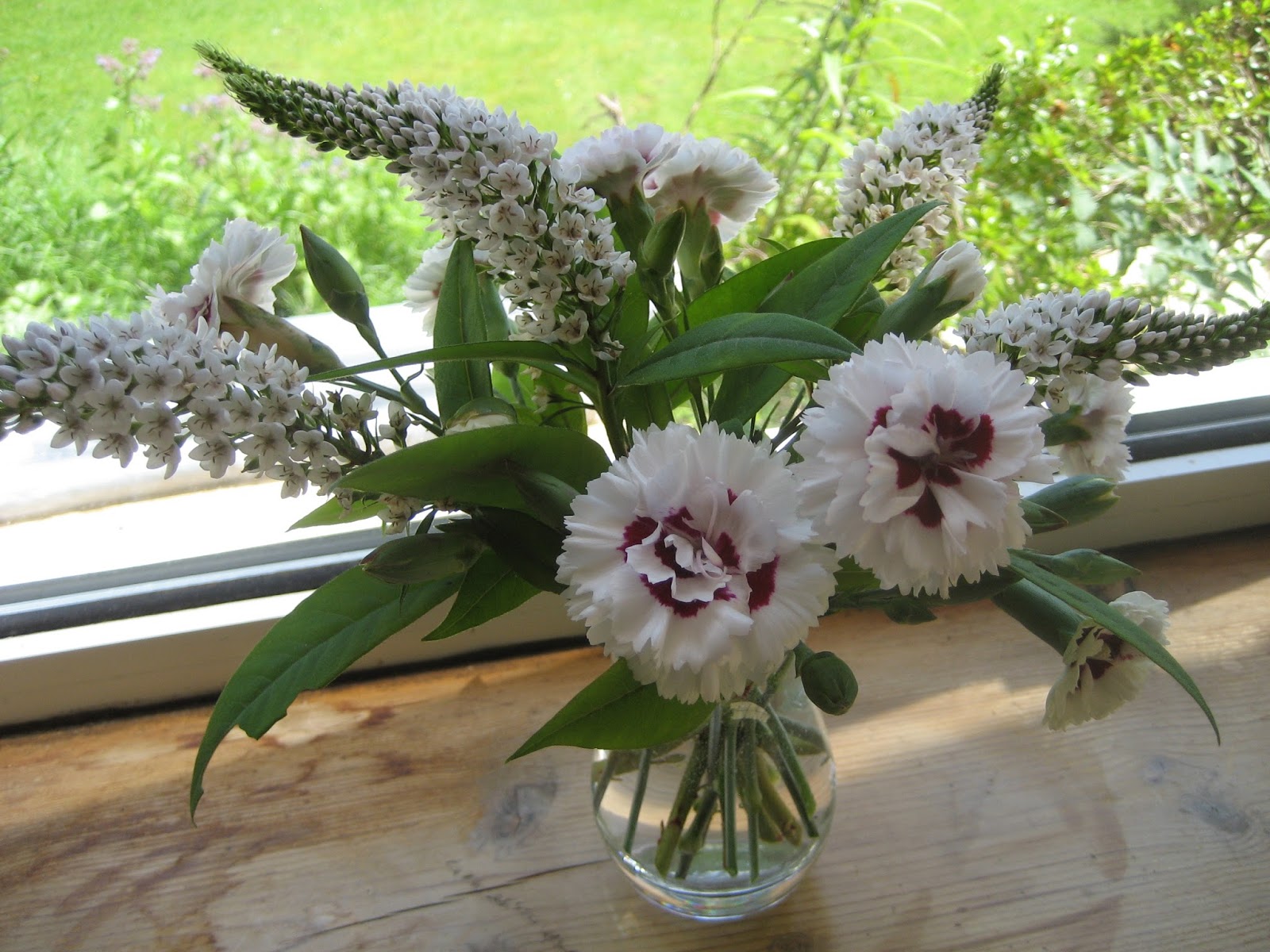
Some pinks
Flower colour is rather less in evidence.  The dahlias have finished flowering; the last blooms made a vaseful with some of the yellow and red chrysanthemums, which wasn't the most tasteful colour combination but, when colour is at a premium, anything goes.  I also managed a vase of pinks, and there are still sedums to fall back on, although they are fading now.  The borage is nearly over, but I've spared it for the moment as there are still a very few flowers open, and indeed a large bumblebee was enjoying them the other day; it also found some last oregano blooms, so they have been spared too.  The 'Blush Noisette' rose still has a few flowers on, though in no fit state for cutting.  Otherwise it's the winter shrubs - Mahonia 'Winter Sun', winter jasmine, winter honeysuckle (early into bloom this year) and the winter viburnums, all of them always welcome at this time of year.  And, despite the lack of colour, the garden is looking relatively tidy at the moment; we managed to mow the lawn the other day, which must be the latest we've ever done it.  It is looking very healthily green, which may not last long if we do get a cold snap!

The wildlife is also preparing for winter.  Migrant birds are now here - fieldfares and redwings, lots of starlings and a group of collared doves - and there are more blackbirds putting in an appearance, so I'd guess that some of them are migrants too.  The mistle thrushes have been much in evidence, trying in vain to keep the newcomers off the holly tree and next-door's grapevine.  It will soon be time to cut some holly to keep some Christmas berries for us!  I put the nestbox back up (taken down a good couple of months ago for cleaning) and the bluetits have been taking a look at it, probably fitting it out as a winter roost; and the sparrows have been staking their claims to the various hidey-holes under the roof, presumably for the same reason.  There is still some insect life around; besides the bumblebee, which I'd guess is a young queen preparing for hibernation, there must be a good number of flies and the like on the plants, as we have lots of tits very actively examining the foliage.  And there has been a red admiral butterfly enjoying what sun we've had, before it too heads for hibernation.

Thursday, 19 October 2017

Two Ophelias

Reddish sun and orange sky
The tail-end of Hurricane Ophelia (reduced to a Storm) passed by the UK, mostly affecting Ireland, on Monday; very strange it was too.  Storms here are usually wet and chilly as well as windy, but this one was dry and warm, and it brought dust up from the Sahara and from wildfires in Iberia that turned the sky a peculiar orange-yellow, rather like old-fashioned fluorescent lighting but in daylight.  Apparently the sun, for those who could see it, turned red; when the heavy cloud-cover here parted in early afternoon it was only mildly reddish.  I was set for a day indoors, but in fact the weather wasn't too bad apart from the wind, so I ventured outside and got on with weeding the vegetable patch.  With that and good weather on Tuesday, I cleared and forked over two of my larger beds, and dug out the weeds in the adjacent path so that (assuming I didn't miss any roots) they shouldn't creep into the planting.  One of those beds is going to have the garlic in; I had been thinking of preparing the other for the broad beans but I've decided it's too shady (and rooty) for that. 

Since then the weather has turned murky, misty and wet; another storm, Storm Brian, is due on Saturday with more strong winds.  (Apparently Monday's wind wasn't named here as a Storm since it had been a named hurricane.  I doubt if the Irish will care about the distinction; they're going to get the worst of it again.)  The winds have blown a lot of the autumn leaves away; the ash trees are mostly bare on top already and there haven't been the fine autumn colours that we were hoping for.  The hazel and apple tree leaves are still to fall, as well as those on most of the shrubs, so I should get some leafmould cooking for next year; most of the plum tree leaves are already collected.  There are also a lot of ash leaves on the drive to deal with.

The other Ophelia is the aubergine of that name.  I've had five aubergine plants this year, four of the classic variety 'Bonica' and one 'Ophelia'.  The latter seems tricky to germinate and a bit fussy to grow, and I had wondered whether to bother with her next year, but she produced the best-looking of the aubergines and I think I'll try her again.  The trick seems to be to get them going very early in the year; since I grow them on in the greenhouse rather than outdoors there's no benefit in holding back with sowing.  They also need to be grown in bigger pots.  The plants produced six little fruits, none of which would win prizes for size or beauty but 'Ophelia's was the best of the bunch.  They have now been turned into a little aubergine and tomato stew.  The tomatoes have also been picked, and the plants, and the aubergine plants, are now on the compost heap.  The courgettes are still cropping sporadically so have been left for the moment.  The growbags will be sown with salad leaves, as I did last year, to keep us going over the winter; there are also two small troughs in the greenhouse, one with red mustard and the other with rocket, to provide baby leaves.  There are half-a-dozen little lettuces in modules as well; I need to sow some more.  Some eating apples and three pears are still on the cordons, and the cooking apple tree is producing prolifically as usual (I need to pick a few more apples in advance of the storm to lighten the load on the tree).

Hedychium on the patio
The hedychium (ginger lily) in the patio pot finally flowered; I had been hoping that it would waft its scent across the garden but I fear it wafted in the wrong direction and wasn't really noticeable.  The flowers only lasted a week or so and are now dying back.  The nerine failed to flower well again this year (only three flowers); I've tied the wisteria back more severely to stop it shading the nerines out, and will try to keep the fallen leaves off it next year.  I thought I was providing it with some frost protection but the leaves would have prevented the roots (corms? rhizomes?) from getting enough sun to ripen them.  Also I really ought to feed it more.

Nerines (in vase in greenhouse)
I'm gradually going through the patio pots, repotting things and potting up the spring bulbs.  And the sweet peas have been sown and are germinating in the greenhouse.

Around this time last year I recorded finding a mouse's stash of cotoneaster berries; this year I haven't found the stash, but I have found the mouse (or more probably his descendant) - a rather sweet little fieldmouse hiding under the green wheelie bin.  I had been lopping off some of the cotoneaster branches to stop them from obscuring the view when we reverse the car out of the drive, and a lot of the berries had fallen to the ground.  I hope the mouse enjoyed them.

The sparrowhawk has been through the garden several times; a few woodpigeon tail feathers were left under the peanut container one day, probably the sparrowhawk's work as there was no carcass.  We feared for our lame pigeon Lefty, but I'm pleased to report that he is alive and well and busy feeding two offspring. 


Wednesday, 4 October 2017

Big things, little things

Elephant garlic cloves
Early October, and it's time to sow broad beans and garlic.  I've been waiting until I can find time to beef up the soil for them, by burying some old garden compost in the beds, with some shredded paper to help water retention in case we have a dry winter.  (Waterlogging is not a problem we suffer from here.)  The garlic bed in particular needs to be well fertilised.  A neighbour and I have entered into an elephant garlic pact: he has given me two massive cloves (each 7.5cm/3 inches long and chunky to boot) and the deal is that, in return, I give him some from my crop next year, so I need to make sure that they grow well!  Reminder to self: water well in winter and spring, and feed in January.  I'll also sow some cloves from this year's store; I got a big crop of very small bulbs (my fault - dry weather and no watering!), so there are plenty to put back in the ground.

The giant apple on the scales
Another Big Thing is the apple that was blown down from the cooking apple tree by the recent winds (the tail-end of a Caribbean hurricane; another is on its way tonight).  684 grammes (over 1lb 8oz) - the biggest apple so far this year.  I've already picked a good few but there are plenty left on the tree.  The birds don't seem to have gone for them so far; a blackbird appears in the garden very occasionally, but I suspect they're all out in the hedgerows enjoying the berries, and the fieldfares haven't arrived yet.  A pair of mistle thrushes were in the big ash tree one day, but neither they nor the woodpeckers appear to have paid the apples a visit.  As for other birds, the swallows and house martins are gone but the willow warbler is still around and occasionally coming to the patio for water; there are also at least three coal tits and a family of long-tailed tits about.  And, as I write, the sparrowhawk has just flown past the window (empty-clawed this time).
Berries in the hedgerows

Back on the subject of Big Things, the dogwood (Cornus sibirica variegata) needs taking in hand.  Last winter I didn't cut it back - latest advice is that it shouldn't be done every year - and as a result it is now a handsome bush but it has really spread beyond its allotted space, smothering a rose ('Mousseline') and in danger of overpowering the peony ('Sarah Bernhardt').  It will be butchered in the old style, ie to the base, come late winter.

Little carrots from the trough
In the greenhouse, the last of the tomatoes are ripening and the little aubergines are ready for picking.  Some rocket and mizuna is germinating in small troughs for winter greens, and the tray of pea shoots is still cropping nicely.  The lettuces have been left in their modules as they're growing well and are safer there than outside in slug-land (the beer traps have only been partially successful; the pak choi is fairly ok, but there has been some slug and flea beetle damage).  Other unwelcome Little Things are the cabbage white caterpillars on the brassicas; I've removed all I could find on the broccoli but one of the kales ('Nero di Toscana') has been well eaten.  However my experiment of growing carrots in a trough in the greenhouse has gone very well; I've just picked some small but beautiful little carrots from there.  They wouldn't win any 'longest carrot' prizes but they'll do very nicely.  That's one thing to try again (I wonder if they'll grow in there in winter....).

Another welcome little thing is the alpine strawberries that are dotted (mostly self-sown) around the place; they're fruiting nicely and providing very tasty little puddings.

The spring bulb order has started to arrive, so I need to get my pots sorted out for planting.  The big pot on the corner of the patio still has the hedychium, tithonia and dahlia combination in there; the tithonias have finally started to flower and the hedychium is just about to.  I hope it gets a move on before the temperatures drop; it needs to be potted up and put in the greenhouse very soon, or it will die of cold!


Tuesday, 19 September 2017

A sparrow falls

Scene: I'm indoors watching well over a dozen sparrows joyously going about their morning business on the patio. It's bathtime: three or four sparrows splashing in the bird bath, a couple in the small saucers of water and six crammed into the terracotta shell bath (didn't think it could hold that many), plus a few others feeding on the fatball container.  I glance away, and suddenly a dark shape flashes by the window; when I look out again, the sparrows have scattered and the female sparrowhawk is standing on the patio with a dead sparrow under her claws.  We eye each other for a few seconds; I don't want to watch what will happen next, so I make a movement which makes her fly away, taking her lunch with her.  She's certainly an quick and efficient killer, and I expect the sparrow didn't know what had hit it; at least I didn't have to deal with the remains.  Actually we've had a very low casualty rate this year, at least in terms of corpses to bury.  Several birds have flown into the windows, as always happens, but all seem to have bounced off with nothing worse than a sore head.  There have only been two burials: a fledgeling blackbird in early summer, and a little vole found on the lawn just the other day.  The blackbird was found ailing at the bottom of the garden with no obvious injuries; we tried to help in a hamfisted sort of way, but it died a couple of hours later and was buried under a blackcurrant bush whose fruit it would have enjoyed if it had lasted a few weeks longer.  The little vole - perhaps the little fellow who has been living in the compost bin? - was much smaller and easier to deal with; I put him in a shallow scrape under ivy in the bottom hedgerow.


First colour on the spindle tree
Viburnum x bodnantense 'Dawn'
Autumn is drawing on, with the first storm of the winter (windy rather than very wet), leaves starting to sprinkle the lawn, and the spindle tree beginning to turn red.  Temperatures are dropping, particularly at night (9.3C is the current low in the greenhouse), although today was pleasantly warm and sunny (lunch outdoors).  It's becoming more difficult to find flowers for cutting in the garden, although Phlox 'White Admiral' is still (rather too) bright, Sedum 'Herbstfreude' is just colouring and there are still dahlias coming (though they haven't done too well this year; in too shady a spot, I think).  The pink Japanese anemone is petering out.  There are a few cyclamen under the holly tree - not as many as usual, must do something about that - a nice patch of borage by the new terrace, and Viburnum 'Dawn' is in flower already.  There are also a few odd blooms here and there, such as some late flowers on the astrantia, but overall there's not too much flower colour in the garden.  It has been a good year for berries, though.
Cyclamen hederifolium
Elderberries

The pak choi and some of the dill have been planted out in the vegetable garden, with beer traps for the slugs alongside; these have indeed filled up with dead molluscs, and the seedlings have survived so far without damage, so I think I may have found at least some sort of solution to the problem!

Despite the few flowers available, there are still some butterflies about - three red admirals and one each of large white, speckled wood and comma.  And a big dragonfly zooming around the other day.  There are plenty of smaller flies as well; the swallows and house martins have been feeding overhead, and we've had visits at dusk from a little bat which is presumably finding plenty to eat as well.

Tuesday, 5 September 2017

Mists and mellow fruitfulness

We are now into meteorological autumn, although the weather has been there for some time.  The day after my last post saw the first autumn dew on the grass in the morning, and overall the weather has been cool (not to mention chilly on occasion) and showery, with the exception of a hot Bank Holiday weekend and some nice sun last Saturday.  A few days have been seriously misty, more November than August.  There's still time for an Indian summer, but I'm not holding my breath.

Mellow fruitfulness: a few tomatoes
The plum crop was very early, and small, but the fruit was of good size and sweet.  The early apples have started; the 'Discovery' ones are mostly eaten (partly by the wasps!) but the little tree that we keep mostly for its value as a bird feeder support has produced better-sized apples than usual (I thinned it fairly thoroughly).  The cooker has its usual crop of huge fruit, but they won't be ready for a few weeks yet.  D picked a nice punnet of blackberries from the local hedges, and the various little alpine strawberry plants dotted around the garden have been keeping us in occasional strawberry feasts.

... and some chillies
Most of the bean plants have been ravaged by the slugs, but there are a few French beans; the 'Roquencourt' ones seem to have withstood the onslaught rather better than 'Ferrari', though I've had a few beans from both.  I've had a (very) few courgettes, all from one plant ('Zucchini': the 'Orelia' in the tub hasn't actually done anything).  The kale and cabbages have been keeping me in stir-fry greens; netting them hasn't completely kept the pests off, but it has protected them from the worst.  In the greenhouse, the tomatoes are cropping quite well and the aubergines, although very small, are better than I've had in the past.

Pak choi in the greenhouse
This year I've finally realised that it's possible to sow plants in the greenhouse in late summer/autumn and get them bedded out before winter.  There's a nice little crop of lettuces, pak choi, cabbages and various herbs in modules in there; also a trayful of old pea seeds grown for salad pea shoots, and I'm trying some carrots in a trough (with the intention of pulling them before they grow long enough to hit the bottom of the trough - we'll see if that works).  I'm still trying to pluck up courage to plant out the ones than need to go outdoors; some slug traps are going to be required.  I did sow some seeds direct a few weeks ago and they germinated ok, only to disappear virtually overnight, leaving a few chewed stumps.  The toad and the hedgehog are not doing their job, obviously.  (We met the hedgehog over the Bank Holiday weekend; returning from a late supper in the summerhouse, we found a dark, hedgehoggy shape on the lawn, but he had disappeared by the time we got the torch out.)  It seems a pity to put out such thriving plantlets only to have them eaten by the slugs; in fact the lettuces look so good that I may just leave them in the greenhouse and use them as baby leaves.
Lettuces and some kale
Coriander


Pink gazania


Earlier in the summer I put the tender plants outdoors for some fresh air.  The avocado went back into the greenhouse when the weather started to cool, but the hedychiums are still out there.  I planted one of them in a big pot with a couple of tithonias and some other things (I was thinking of a lush, tropical look); the tithonias have just started to flower and the hedychium has two fat flower spikes coming up, so they may just flower before it gets too cold for them!  On the subject of tender plants: last winter I kept a couple of gazanias going in the greenhouse.  They're still in their pots (outside now), but the flowers are lovely.

There seems to have been some sort of animal fracas in the garden one night; the builders found several large tufts of what looked like rabbit fur, and the courgette tub had been tipped over the edge of the terrace.  It would have required a very muscular rabbit to move it!  I'm guessing that we might have had a fox in (even a cat would have found it heavy to move).

The birds are having their moult at the moment.  Very few blackbirds are coming into the garden, and now that the breeding season is over the starlings have vanished also.  (Sadly for them, their nest hole in the wall up by the roof has been filled in; they were making an expensive mess of the roof woodwork.  A few sparrow nest holes have probably also gone.  Sorry, sparrows.)  My little robin now has his adult plumage, but is still very sociable with humans, if not with other robins!  Our builders almost managed to get him to feed from their hands.  Today we've had a willow warbler and a juvenile male bullfinch come to the patio for water.  The butterflies have started to tail off; a comma has been on the buddleja, and there's a speckled wood fluttering about in the shadier spots.  The buddleja is fading now, but the borage seems to be keeping the bees happy.

Dianthus and lysimachia

Mostly dahlias
Flowers for the house recently have mostly been dahlias, dianthus and Lysimachia clethroides, with the occasional sweet pea.

Monday, 14 August 2017

Flying visits

Red admiral and peacock
It's peak butterfly time in the garden.  The buddleja is the big attraction, although Big Yellow Thing (now fading) has also been a draw, and the smaller butterflies also like the oregano.  There seem to have been more butterflies than last year, but nowhere near as many as we used to get; but there's a hard core of a few red admirals, some peacocks, a few brimstones (two males and a female, at least), a painted lady, a couple of small tortoiseshells (at last), lots of large whites, and occasional small heath and gatekeepers.  There was also, briefly, one large fritillary; I've never seen one before so can't be sure of exact identification, but it was definitely a fritillary.  I've also logged a holly blue (and now know the difference between that and a common blue, at least if I can see the underside).  And one day we had a hummingbird hawkmoth on the buddleja; haven't seen one for a few years.  Butterflies are a real summer pleasure, and I'm always sorry to see them disappear at the back end of the season.

Rose sawfly caterpillars
Less of a pleasure was finding a couple of rose sawfly caterpillars trying to defoliate my Rosa alba 'Koenigin von Daenemark'.  Fortunately they hadn't done too much damage; it's a rose with very healthy leaves, which was how I spotted the little nuisances in the first place.  Identification from the butterfly book was easy (the real ones are on the left of the photo).  I'm afraid I fed them to the birds.


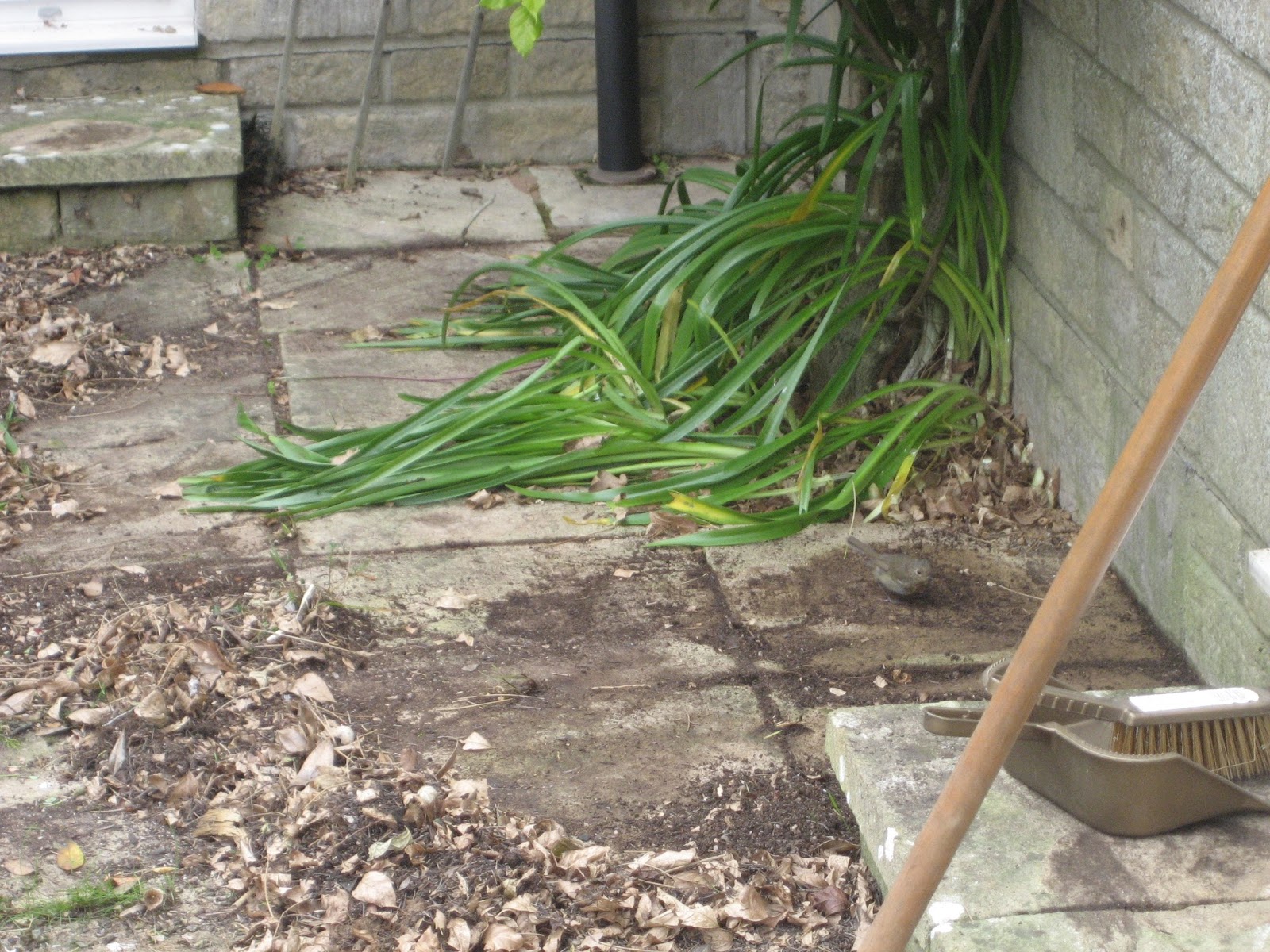
Our feathered flying visitors are still numerous, although I sense a slight decrease in interest in the food put out for them.  The blackbird and sparrows are still feeding young, but the robins are starting to sort out winter territory (much competitive tick-ticking); the youngest robin is still my great friend, appearing whenever I weed, clear up or do other garden jobs.  He had a bonanza yesterday, when we moved most of the patio pots to allow our builders working space to replace our guttering this week.  I was able to sweep up many months-worth of debris that had collected in the corners, and to cap it all an ants' nest under the step broke up that afternoon and there were flying ants all over the place; the robin clearly thought it was all his birthdays rolled into one.  There are plenty of insects flying around, and the local house martins and swallows are often feeding overhead, though I haven't seen the swifts since late July; theirs is a real flying visit, barely ten weeks long by my reckoning.
My little robin friend ...
... and helping with clearing up


A week or so ago we had a flying visit from a sparrowhawk which landed briefly on the big hook holding up the fatball feeder; fortunately the sparrows saw him at the last minute and bolted.  Barely had he landed, however, than a woodpigeon flew at him and saw him off; he and his mate seem to have a nest in the holly tree and he wasn't taking any chances.  I think it was our lame pigeon Lefty.  I see from my old blog posts that he has been around since at least 2013; he used to rule the roost in the garden but for the last couple of years seems to have been based out in the fields, coming in here only occasionally for water and a little food.  He's a feisty bird - I suppose he has to be, with his bad left leg - but in the past doesn't seem to have had any success in mating.  This year, however, I've seen him with a mate, and a couple of times earnestly carrying bits of twig around as if he's helping build a nest.  Good on you, Lefty.

The building work at roof level involved replacing a bit of broken roof fascia behind which some sparrows had nested this year.  Now that the nesting season is over, we had no compunction about removing the nest: a tangle of dead grass and (mostly pigeon) feathers.  We've also taken down the nestbox for cleaning; the bluetits had a neat mat of grass and moss, with a perfectly round hollow in the middle for the eggs, quite a construction for a pair of little birds.  There's a good number of tits, including great and long-tailed tits, around in the garden; they seem to have had a reasonable breeding season.

Sparrow nest contents
Bluetits' nest
Rosemary in need of attention!
Moving the patio pots was a job that really needed doing.  Several of the plants are badly in need of attention.  The big rosemary, in particular, was partly blocking the patio doors and had rooted down through the pot and into the soil under the flagstones; it really really needs a lot of cutting back or possibly discarding (there are other rosemary plants elsewhere in the garden).  The move also allowed me to spot a plant label under the lilies whose identity was puzzling me the other week, but I'm not sure I'm much the wiser; the label said 'Pink Perfection' but that doesn't match either of the lilies that are in there!

The runner bean plants have succumbed to the slugs (despite the toad, who was found hiding under some nicely damp and rotting wood nearby), and one of the courgette plants is also looking chewed.  The most successful courgette plant (ie the only one actually showing anything edible) is the one planted in a shallow tub on the patio; I need to do that more often, I think.  The tomatoes are now cropping, slowly, and all the aubergines have one little fruit on though I doubt that they will come to much now that summer is coming to a close.  I've started shutting the greenhouse up at nights, as the temperatures are too low; it has been chilly for the last couple of weeks except when the sun is out (which hasn't been too often), and even with the door closed the temperature in there has gone down to 12.4C on at least one occasion.  Apparently one in three UK households have turned the central heating on in the last week! - we are resisting, although we did use an electric heater one evening.  It's supposed to be summer, for goodness' sake.

Whether it's a sign of the weather or not, I don't know; but D saw a redwing in a hedgerow outside the village.  Had it spent the summer here, or is it an early winter migrant?

Wednesday, 2 August 2017

Digging up bulbs

There are some garden jobs for which there never seems to be a good time to get stuck in.  Cleaning the pond is one, but another is clearing weeds out of borders with bulbs in; the best time, as far as the bulbs are concerned, is when they are dormant, but that's high summer when surrounding plants are in full flow.  I've decided that this is probably the best time to do something about the seriously weedy patch down near the summerhouse; a lot of what's in there can be dug up and discarded.  I'm working around the plants I want to keep - Crocosmia 'Lucifer' (now fading), Lilium henryi (in flower) and the yellow chrysanthemum (still to come) - and I'll sort them out in the autumn or early winter.  The doronicums will also stay, but they're easy to dig up, weed underneath and replant.  So I've been removing the bugle (Ajuga reptans atropurpurea - attractive but seriously rampant), an overenthusiastic self-seeding euphorbia and the big red poppy Papaver 'Allegro'; the latter will probably reappear in due course, but that's fine by me.  That allows me to get to grips with the couch grass, vetch and other nasties in there.  I've been digging up bulbs as I go.  The little red and orange species tulips (um ... T. linifolia and urumiensis???) will go back in, along the sunniest edge, as they are delightful, as will the very few bulbs of the big red tulip (no idea of the variety, they were in the garden when we arrived) if I can find them.  The daffodils I'm not so sure about.  They are large trumpet varieties, also inherited with the garden, and I'm in two minds about them.  On one hand, they are good for cutting, and they certainly brighten up the garden, especially after a dismal winter; but they have no scent, aren't particularly elegant and seem a bit out of place in a country garden.  Increasingly I'm preferring smaller-flowered varieties.  I may replant some of them, but in any case they had become very congested, and I will have lots of spares (I have ideas about what to do with them, more in a future post!).  There are also lots of little white bulbs in there, which I've been picking out to throw away.  I can't think what they are; I don't recall other bulb flowers in there.  Much of that patch is really too shady for most bulbs, so I wouldn't have planted them there.  My best guess is that they are Allium triquetrum (although they don't seem to have the distinctive onion smell), which I established a few yards away (before I realised how thuggish they are!) and am now trying to remove.  Whatever they are, I can do without them, so they can be binned!

On the bright side ....
No weeding today; it's raining.  The weather over the past two or three weeks has been very unsettled and rather disappointing for summer - below-average temperatures, quite a lot of wind and showers.  The rain is at least partly welcome after the dry spring and early summer, but a little more warmth would be nice.


... a lovely rainbow
The shallots and garlic have been lifted and are drying in the greenhouse.  The dry weather wasn't good for them; the shallots, frankly, aren't much bigger than when they went in! and the garlic is on the small side, but prolific and should keep me going for the next few months.  Various seeds, for late autumn/winter crops, have gone into their place.  My very late-planted courgettes are trying hard but struggling with the temperatures, and the bean plants are attracting far too many slugs (where is that toad when I need him? I haven't seen him since his day in the greenhouse).  The tomatoes are just starting to ripen, and the aubergine plants have two little fruits on.  I am always frustrated by the garden writers who urge you not to allow your aubergine plants to produce more than six fruits - if only!  The plums have ripened this week; far fewer than usual, though at least I don't have the normal business of dealing with the glut.  Wasps have attacked some, and the blackbirds have also found them, but several punnets have made their way into the kitchen.

Butterflies continue to appear in the garden, weather notwithstanding.  The count so far is up to four red admirals, two peacocks, and one each of painted lady, gatekeeper, small heath and meadow brown (and lots of whites).  No tortoiseshells to date - I wonder why.