Sunday, 10 January 2021

New Year jobs


Frost on Viburnum davidii

New Year, and still so much to do.  There has been a further dusting of snow and the temperature has barely risen above freezing, so outdoors has been too frosty and icy to do much.  The greenhouse still hasn’t been cleared out and washed down, so it remains un-insulated despite the cold; several nights have been a few degrees below zero and the temperature in the greenhouse has fallen to just above freezing, but I’m trying to resist turning on the heater unless absolutely necessary.  Nothing seems to be suffering too much in there at the moment.

A priority job has been to get the last dahlia tubers out of their pots – one had been sitting, pot and all, in the greenhouse, and two more out in the cold – and replaced with the last few tulip bulbs.  My good intention had been to give all the potted bulbs fresh compost, but given the renewed lockdown and last year’s compost shortage I’m concerned about not having enough, so they have got a layer of new stuff above and below them, with old compost at the top (some 6X fertiliser mixed in if they were lucky).  The two very big pots have mixed tulips: the one by the summerhouse has the doubles ‘Angelique’, ‘Uncle Tom’ and ‘Black Hero’, and the one on the patio has ‘Ballerina’, ‘Antraciet’ and a purple tulip whose name I’ve forgotten (!).  The other tulips are planted one variety only in each pot, with no other accompanying bulbs or plants; this should mean that I can discard them (at least, those that don’t flower a second year) as soon as they’ve finished flowering, without having to wait for other plants to go over.  I’ve even planted the crocuses separately in little pots; this seemed a good idea at the time, but I now realise that this leaves them vulnerable to being dug up and eaten by mice (as has happened).  In the big pots, above the tulips, they’re safe; the mice can’t climb so high!  Some of the crocus pots are now in the greenhouse and some in the cold frame, but even there they’re not completely safe.  Something has been digging into the snowdrop pots in the cold frame, and it looks like mouse work - although I can't see how the mouse would get in there.

I have spent some time clearing soil off the dahlia tubers.  Those that were in the ground had been dug up in wet conditions and had a lot of claggy soil stuck to them; this has mostly dried now and is easier to remove.  There was some microlife and the odd worm in the soil; I dumped it outside on one of the borders, to the great delight of the robin and the sparrows, the latter using it as a dust-bath when the birdbaths were frozen.

Another job has been to shell the beans that I hung up in the greenhouse to dry off, in the hope of getting beans to sow this summer.  I had been afraid that the greenhouse was too damp for this (the roof leaks in heavy rain), and I was also concerned that I wouldn’t be able to tell one variety from another; I hadn’t labelled them, failing to realise that the pods wouldn’t be easily distinguishable once they had dried and shrivelled.  I needn’t have worried.  There was a decent number of good-quality beans from each set, and they were easily identifiable: the haricot-like ones were from the runner bean (variety unknown) given to me last summer by a neighbour; the brown mottled ones were borlotti beans; and the handsome black-and-pink ones were the climbing purple French bean ‘Blauhilde’.  More than enough to sow.

Beans, top - runners; middle - Blauhilde; bottom: borlottis
 
Today the thaw has started; temperatures will rise this week and it will rain.  I took the opportunity of making a start on pruning the roses; still several of the big ones to do!

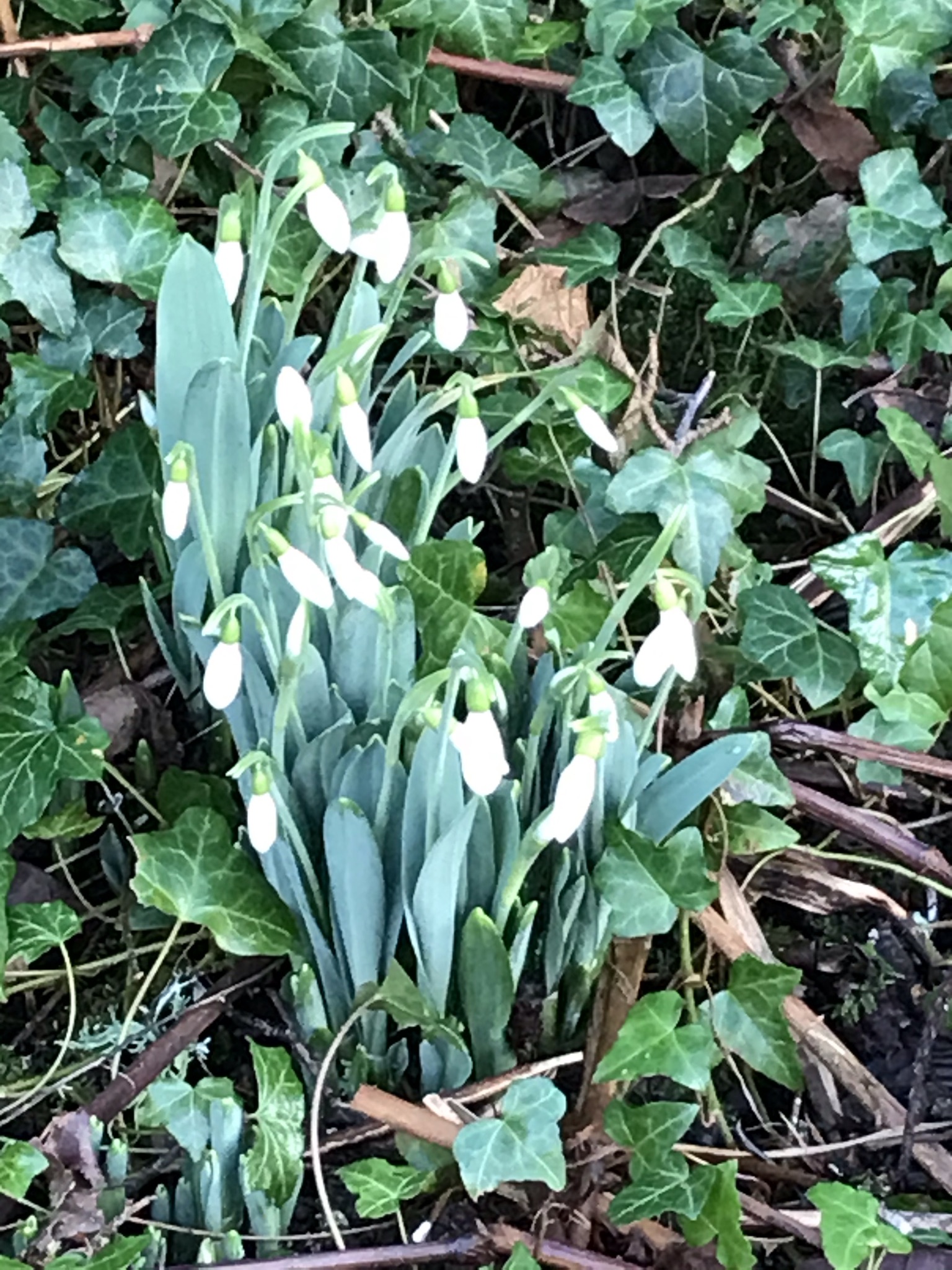
The snow prevented me from doing a New Year’s Day tally of plant varieties in flower in the garden.  Early the following week, when the snow had fallen off most of the plants and I could see what was and what wasn’t flowering, I managed a total of ten.  The usual winter shrubs, of course: winter honeysuckle, winter jasmine, Mahonia ‘Winter Sun’ and two viburnums (which only count as one variety); the big hellebore in the front garden was starting to bloom (the others still in bud); and the toughies: one flower on the Centaurea montana, one Allium triquetrum, some alpine strawberries and meadow grass.  And the first snowdrops of the year, the Galanthus elwesii near the pond – the first real sign of spring in the garden!


Thursday, 31 December 2020

Goodbye 2020

Sunset 31 December 2020

Goodbye 2020, the year nobody has loved.  As chance would have it, the last day of the year seems to have been trying to make up for the previous 364 days – a lovely winter’s day, bright, sunny, calm and cold, with snow lying (patchily) on the ground.  We made the most of it by going for a walk.

Out for a walk

On Monday last we awoke to find a couple of inches of snow over everything; at least it was an improvement on a couple of nights previously, when Storm Bella swept through, with torrential rain and gales.  The snow continued intermittently and mostly lightly that Monday and part of Tuesday, and it stayed cold; there was a slight thaw on Wednesday, clearing snow at least from places where the sun managed to reach, but the local roads remained too icy for us to feel like venturing out.  Today, despite the sun, it has been too cold to improve the situation.  So all that food in the fridge has proved useful after all; no shopping until after New Year!

The garden, Monday morning

Thinking back over the year’s weather, the main events in my memory are a stormy February, a warm, dry and sunny spring followed by a miserable June and most of July, another hot spell in early August, and nothing very pleasant after that, including the wettest October on record. My usual failure to water the potted plants thoroughly enough during the dry spells caused a few losses, and is the likely reason for quite a few other plants not performing well. Those plants that had their feet in the soil did rather better, and the fruit trees obviously enjoyed the weather, as we had a bumper crop of apples, plums and raspberries – and much the best pear crop we’ve ever had (six juicy pears).

It was also the year when potting compost was unavailable for months, the result of gardeners panic-buying ahead of lockdown and then suppliers being closed; and apparently seed merchants were so inundated with online requests that deliveries of seed orders were taking ages to arrive (although I had all my seeds bought by late 2019 so didn’t have that problem).  On the plus side, thousands of people took up gardening for the first time, having nothing much better to do, and that can only be a good thing.  Let’s hope they continue in 2021!

And now we're back into lockdown.  Well, there's plenty to do in the garden - weather permitting.

Goodbye 2020 – it’s been a rollercoaster, and on the whole one best forgotten.  Let’s enjoy 2021.


Saturday, 26 December 2020

Have yourself a mossy little Christmas!

Even a quiet Covid Christmas inevitably leads to a lot of advance shopping and preparation.  Why, when the shops are open again on Sunday?  I suppose we just follow what we’ve always done.  As a result, there’s so much to do and so little time to get it done.  Hugh Johnson appropriately called it the Season of the Great Too Much, and even with only two of us in the house it’s not so much No Room at the Inn as No Room in the Fridge.  Until Christmas Eve it was also No Room yet Decorated with Greenery, because of other things needing to be done, and because it had been too wet in the preceding days to bring in dry(ish) material to deck the halls with. 

We’ve never got into the habit of having a Christmas tree; instead I decorate the banisters and at least one mantlepiece with greenery, of which there’s plenty in the garden.  This year, having instituted a local online competition for various Christmassy things (best-dressed Christmas tree, homemade door wreath, table decoration etc), I thought I ought to show willing and create my own Christmas wreath. 

Mossing the wreath

It’s a complete DIY wreath.  The only non-natural element is an old wire coathanger which I’ve used to form the initial ring (and to provide a hanging hook).  First step was to bend it into a rough circle (more of a diamond really, but that doesn’t matter too much).  Then I used several long, thin, whippy stems of Buddleja alternifolia (which needs cutting back anyway) to build up the wreath, twisting them around the wire; a few of the thicker ends stuck out, but I reckoned (rightly) that I could work them in during the subsequent stages.  This produced a rather thin-looking wreath – I could have added more buddleja but at that point it started to rain again and I retreated indoors – but next I added the moss, which built it up considerably. 

The moss was easy to come by; there’s more than enough in the lawn to moss up thousands of wreaths.  Ten minutes with the wire rake pulled up a big bagful, of which in fact I only needed half; it made scarcely any inroads into clearing that patch of lawn, but it was enough to please the local robin.  Then I spent a damp and drizzly half-hour in the greenhouse binding it onto the wreath with green garden twine, creating something that looked quite professional except for the slightly wonky shape!

All mossed up

As a base material, I used bits of leylandii from the long hedge.  Just as well that I didn't complete trimming the hedge in the autumn!  It made an effective covering, but I was surprised how tricky it was to get the ends to penetrate the moss.  In my impatience I probably used too-long pieces of leylandii, resulting in them sticking out rather than forming the smooth base that I was aiming for, but it looked not too bad.   I intended to use yew on top to create a slightly more elegant finish, but, having added a few yew twigs, I realised that its habit of growth is rather splayed and spiky and it creates too jagged a profile, and anyway it could hardly be seen against the leylandii, so I didn't bother adding more.  You have to look closely to see the yew at all!

Leylandii (and spot the yew if you can ....)

This dark base then needed some decoration.  Last week we saw a wonderful wreath on a door in Cirencester, decorated largely with brussels sprouts (some would say that it’s the best use for sprouts), looking really good.  I do have sprouts in the garden, but they’re tiny – not much use either for eating or for decorating wreaths.  So, for a highlight, I cut a few sprigs of the variegated euonymus that was a present back in the summer, and which has settled in extremely well, to the extent of now needing some trimming to shape, so it was two jobs in one.  It looks not unlike variegated holly, which is quite appropriate for a Christmas wreath.  

With euonymus....

Then some orange seed-pods of Iris foetidissima for additional decoration.

... and iris seed-pods

The end result looks a little like it’s having a bad hair day, but it does the job!  It’s now hanging on the front gate, wishing passers-by a happy Christmas.

Thursday, 10 December 2020

A cold and frosty morning

The other morning we had the first proper frost of the winter, which froze the water in the bird-bath and blackened the dahlia foliage.  At last.  The dahlias stopped flowering a few weeks ago, but you’re supposed to wait until the foliage dies back before lifting them for winter storage, and they had been stubbornly staying green(-ish) despite a couple of light frosts and a thin covering of snow last weekend (it melted after a few hours in the sun).  I’m now digging them up gradually, though the ones I really want to get lifted are those in pots; I need the pots for the spring tulips! 

I’m wondering whether I should put more of the dahlias in the ground next year rather than having them take up space in the pots.  If we really are going to get milder winters, they will die back later and later, and the tulips won’t have a chance.  On the other hand, they’re invaluable for filling the space in the two really big pots, which need something of substance to make an impact; a smattering of bedding plants just wouldn’t do the job.  Maybe next year I’ll put some in the big pots and plant all the others in the borders, or in one of the veg beds for cutting; the ones in the medium-sized pots didn't flower well this year in any case.

(I also wonder what would happen if I lifted them before they turned black?  Maybe I should do an experiment next year and see; I have plenty of tubers, especially of ‘Bishop of Auckland’, so I could spare a couple, and if they didn’t survive I would have enough of the others.)

Blackened dahlia foliage isn’t very photogenic, so instead here is a picture of my beloved ‘Bishops’ Children’ in full flower (they are now drying off in the greenhouse).  I still have some of the seed, and may sow a few more in the spring; I usually lose a couple of tubers in storage and it would keep the numbers up.

'Bishop's Children' dahlias in their heyday

I’m toying with the idea of moving the pot of gazanias into the greenhouse to overwinter.  They didn’t all flower, but they’ve made strong plants and they have lovely bright sunny yellow flowers.  On the other hand, I still have seed of those too, so I could just grow more in the spring.

Usually I try to overwinter all my half-hardies in the greenhouse, but they take up a lot of space, and as some of the plants are no longer in their first flush of youth I’m not sure it’s worthwhile.   This summer and autumn I took cuttings of the osteospermums and all the penstemons – I read somewhere that penstemons lose vigour after a couple of years and are best replaced – and may well discard most of the parent plants.  The little baby plants will be much easier to overwinter; certainly they will take up less room.  The penstemons might be a good replacement for the dahlias in some of the medium-sized pots in the spring; they could be more easily taken out when it’s time for the tulip planting.  Just a thought.

Monday, 30 November 2020

National Tree Week

It's National Tree Week, not that I expect most people to notice.  We have four large (over 10m) trees in or on the boundary of our garden, and several medium and small ones, and they provide much of the visual interest and wildlife habitat about the place.  The four biggies - three ash trees and one holly - are all mature and may be reaching the end of their lives, especially the ashes.

The holly tree was mature when we moved here nearly 30 years ago and, although it has some dead branches in it, I'm hoping that it is aging more slowly than the ashes.  It still berries well, not that it has any left this year; we cut several berried stems for Christmas decorations one day, and by afternoon of the next day there were no berries left on the tree.  The redwings and blackbirds which had been gradually stripping the berries were encouraged by a couple of frosty nights to take what was left.

The veg plot ash tree, pruned

I've written before about the big ash at the bottom of the garden (actually just over the fence in the field beyond), which is clearly dying either of ash dieback or old age.  It managed to put out more leaves than we were expecting this year, but it's still on the way out.  The other two ashes - one next to the drive and one, in the neighbours' garden but leaning across over ours, increasingly shading the veg plot - aren't so obviously suffering, but Michael the local tree man advises that they too have the dreaded dieback.  We (and the neighbours) got him to remove some of the lower branches on those two, to reduce the overhang on the drive and veg beds, resulting in a lot more light coming in, especially now that the leaves have fallen.  I hope that next year's veggies will benefit as a result!  However we have heeded Michael's warnings, and have told him to come back in the spring and take out 'our' ash alongside the drive, before it becomes too dangerous.  It would cause a lot of damage if it fell, regardless of where it landed; it would hit either our house or garage, or the neighbours' house or garage, or the overhead electricity wires.  It's sad - but it would open up other opportunities for planting.  That's the natural cycle of things in any garden.

The most prominent of the other trees at the moment is the apple tree, which still has a lot of big apples on it in addition to the windfalls beneath; it's a magnet for the fieldfares, starlings and blackbirds, and I've seen smaller birds, even bluetits, feeding on the apples as well.  We have plenty of apples in store for the coming months for ourselves, and to share with the birds during the cold months.

Speaking of cold, the first snow of the winter is forecast for the end of this week; probably not very much, but after a largely dark and murky November it would be a welcome change.


Monday, 23 November 2020

The winter crew

I know I’ve said this before: winter may not be the most interesting time of year in the garden as far as plants are concerned, but it is the best time for birds.  Maybe it only seems that way because the hustle and bustle of spring and summer activity is followed by a much quieter autumn when birds are moulting and mostly keep themselves to themselves, and then the appearance of the winter crew seems much livelier by comparison; but we do get a wider range of birds in the colder months.

The winter migrants, redwings and fieldfares, were here in October, even though the weather on the Continent (and indeed in the UK) has been mostly mild so far.  October here was very wet, with gales late in the month and into November, and this month has been largely damp and chilly but with only a couple of very light frosts.  Some of our other winter birds may well be incomers, either from the Continent or quite possibly from elsewhere in the UK, though I’m not sure why British birds would choose to migrate to a windy site 260m (about 850ft) above sea level – they must be able to find somewhere more clement, surely? – certainly we see more blackbirds, for example, in winter than in summer, and I suspect that some of them have come from elsewhere.  One influx this year has been collared doves; there were hardly any in the garden over the summer, whereas at the moment there is a huge flock of them around, and at one point we had over 20 sitting in the plum tree alone.

Collared doves in the plum tree

As usual we have at least two, and probably three if not more, robins; lots of sparrows and starlings; several dunnocks; and good numbers of blue and great tits as well as a coal tit.  The goldfinches, which were frequent visitors over the summer, are still around, as is at least one nuthatch.  Woodpeckers (great spots) are still coming to the peanut feeder, and to the fatballs when they feel brave enough, although they are nervous of us.  There are a great many woodpigeons in the fields around, and some (including our lame friend Lefty) come to the garden from time to time, although we haven’t had the large numbers that we’ve seen sometimes in the past.  And there is quite often a pheasant or two hanging around; shooting has been suspended at the moment because of the lockdown, so they are safe for the time being.

More noteworthy visitors have included a pied wagtail which called by a few times; they’re not at all uncommon but they rarely come into the garden except in very cold weather.  One day he was accompanied by the rarer grey wagtail, which I’ve only seen in this garden once before; they are birds of fast-flowing streams, and there is no stream of any description (and certainly not a fast-flowing one) anywhere near here.  It was raining at the time, but not enough to attract a water bird!  I’ve also seen the first bullfinch visitor of the winter, a handsome male checking out the winter honeysuckle, which is already in flower (they like to eat the buds).

Admittedly our garden holds a considerable attraction for birds at this time of year.  While I don't keep the feeders full all of the time, there is usually some food put out for them, and the cooking apple tree still has plenty of big apples, both on the tree and windfalls underneath, which the larger birds enjoy.  It has been a very good apple year.  (I haven't seen a green woodpecker on them this autumn, though.)  There are also still quite a few insects on the wing, and seedheads on the plants; and the ivy is starting to produce berries.  The redwings have been working their way down the holly tree, with only the lower branches still showing berries; we cut some today for Christmas decorations, and have put them in a bucket of water in the summerhouse.

Four-legged life is presumably also around, but less conspicuously.  We had a little harvest mouse come to the patio a few times.  I will need to plug the gaps around the greenhouse glass to keep the place mouse-proof; apparently mice can get through a gap only 6mm (a quarter inch) wide.

Also part of the winter crew, although not actually in the garden, is the little flock of sheep in the field beyond our bottom fence.  Usually this field has been home to horses in the winter, but it has changed hands this year and the new owners are renting it out for the moment.  The sheep are doing a good job of keeping the vegetation down under the big ash tree, which should improve the view a little (fewer nettles in the picture, I hope); the other day a couple of them were eating the ivy from the bottom of the ash tree trunk, precariously standing on their back legs to reach as high as they could.  They’re properly woolly sheep, very appropriate for the winter!

The woolly sheep (in the summer)

Tuesday, 17 November 2020

My lockdown treat

November already (ooh, rather a long time since my last post!), and we’re back in lockdown.  During the spring lockdown, like many people I got myself a treat.  Nothing frivolous like a new dress or lipstick.

It’s a compost bin 😊.

 40C on the lid thermometer
Not just any old compost bin, but a Hotbin; basically a big polystyrene box with a lid at the top for stuff to go in, a hatch at the bottom for stuff to come out and a drain for removing excess liquid.  It also has a thermometer in the lid, to give an idea of the temperature reached by the contents, for the point of the Hotbin is that it is so well insulated that it allows the waste inside to reach temperatures high enough (40-60C, 104-140F) for it to compost much more quickly than a conventional compost bin.  The heat is generated by naturally-occurring bacteria, and allows you to compost material including weed seeds and, within reason, food waste.  The lid thermometer usually registers a slightly lower temperature than the waste actually reaches; to get an accurate reading you have to insert a separate thermometer, which comes with the Bin, directly into the composting waste.

 waste registering 60C

Over the past few months I’ve been getting to know my Hotbin and its needs.  It needs a certain mix of soft kitchen and garden waste, shredded paper (to absorb excess liquid) and woodchip or similar to keep the mix open and prevent it from turning into a messy lump.  It took me a little time to get it up to temperature and keep it there; like some people I know it likes regular feeding (every couple of days or so), and not too much at once.  I’m coming to realise that the paper has to be shredded small for it to mix properly through the softer contents, otherwise it sticks together and doesn’t break down well, so I’ve reestablished my relationship with our little paper shredder instead of just tearing paper up by hand; soft paper like bits of kitchen roll are reserved for the old, conventional, compost bins.  When you get the mix right, the contents of the Bin get really steamy in a most satisfying way.

The Hotbin doesn’t care for newspaper apparently; it doesn’t break down properly in the bin.  This makes sense to me, as I know only too well that mulching my veg beds with newspapers covered with compost can result in the paper drying out and failing to be absorbed into the soil; some of my beds have ended up covered with bits of newsprint, like some sort of rubbish tip.  It’s surprising how long a sheet of newspaper can last out in the garden.

The idea is that the Bin should generate compost good enough for mulching in 30 days, and proper compost in 90.  I take it that this assumes that good temperatures have been maintained, and so I waited for 3 months before taking any compost out, given that temperatures fluctuated a lot until I got the hang of things; in any case the instructions warn that the first batch may not be all that great.  I got two sackfuls of compost from it, and indeed the quality has left something to be desired (though not bad for only 3 months composting): partly the result of not mixing the paper well enough and partly because the mix was probably too wet.  You’re supposed to be able to tap off about an espresso cupful of liquid every week or so, but I’ve been getting a good mugful more frequently than that, and it has leaked out of the overflow vent at times.  I’ve now started to be more careful about wet material, and am ensuring that plenty of paper goes in, which all seems to be working.

Hatch open, ready for the first batch to be taken out ...
 

... emptying in progress

All seems to go well until you stop feeding the Bin.  Just before lockdown we managed a 10-day trip away (one of the reasons for the hiatus in blog posts), and on our return the thermometer was registering a measly 10C (50F).  I’ve been feeding the Bin again and the temperature is slowly rising; if all else fails, the Bin comes with its own hot-water bottle to heat it up!

The conventional compost bins are still in use, as is the council food waste bin.  The latter is only for things that are (probably) beyond the Hotbin’s capabilities (it's not too good with egg shells and avocado skins - neither are other compost bins, to be honest - and it won't digest an avocado stone, I've tried), while the former is still good for waste that isn’t easy to cut up small (most recently, disintegrating and very slimy rhubarb leaves) and for when there isn’t room in the Hotbin – this garden can generate quite a volume of waste and the Bin fills up quite quickly.

A lady came to give us a quote for some decorating work.  She was barely out of her car when she saw the Bin.  “Oh, a Hotbin” she said.  “I can’t get mine hot enough, how do you do it?  And I get too much liquid out of the bottom ….”  We did eventually get around to discussing the decorating; she’s coming to do it in the spring, by which time both of us will have more experience of our bins to discuss!