Wednesday, 10 March 2021

Dogwood dreaming

Crocuses on a sunny day
After a mostly dry spell, often pleasant by day but sometimes frosty at nights, we’re now having the March winds, accompanied by light but persistent rain.  The wind is not so good for the crocuses, blooming now, and badly timed for the first small daffodils coming into flower, but the garden will welcome a bit of wet.  Although there are jobs to be done in the greenhouse, it’s a good time just to look out of the window and dream.

With the buddleja and apple tree pruned, I’ve been tackling the dogwood.  (For my American readership, I should explain that this is not your beautiful East Coast flowering dogwood – which I’d love to have in the garden, but it doesn’t do well in these parts – but the one grown for its coloured stems in winter.  It’s Cornus alba ‘Elegantissima’ to be precise, and though it does have flowers, they’re much less showy than yours.)  You’re supposed to cut it to the ground in late winter to encourage the bright new stems for next winter, though of course that means sacrificing the show of variegated foliage, which is lovely.  But I haven’t been good at pruning it for a few years, it had sent out great long shoots which arch down to the ground and root there, and as a result it had turned into quite an extensive thicket.  So, out with the saw and back down to the ground, mostly, leaving just a few taller shoots to provide foliage interest in summer.

With all the top growth removed, suddenly I have more garden to play with – and a lot more open space.  Rather too open, actually; it’s now looking rather bare, and the patio is feeling rather exposed.  The patio is to be relaid at the end of the month, and a new path put in leading off towards the long hedge, so I’ll leave it for the moment and tackle the area once the new landscaping is in place.  In the meantime – time to dream, and plan.

The first job, after a spot of weeding, will be to decide which bits of the dogwood to leave in place.  At least all the layerings that have been formed allow me to choose which to keep and which to dig out (in theory – some of them are immoveable!).  There are other plants in there to be kept, noticeably a couple of roses which have become really leggy after a few years of being sat on by the dogwood, and I was surprised to find a clematis.  This will be C. viticella ‘Etoile Violette’, which I planted a good many years ago and thought I had lost – but I’m sure I didn’t plant it quite where it’s now growing.  It must have layered itself too.  And now it no longer has a plant to climb over! – so I’ll need to create some sort of interim support for it.

(I could, and probably will, lash up a tripod of long buddleja prunings for it to climb up, at least for this year.  Last year I did something similar in one of the big pots on the patio, as a support for the ipomoeas, but I failed to tie the stems together firmly enough.  It was strong enough for the ipomoea, but I didn't reckon with the sparrows using it as a launch pad from which to bounce onto the fatball container, and it looked in a very sorry state by the end of summer.)

With the unwanted parts of the dogwood removed, I will need to make some careful decisions about planting.  The patio needs a feeling of enclosure but without actually being hedged off; the dogwood provided quite a dense screen in summer, and I want something rather lighter in texture.  Some of its stems will still be fairly tall, but I'd like some ‘see through’ plants in there as well; perhaps some of the Gaura lindheimeri that I grew last year in the bed round the corner.  They were lovely, little white flowers dancing in the breezes, but a bit too white when set against the soft yellows nearby and they looked out of place, so they're due for a move.  (White can be a difficult colour in the garden; it clashes with nothing, but doesn’t go with everything; a pure white alongside an ivory, for example, just makes the ivory look dirty.)  The gaura might do well in there, especially as the bed will now be sunnier than before, provided it tones with the dogwood foliage.  There is also some sweet rocket self-seeded throughout the bed, and also aquilegias – both with good low-growing foliage below taller, but temporary, flower stems.   Add some foxgloves too?  The edge of the patio will be tricky to get right; I’ll need to resist the temptation to go for only low planting there, otherwise it will look like a mini-hedge gone wrong.  Something substantial, but not too bushy, could be in the line-up: I’m thinking of a daphne at the moment.

In the meantime, the sparrows have been deprived of one of their favourite perches; the dogwood was next to the fatball container, and was where the small birds sat while waiting their turn to feed.  I ought to put in something for them to sit in (other than the tripod!).

Self-seeded Cyclamen coum
The landscaping work won’t disturb too many plants, at least not plants that I care about (there are plenty of weeds that will be removed!).  I hope the little Cyclamen coum that have self-set alongside the side path (which is to be relaid) survive; they’re not meant to be there, but they’re very welcome.

Wednesday, 3 March 2021

20%

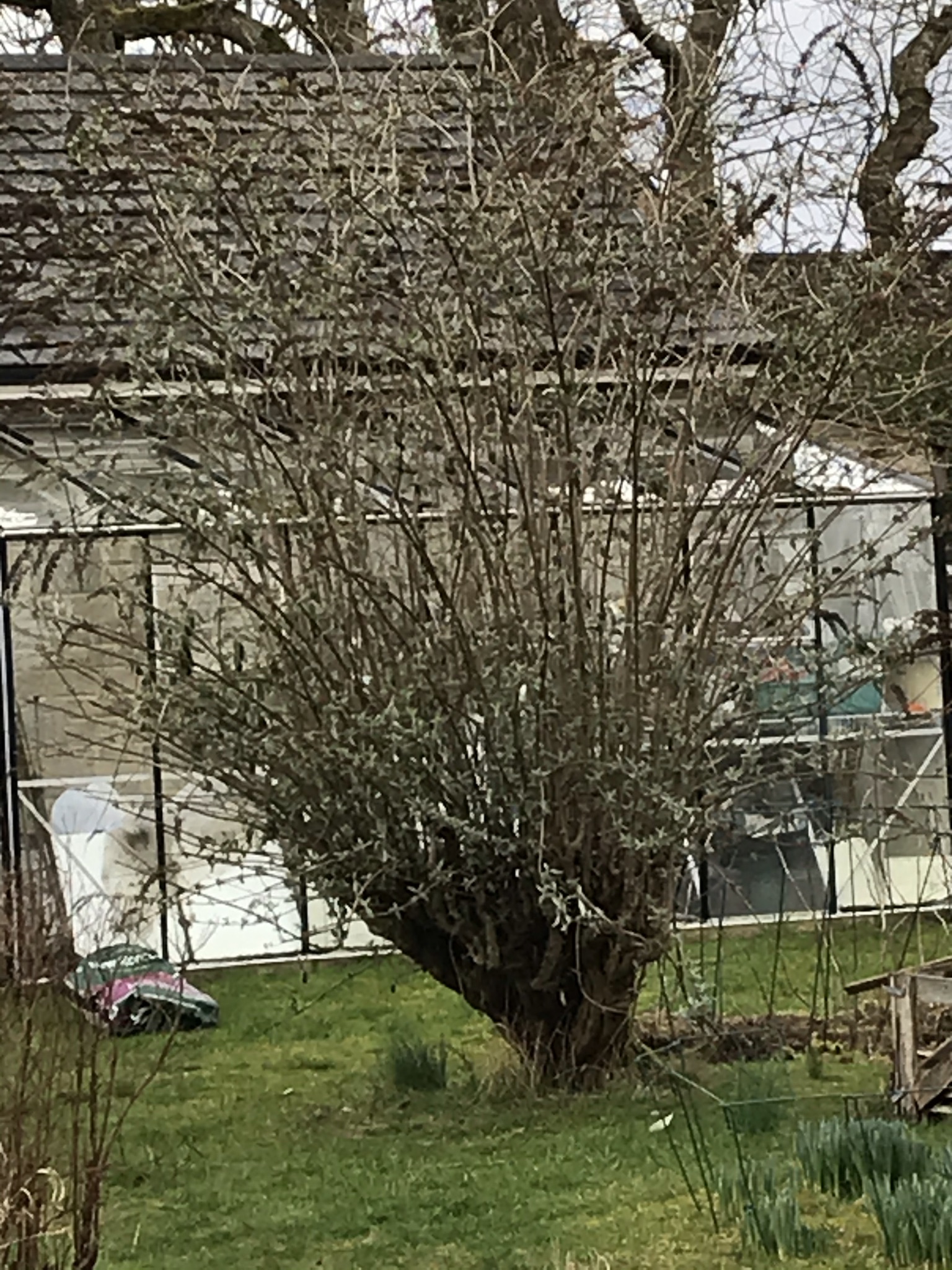
The two big spring pruning jobs – the cooking apple tree and the Buddleja davidii – have been done for another year, helped by several dry days.  Both plants pre-date us in the garden, and I have to say that neither is ideally positioned in the garden, but they are where they are, they’re much too mature to move, and I have to make the best of it.

The apple tree was a lot smaller when I laid out the vegetable garden, close by.  I didn’t really appreciate just how much shade it would cast as it grew bigger, and neither did it occur to me how far the branches would spread (particularly when fruiting; the apples are big and heavy and pull the branches down low); they are now reaching over the edge of the veg plot, right at the point where I put the main entrance/exit.  The positioning of that was part of the geometric design, but not very practical; in recent months I’ve been going in and out by stepping on one of the outer beds rather than ducking under the apple tree, not ideal.

20%?
So when I started pruning this year, the first cuts were made to remove two branches that had been threatening to poke me in the eye whenever I emerged from the veg plot by the proper path.  There’s more that can be done to improve matters, but not this year.  It’s not advisable to remove too much wood – no more than 20% - from an apple tree in one year, otherwise it responds by sending up ‘water shoots’, long spindly shoots that reach for the sky and get too tall to cut back; I’ve done that in the past and don’t want to go there again.  As it is, I’m still trying to get rid of the last batch of water shoots, some of which are completely out of reach, and the only solution is going to be to remove entirely some of the branches that they spring from.  So staying within the 20% becomes a matter of judging what to take out and what to leave for next time.  How do you quantify 20% of an apple tree?  What does 20% of an apple tree look like?  I think I may have overdone it this year, so I hope the remaining 80%, if that’s what it is, doesn’t get too upset.

Last year I checked the tree regularly for unwanted buds appearing on the big branches and rubbed them out, which seems to have reduced the number of spindly shoots, so I must remember to do the same this year.  While pruning this time I took the opportunity to remove any badly placed buds as I came across them; at least then they won’t add to next year’s 20% of removed wood!  There’s too much congestion in the tree as it is.   I’ve mentally earmarked a few branches for removal next year (memo to self: take out the topmost branch pointing towards the greenhouse, and some of the northeastern side).  But the 20% rule is always going to constrain how much I can do at any one time!

This year – or more properly, last year – the tree seems to have held on to quite a lot of undeveloped fruitlets, which I’ve had to knock off.  I don’t think I’ve seen that before, and I don’t know what has caused it – or what to do about it.  There certainly was no shortage of (good) fruit.

The buddleja is always a time-consuming job, not only because it’s so big but also because of all the prunings to be sorted and disposed of.  Some of these make good stakes for use around the garden, but I always keep too many of them.  The plant is very old, very woody and very large (and why on earth was it planted so close to the gooseberry bush?).  At least there is no problem about percentages of wood to remove: you remove the lot, cut as low down as possible.  In the case of this plant, that’s about waist-height, because over the years all the growth has created a woody base with a hollow centre, and nearly all the shoots come from the top of that.  This year I’ve tried to remove those shoots on the outside edge of the trunk; they tend to grow outwards (rather than straight up), which causes the plant to spread out too much, and those stems flop out over the lawn (and usually break off when caught by the wind).  We’ll see if that works.

Buddleja before ....

.... and after pruning

It’s that time of year when a wander round the garden often reveals something new in flower: a lone cowslip in this case, flowering in a corner by the summerhouse.


Sunday, 21 February 2021

Getting on with it

After a week or so of cold and frozen ground, the weather has lurched to damp and drizzly and now unseasonably mild. Friends in Germany tell us that the temperature reached 21C, about 70F, where they are – not at all February weather.  The climate seems to be going haywire: there's snow in Athens and Texas, and a heatwave heading for us.  As the end of the month approaches, so too does the start of the growing season, and with more pleasant weather on the way it’s time to get down to work to start off the new season’s plants. 

Most of the seed-sowing will start in March, but there are some jobs to be done earlier. While last year’s seed-sowing was a bit hit-or-miss, there were successes particularly in the veg plot and greenhouse that I’d like to build on this year. 

Among last year's successes were the chard and leaf beet

The early jobs include sowing broad beans, and planting garlic and shallots. Normally I would have done at least some of this back in the autumn, but that didn’t happen this time because of problems with the seed companies. For the past few years I’ve saved garlic cloves and shallots from the previous crop for planting out, but last year’s garlic heads were tiny – probably because I didn’t water them enough in the dry spring – and I decided I would buy a new and more productive variety for this season. The variety I wanted was listed as ‘available soon’ in both the catalogues I usually buy from, but ‘soon’ never happened, and both catalogues are now listing it as ‘available September 2021’. The same thing with the shallots; although the bulbs from the 2020 crop were of a good size I was hoping to try something different, but that variety too never materialised. Is this some manifestation of Brexit (most of these things come in from Europe, but other varieties seemed unaffected), or a crop failure somewhere? Anyway, I finally decided to plant a few of last year’s garlic cloves and shallots out in the garden to give myself a small crop, and wait until September to order some more (is that being too optimistic? If necessary I can buy another variety of each). They went in in early February with some fleece over them, mostly to stop the birds from pulling them up, but it was useful during the freeze. Garlic needs a cold spell to do well, and it certainly had that. The fleece has now been removed and replaced with some plastic netting as the shoots are coming up (a number of the bulbs were already shooting when planted). 

Same with the broad bean planting– my chosen variety has been out of stock for months. Finally, last week, I relented and sowed some of my remaining Superaquadulce seeds in modules in the greenhouse. In any case I’ve never been sure whether it’s worth autumn-sowing broad beans; they don’t seem to crop significantly earlier than those sown in early spring. I’ve also given up sowing direct in the ground, as the germination rate is often poor (eaten by mice?), so a lot of seeds this year will be in toilet-roll-tube modules for planting out (complete with tube, which will break down in the soil). 

One lot of seeds that were sown in autumn were the sweet peas; they have been in the cold frame but have done very poorly, with only a couple of them germinating. There have been signs of disturbance in the pots, though it beats me how a mouse could have got in there. Anyway the spring sowing can be done soon, and I hope they will do rather better! 

The aubergines, peppers and chillies were sown indoors last week and are awaiting germination on the radiator. It’s too early still for the tomatoes, which will in due course be treated in the same way. Some of the early crocus planted in little pots last autumn are coming through, and some self-sown pulmonarias in odd corners are starting to flower – some very welcome colour to herald the spring! 

Crocuses 'Blue Pearl' and 'Cream Beauty'


Pulmonaria flowering quietly by the wall

The birds are also feeling spring-like; a blackbird has been gathering moss and dunking it in the pond to make it nice and muddy for her nest (which is in the long hedge). A pair of robins have been checking out a hole in the fascia of the neighbours’ garage, and a thrush has started singing quietly somewhere nearby.

Wednesday, 10 February 2021

Cutting back

Some years ago we went into a favourite restaurant and commented to the waiter that it was cold outside.  “Yes.” said the waiter.  “It is December.”  Fair comment.  And now it is February.  And it is cold.  Not as much as in some parts of the country; it’s much colder further north, and all the snow is in the north and east.  All we’ve had are a few light snow flurries every now and again, but the ground is mostly frozen and the temperature hasn’t risen much above zero (centigrade) for a few days, with significant windchill from the east making it feel colder.  Not a good time for digging or weeding.

However there is a lot of cutting back to do.  I’m leaving the wisteria, apple tree and Buddleja davidii – all of which need pruning this month – until the temperatures rise a little, next week if the forecast is correct, but shrubs which are for the chop anyway are fair game; it doesn’t matter if they get frosted in the process.  I’ve been tackling the elder bush that self-seeded between the ‘Mary Queen of Scots’ rose (which also needs cutting back) and the choisya (which seriously needs taking in hand, but not just now), cutting out long branches back to the trunk in the hope that I can control it from there.  But my main focus has been further down the garden, where the Buddleja alternifolia has been getting beyond itself.

Buddleja alternifolia is not what you would call a graceful shrub.  It’s a sprawler, sending out long, long wands of growth which sprout even thinner (and longer) shoots; in due course these produce narrow leaves and little lilac puffs of flower clusters which are striking when they are allowed to cascade through a stronger-growing shrub or tree, but otherwise they arch over and colonise quite a wide area of ground.  Sometimes they layer themselves, creating new plants.  For a few years now I’ve wondered about removing it entirely, but it’s pretty in flower and I’m giving it another chance by taking it in hand and seeing how it does.  Or, more correctly, I’m taking them in hand, for there are now two of them.  It must have layered itself, and I can’t remember which is the original plant, but I’ve decided that the one which is shooting up through the neighbouring osmanthus and waving about way above my head is the one that is going to go.  It's not the correct time of year to prune B. alternifolia, but it's easier to see what I'm doing while the leaves are not in the way, and it will make no difference to the plant that I'm planning to dig out; I might lose some flowers on the other plant, but I can live with that.  Removing one of them will also make more room, and light, for the Japanese anemones that have lived in its shadow, and for rose ‘Mme Hardy’, and allow me to dig out the nettles and other undesirables that live under there.  On closer inspection, it turns out that both buddleja plants have a lot of dead wood in them, and I’ve been hacking away at both to thin them out and recover a lot of adjacent ground.  The dead twigs have made useful brushwood to cover the long path alongside the leylandii hedge, and the thicker wood has made its way to the log piles at the bottom of the garden, providing a home for various garden creatures.  My efforts were closely watched, and encouraged, by whichever garden robin owns that particular territory – I’m never sure whether it’s the veg patch robin or the patio robin – and he (or she) was particularly pleased when I dug up a few comfrey plants, exposing some of the minibeasts that live in the soil.  Now that some of the area has been cleared of buddleja cover, I can tackle the ever-spreading comfrey and create room for more (different) plants!

Being watched ...

... and encouraged

The Viburnum davidii also needs cutting back; part of it is sprawling into the pond.  I’m leaving that for the time being, as the cover it provides has been keeping part of the pond from freezing on the slightly less cold nights, allowing somewhere for the birds to drink and bathe.  There are advantages to leaving some of the more overgrown areas untouched – the local pheasant has been hunkering down in the undergrowth to shelter from the cold wind, and the blackbirds appreciate my leaving windfall apples for them in the lee of the shrubs.  One day we even had a nuthatch taking a rest in the purple-leaved prunus, sheltered from the east by the ivy-covered trunk, and occasionally poking around in the moss-covered branches and in the ivy for food.

The icy blast from the east has flattened the snowdrops (Galanthus atkinsii) down by the summerhouse, and the phlomis in the same area.  They should both survive the experience; snowdrops come from cold mountain places, and I've seen phlomis growing wild high in the mountains of Crete were snow is common in winter (although admittedly snow provides protection from the cold, whereas snow-less icy winds are a different thing).  However I was pleasantly surprised to find a few golden-yellow crocuses flowering near the drive entrance when the sun encouraged them to open up.  They must be Crocus angustifolius, which I used to have in the windowbox, but I have no recollection of planting them where they now are.  They were a lovely sight on a cold February day!

Crocus angustifolius

Sunday, 31 January 2021

Lunch for one

Having reported last week on the breakfast-and-supper bird visitors, today's big sighting was more a case of lunch for one.  The local red kite, who cruises by occasionally to check whether the neighbours' cat has left any dead mice on their lawn (then comes down and eats them if so), did a fly-past and came to rest in the big ash tree at the bottom of the garden.  He had brought his packed lunch with him and proceeded to tuck in; I couldn't see what he was eating, probably part of a pheasant.  Unfortunately he must have sensed he was being watched, as he kept looking round uneasily and after only a minute or so decided to take his meal elsewhere.  We don't usually have the opportunity to view the kites so clearly; although they do sometimes hunt low, we rarely see them at rest.

He was too late to be counted as part of the Big Garden Birdwatch.  I did two Birdwatches, to see which one gave the best results.  Friday's count, in good weather, was ok, but entirely of our usual birds, the ones we could rely on seeing day in day out, with perhaps the addition of the wren spotted skulking in the undergrowth, and a couple of chaffinches.  Today I tried again; after several relatively mild days the night had been cold and, although we didn't realise at the time, snow showers were on the way (not forecast!), which might have encouraged the birds to come down to feed quickly.  The count was just as good as Friday's, including the wren and chaffinches, and in addition we had a goldfinch, fieldfare and the little family of long-tailed tits, the latter all piling together onto the peanut container in a flurry of long tails sticking out at all angles.  All duly counted and submitted to the RSPB.  Job done for another year.

The snow didn't lie, and at the moment there is no more in the forecast - but it's hard to tell as the forecast seems to change daily just now!

Monday, 25 January 2021

Breakfast-and-supper club

A modest dump of snow – about 3in/7cm – on Saturday night, followed by two days with only minimal thaw, brought the birds flocking in to be fed.  We have a good number of regulars in any case, coming every day for breakfast and again in the afternoon in preparation for the night, but other birds have come in from the fields looking for a quick meal on the patio and round the apple tree, where there are still the last fruits hanging on the branches.  (Not much left now!)

Lefty and robin have breakfast

Lefty, the woodpigeon with the damaged left leg, has recently started to turn up regularly in the mornings for his breakfast (breadcrumbs, usually); this morning he was waiting in sight of the upstairs landing window, watching for us coming down.  We had cleared the snow off an area of the patio yesterday to allow the birds to feed, and he waited there for us; however he’s very nervous of our approach, and flies off when we open the patio doors to throw food out.  It doesn’t take him long to come back, though.

Fieldfare (at the back) creeping up on the blackbirds ....

There are always a few blackbirds around, but today we’ve had about six squabbling over the apples (I’ve left a few windfalls on the patio and under the buddleja, where the snow had only landed lightly and quickly melted, and it’s a sheltered feeding site for them).  Whereas we usually only have one fieldfare down, today there were three, fighting each other and the blackbirds.  Another, very welcome, sighting was a little posse of chaffinches – three males and two females – sitting under the peanut container and picking up the bits dropped by the woodpecker and starlings; finches have been in decline here for some years and it’s always good to see them around.  I haven’t seen a greenfinch all winter, although a goldfinch dropped by a couple of weeks ago in search of old flower seedheads.  Other welcome visitors include the long-tailed tit family, who sometimes turn up at the fatball container at their supper-time.

The sparrows already have nesting in mind, with mating fights going on and several birds starting to take strands of grass into the nest sites under the roof.  The patio robin, another regular breakfaster, is in an uneasy relationship with another robin; sometimes they’re friends and sometimes not.  Today, not.  I’m never sure which robin is which.  The veg patch/bottom of the garden robin seems to have a friend; they’ve been seen in each other’s company a couple of times without any fighting.  I wonder whether it’s the same very trusting robin that was there last year; he (or she) has again been following me around when I’m working in the veg plot.  Last week I spent some time weeding the ‘long edge’ bed and some of the paths, with the almost constant quiet chattering of the robin close by; he did come down to pick up worms where I had turned the soil, but he seemed more interested in following me about, and sometimes I think he just wanted the company.

There have been fewer of our less-regular visitors around.  Blue tits occasionally come by, but I’ve only seen one great tit for some weeks, and today’s coal tit was the first I’d seen this year.  A wren was over by the veg plot wall the other day, and a pied wagtail was sitting on the guttering, but it’s been a while since I saw a bullfinch or song thrush, for example.  Next weekend is the Big Garden Birdwatch; it would be nice to have a good variety of birds appear in the garden!

Monday, 18 January 2021

Lead us not into temptation


The seed catalogues arrived before the old year was out.  Fortunately I’m on the mailing list of only a couple of companies, plus a couple more online, and temptation was limited by the fact that I had already ordered and received my seeds (from Dobies) in the autumn.  I was very good this year and didn’t get too carried away with the size of my order (though I still have a lot of seeds to sow!).  Last year I sowed way too many seeds, especially of flowering plants, and ended up throwing a lot of them away – but that’s maybe a story for another blog post.

Seed temptation

However I did have a rueful laugh at myself while reading Jack Wallington’s recent blog post (My self-help guide to resisting seed and plant catalogue order overload | Jack Wallington Garden Design Ltd. - Clapham in London) about the dangers of the seed catalogues.  Oh yes, Jack, and me too.  The big problem with the mid-winter catalogues is that they include the dahlia tubers.  Now that is – for me, as well as for Jack – a serious temptation.

Dahlia temptation ('David Howard' bottom left)

I came relatively late to dahlias, but they have become the mainstay of my late summer garden.  They can be left in the ground over winter, with sufficient protection, but I’ve always dug them up and overwintered them under cover, mostly because I don’t have a dedicated place for them in the garden and I like to be able to move them from one spot – or from one pot – to another from year to year.  They do take up quite a lot of space – some dahlias can get quite big – and they need sun, which isn’t in plentiful supply in my plot.  They’re also quite time-consuming; digging them up, drying them off, shaking off the soil, storing them, planting them up, hardening them off and then putting them outside again is a bit of a rigmarole.  I have four varieties (the dark red single ‘Bishop of Auckland’, even darker red ‘Sam Hopkins’, purple ‘Ambition’ and the giant cream ‘Café au Lait’), and several tubers of each as they divide naturally after a while in storage; plus my collection of seed-grown ‘Bishop’s Children’, offspring of dahlias in the Bishop series; they don’t come true from seed, but they all share the Bishops’ open, single flowers and dark foliage.  That’s quite a lot of dahlias, and I don’t need (or have space for) any more.

But then the Sarah Raven catalogue comes…. and it’s my downfall, as well as Jack’s.

I have resisted for the past couple of years.  My last acquisition, ‘Dark Butterfly’, died on me without flowering a few years back, which dented my enthusiasm, and the labour-intensiveness of them also put me off adding to my collection.  However I’m thinking of finding a place for at least some of them in the veg plot, and leaving them there next winter, which will reduce the workload; and then I received a letter from Sarah Raven (not from her personally, you understand, but from the company).  They’ve had a spot of bother with their transfer to a new warehouse which has affected deliveries, and in compensation they would like to offer me (and thousands of others, no doubt) a £10 voucher.

Well, it would seem churlish to decline, wouldn’t it?  This is a good year to order more dahlias, I tell myself; mail-order dahlias are sent out in February, when we’re usually away on holiday, but this winter all travel is stopped by the virus, and we shall be here to take delivery of them and ensure that they don’t spend time sitting around somewhere inappropriate waiting for our return.  Dahlias will be some compensation for not skiing this year.

So, what to choose?  One advantage of the Sarah Raven catalogue – and here I’m being quite serious – is that they sell dahlia tubers singly, whereas most companies sell them in packs of three or even five (and if I have trouble finding space for more, finding space for three or five is an even bigger problem).  I forced myself to go for only two, and spend the rest of the £10 (ok, and a bit more, and plus p&p of course) on a pack of Lilium regale, for a potful of scent on the patio earlier in the summer.

As I’ve already said more than once in this blog, I’ve particularly enjoyed my Bishop’s Children this year, and the colour mix – mostly red and orange – has been given some real zing by the inclusion of two with pinkish flowers.  Those two plants died back earlier than the others, and the tubers, when dug up, turned out to be on the small side, so I’m not sure whether they will survive.  They looked like offspring of pink ‘Bishop of Canterbury’, so I’ve gone for a tuber of the real ‘B of C’ to be sure of keeping the colour mix in the garden.  For the other, I’ve ordered the classic orange ‘David Howard’, whom I’ve had my eye on for a while; he also has well-coloured foliage, bronze rather than the bishops’ purplish tone.

All I have to do now is find room for them … and hope that they don’t send another voucher next year....

More temptation ....