Thursday, 23 December 2021

A long hard look at the veg seeds

The seed order for 2022 has arrived, and the packets have been sorted by sowing date, along with the (many) packets, opened and unopened, left over from last year (and years before that).  As promised in my post earlier this month, I have cut back on varieties ordered, with a view to only growing what I need to (plus a very few ‘can’t live withouts’); and some of the oldest seeds that I’d been keeping have been thrown out, along with a few that I've decided I'm really not going to use.  In this post I’m going to review the edibles, leaving the ornamentals for another day.

I took a long, hard look at what has been successful and what not, and what got eaten and what didn’t.  And what never got sown at all, and whether I actually needed them. Admittedly it wasn’t the best growing year weather-wise; a cold spring, right to the end of May, delayed sowing and growing, and the rest of the year was mostly indifferent at best.  And I have to admit that I let too many other things distract me from looking after the garden.  So for next year, my plan is to stick to as much as I can manage and very little more.

First, the greenhouse crops.  The tomatoes did reasonably well this year, not as well as last year but quite a good crop.  I tried a new (to me) variety, ‘Apero’, a mini plum tomato, which was good to grow and eat, plus ‘Harzfeuer’ and 'Cherrola', both of which were less productive than last year, and of which few seeds are left.  I thought I’d add another full-sized fruit variety, ‘Costoluto Fiorentino’, to my sowing to ensure a reasonable range of types next year.  I can only accommodate 6-7 plants in the greenhouse so shall have to be rigorous as to how many seedlings I keep.  Much of this summer’s crop had to be picked green before we went away for an autumn break, but they ripened nicely in the kitchen and were very welcome come November.

Tomatoes ripening in the kitchen

The other greenhouse crops, aubergines and red peppers, were less successful and less useful in the kitchen, and I’ve decided not to bother with them for a year or two at least.  The aubergine crop was small; this was probably my lack of attention to their needs, as I gave some of my surplus seedlings to neighbours who grew them quite successfully.  The peppers produced fruits so small that they were pretty but not actually worth bothering with.  And the chilli pepper plants died on me; again, almost certainly my fault.  I still have lots of dried chillies from the year before anyway, so no pressure to grow more.

Aubergine 'Slim Jim'

I grow my courgettes outdoors, after sowing and bringing the plants on inside the house. Mixed results this year.  I ended up with three viable seedlings, two of which I planted on the patio in the brown plastic tubs which I’ve used before; this time, though, I didn’t bother to remove the miniature daffodil bulbs that occupy those tubs in the winter.  The old compost was left in there and only a little fertiliser added.  Whether this wasn’t enough feed, or whether I didn’t water them enough, I don’t know, but they didn't grow well and produced no usable fruit.  (The daffs are still in there, and it will be interesting to see what they do, if anything, in spring.)  Peat-free compost retains its structure well enough for re-use, but I need to remember that it’s low in fertiliser and I ought to feed, feed, feed.  The third plant eventually went out into the veg plot, where it did fairly well; two squash plants planted nearby were totally unproductive, and I won’t be trying them again for a while (the 2020 ones produced several fruits which rotted off on the plant, and the two survivors lasted just long enough to serve as Christmas decorations before suffering the same fate).

Courgette in the daffodil tub - it never got any bigger

For a few years now I’ve grown my garlic and shallots from bulbs saved from the year before, but my pathetic 2020 crop made me think of buying new sets.  My chosen varieties were unobtainable, however (a result of Brexit, I think; they’re European varieties), so I made do with my own old bulbs again.  The 2021 garlic crop was, once again, dismal; admittedly the plants were seriously overshadowed by the parsley and probably suffered from lack of water in the dry spring; but the shallots did surprisingly well.  So this autumn I bought new garlic bulbs (they come in packs of two, and I’ll share with a neighbour) but will plant my own shallots again – and take care to water them.

Shallots, drying off in the greenhouse

Leeks: total failure.  Probably my fault for sowing them in relatively unimproved soil and not watering sufficiently; but they only reached transplanting size (just) in late autumn.  They’re still sitting out there.  I might try transplanting them in spring and seeing what they do, if anything.  Usually I’m fairly successful with leeks, but this was a wake-up call to pay them more attention.  I’ve bought new seed for next year, anyway, so have a fall-back if transplanting this year’s runts doesn’t work.

I’ve become disinclined to plant potatoes, which don’t seem to do too well in my shallow and dry soil and which are cheap enough in the shops.  However in 2021 I found myself with half-a-dozen ‘Pentland Javelin’ seed potatoes hanging around in the greenhouse well beyond the usual planting time.  I tried a ‘no-dig’ method with them, planting them shallowly with a pile of old compost on top of each, which I added to once the stems started to come up, thinking that I had nothing to lose and that I might get a few new potatoes for Christmas.  In fact they grew very well, and I pulled them up in late summer (to my surprise, they came up easily when I pulled on the stem; very few tubers left in the soil, and those were easy to remove).  The result was a nice little crop of tiny new potatoes, the sort that are relatively expensive in the supermarkets.  I might do that again.  In contrast, a few ‘Belle de Fontenay’ tubers grown in the normal way did nothing at all.

Every year I buy carrot seed – it doesn’t seem to store well – and fail to sow it.  Must Do Better.

My 2020 brassicas, while not a great success, at least produced three quite usable Savoy cabbages, which encouraged me to persevere this year.  I learnt two lessons: pick broccoli heads as soon as they become usable, because they run to seed very quickly; and be meticulous about protection from butterflies and pigeons.  The cabbage white butterflies got in under the netting and their caterpillars turned most of my plants to lace curtains – at least there ought to be plenty of butterflies next year.  At least one broccoli plant produced a lovely head, but I left it too long on the plant and it flowered (I ought to have cut it off anyway to encourage sideshoots).  I shall try to be more attentive next year.  Some of the new varieties did better than traditional old Purple Sprouting, just as the new types of kale seemed to be doing better than ‘Nero di Toscana’ (at least until the pigeons ate them – another lesson for next year).  I never got round to sowing any Cima di Rapa (a multi-head brassica for cropping young as stir-fry leaves); my 2020 crop ran to seed very quickly, and I guessed that it does better sown later in the year, but, as with so much else in the veg plot, late summer sowing didn’t really happen.  I did sow a couple of kale and cabbage varieties in modules in autumn, and they're still in the cold frame; I'll try planting them out in late winter, under protection.

Broccoli - just before it flowered!

Broad beans didn’t do too badly.  Last winter I ordered a pack of ‘Superaguadulce’ for winter sowing, but it turned out to be out of stock; it eventually arrived in summer, much too late for 2021 cropping.  Instead I sowed the last of my old seeds – not a bad germination rate considering their age – and some of the remaining ‘Luz di Otono’ ones; both lots were reasonably productive, although the latter had fewer beans in the pod.  ‘Luz de Otono’ is touted as good for summer sowing/autumn cropping; I tried this but the plants succumbed to rust (a common problem with late-sown broad beans, apparently) and I won’t be bothering with that variety again.  I don't need broad beans in autumn, when there are still French beans to be eaten.  Instead I’ve got seeds of ‘The Sutton’ for normal spring sowing – a low-growing variety, good in windy sites apparently, so let’s see.

Being away in late May (and early May still being cold), I sowed my summer beans in situ in early June, rather than under cover for May planting out.  The non-climbing French beans didn’t do too badly, especially ‘Rocquencourt’ (from which I managed to save some beans for sowing next year), but the climbers took some time to get going.  I harvested a few of the latter, but their support blew over in early autumn and I didn’t manage to get it upright again.  Ah well, the wildlife will have enjoyed the beans.  Fortunately they aren’t hardy so won’t self-seed, and I still have seed from 2020 for use next year.  Reminder to self: need firmer bean poles!

The summer beans (and a row of peas in front) - before the supports fell over!

Given my experience with the climbing beans’ support, perhaps I’m being too optimistic in having bought in seed of the traditional old pea ‘Alderman’, which climbs to 6ft (just under 2 metres).  This year I got round to sowing some maincrop peas late, and managed a small but decent crop.  I also sowed some rather old seed of pea ‘Early Onward’, with the intention of using the pea shoots in salad assuming any of them germinated; in fact they germinated well, and quickly, so I planted them outside and ended up with some actual peas as a welcome result.

Lettuces – several varieties – did well, but as usual I didn’t get the succession right and had a gap in the middle of the year when the first sowing had run to seed and there were no new plants ready for eating.  Apart from a small amount of rocket, I didn’t manage any other salad leaves; a matter of finding time and a suitable place to sow them in.  I particularly missed not having any radicchio, which did well last year.  I’ve stopped trying to grow salad leaf mixes, as I find that the different varieties germinate at different rates and some don’t germinate at all.  The 2020 leaf beet plants overwintered and I got a few leaves from them early in the year, but then they ran to seed; a little of this has germinated in situ, and I’m hoping that the seedlings will survive into 2022, though I still have seed in the packet for a few more plants. 

A lettuce head ('Bronze Beauty'), about to flower but very prettily

I notice that I haven’t kept much of a record of my veg seed sowing in my blog posts this year; perhaps an indication of how little attention I had paid to it, although in fairness I had spent some time over the year sorting out the layout, the paths and the weeding – the sort of basics that I’m wanting to focus on in the coming months - rather than the sowing.  Maybe once I get that in a better state, I’ll be able to concentrate more on actually growing food.

Tuesday, 14 December 2021

Ashes to ashes, part III: A sad day


Goodbye, old friend - one last sunny day

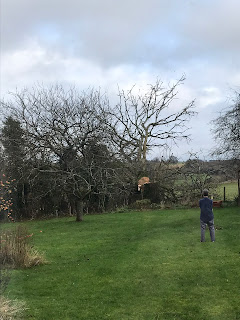
It has been the dominant feature in the garden for the 30 or so years that we have been here, and presumably for long before that; it has provided shade in summer, some protection from easterly winds, autumn leaves for leaf mould and a perch for innumerable birds of many species – but the big ash tree in the field just beyond our bottom boundary is now gone, as of yesterday.  For some years now it has been slowly dying, presumably of ash dieback, and we had been advised by two different tree surgeons that it needed to be removed before it was brought down by the winter gales.  Now done.

The tree, and the field, belongs to the Big House.  They have had a forestry company in to deal with all the sick trees on their land, and the forestry guys agreed that this one had to go.  For a couple of weeks they’ve been working over near the church, and this week have got round to felling the three affected trees in the field – ‘ours’ (it wasn’t really ours, but we felt responsible for it, it was so much a part of our garden view), a slightly smaller ash a few yards along, by our neighbours’ boundary, and an even smaller one at the far side of the field.  Interestingly, a large ash next to the latter tree appears to be healthy.  We had expected that the tree would be dismantled bit by bit, but basically they tied ropes to the main branches, tied the other ends to a tractor, cut almost completely through the trunk and drove the tractor across the field (fast) so that the whole thing went in one go. 

The final cut

"Timber ...".

A shoulder-high stump has been left standing, and the main part of the trunk and a few of the larger branches are being left to lie in the field to rot down, so there will still be some benefit to wildlife, which is a comfort - better than turning it into firewood.  But sadly the pigeons, flock of goldfinches and other birds that sat in the upper branches in the late afternoon to catch the last of the sun’s warmth are going to have to find somewhere else to sit; the highest remaining trees, the hawthorn and maple behind the summerhouse, and the plum tree, are fairly high but still don’t catch the sun in the same way.  And their trunks are slimmer and less attractive to the woodpeckers, nuthatches etc that like to poke around in the crevices.

Talking of birds, the tree-cutting and subsequent wood-moving over by the church may not have been to the liking of the waterfowl on the small lakes nearby; one of the moorhens took to visiting our garden (for a bit of peace and quiet?) on several days. 

A moorhen visits

Big empty space

There’s now a big empty space down on the boundary; a better view, certainly, but it will take time for us to get used to it.  We intend in due course to plant something big (an oak?) to take its place, but the soil is shallow and I need to be sure first that we can prepare a big enough planting hole.  Maybe next winter, once our period of mourning for the ash tree is over.

Monday, 6 December 2021

A dose of reality

At this time of year, the magazines are full of ‘cut out and keep’ recipes for Christmas entertaining.  I’m a bit of a sucker for doing just that, but this year I’m being much more realistic about it.  I know by now that I will never look at most of these recipes again, let alone cook them.  And really, there is no point keeping a recipe for dishes that we’re not going to eat, no point in keeping a recipe that caters for ten when we will have no more than six, maximum, at any one time round the table, and no point in having instructions as to how to decorate your Christmas cake, however prettily, when we never have a Christmas cake.

Likewise, I’m intending to take a realistic view of the garden next year (and maybe the year after that, depending on how things go).  For the past couple of years at least I’ve been guilty of growing plants from seed, especially ornamentals, and then having to throw them away because I haven’t watered them, got round to growing them on or planting them out.  Or even sowing the seeds at all.  And then there are all the cuttings etc, tiny plants in small pots that freeze in winter and dry out in summer because I don’t have the time or energy to look after them.  There are just too many things to do at some times of year, even those times of year when I’m at home and able to spend time gardening.  One issue is that the garden has reached a stage where the basic framework needs an overhaul – large shrubs needing to be cut back or removed, borders where invasive weeds have got out of hand, half-finished (or barely started) plans for establishing a definite structure on parts of the garden.  I need to spend time getting all of that sorted before I start giving my attention to new planting.  It’s the old gardening story: we’re always told to get the structure in first before filling it with colour, but of course most of us start acquiring desirable plants and need somewhere to put them, and the basics get ignored until too late.  And there is only so much time in which to do all of this.

As it is, the garden work is several weeks behind schedule, and it’s now too late to do some jobs for this winter.  Some of this is bad planning on my part and some of it is my being temporarily incapacitated and limited as to what I can do in the garden for a few weeks yet.  The long hedge is only very partly trimmed, a lot of fallen leaves haven’t been swept up, and the dahlias are still waiting to be dug up and dried off.  Other tender plants are also still outside, waiting to be saved from the cold, such as my big pot of gazanias; these are perennial by nature but are grown here as annuals, but last winter I took a potful of them into the greenhouse and kept them alive until spring, since when they provided a splendid show of cheerful flowers all summer and autumn, one of my few successes this year – but is it too late to save them for another year? 

The gazanias in their prime


I had already decided to cut back severely on the less essential gardening tasks so that I could concentrate on the big stuff; for example, I haven’t bought any tulips this year (and the few bulbs that I saved from last spring’s display were eaten by the greenhouse mouse), so that’s one planting job that I won’t have to do this winter.
 Just now I’m looking at the seed catalogue, with a view to deciding which seeds I really need to buy this year and which I can do without.  The idea is that I will take the same approach to my seed-buying as to my recipe-keeping – that ‘s the plan at the moment …..

Tuesday, 30 November 2021

November snow

Snow in November isn’t unprecedented – I can recall at least one very bad snowstorm some years ago – but it’s not usual.  November has been a relatively mild month on the whole, and not particularly wet as Novembers go, but this weekend we were hit by Storm Arwen that brought high winds, some light snow and sub-zero temperatures.  Our area was affected much less than others, but Saturday in particular was windy and bitterly cold outdoors, and the cold has continued through the weekend; reasonably mild today, reverting to something more normal for the rest of the week.

For reasons mostly beyond my control, I’m a few weeks behind with my gardening schedule, no garden work having been done since mid-October.  One of the jobs left undone is lifting the dahlias and taking them into the greenhouse.  Actually this is not entirely unreasonable; dahlias ought to be left until their foliage has started to blacken with the first frost, and that didn’t happen until Saturday, but they have gone from slightly tatty but definitely green to flattened and definitely black in the space of 24 hours.  I hope they haven’t been frozen too hard, especially those (the majority) in pots.  My little red chrysanthemums, in contrast, have bounced back as soon as the snow melted from on top of them, a very small beacon of colour on the patio in an otherwise rather sad-looking garden.

Little red chrysanths, with blackened dahlia behind

A sad-looking garden

The dahlias haven’t done well this year, and I have to admit that it’s mostly my fault.  I haven’t been a particularly attentive gardener these past months, I have to confess.  I started by cutting one corner: last winter was relatively mild, and partly because of that and partly in order to be ‘green’ I didn’t insulate the greenhouse, and only switched on the heater on a couple of especially cold nights; spring was mostly chilly, and when May came along (the usual time to put dahlias outdoors) I took the view that gradual hardening off was unnecessary, since the outdoor temperatures were little different to those that the greenhouse had been registering for a long time.  The dahlias didn’t seem to suffer from this.  However I then hit my usual problem of finding enough space in the ground and in pots to accommodate them, and finding time to do all the potting up; some of the smaller dahlia tubers are still sitting outside in the small pots in which they were brought into leaf.  Not only did this mean that they put on minimal growth and therefore the tubers won’t be in great shape, but being left out in small pots in cold weather will probably result in them being killed off.  We shall see.  Even those dahlias that were planted up didn't flower well; I admit to not having been careful about watering and feeding.  I had already been having thoughts about the number of cuttings and other small plants that I have hanging around in search of a home, and being more realistic about how many plants I can handle; that’s a subject for another post.  In the meantime, I shall have to take a good look at all my little pots and see what has survived.

Thursday, 18 November 2021

Winter is coming

On our return after autumn travels, it’s clear that the garden has moved into early winter mode, with the wildlife that comes with that.  The weather isn’t particularly cold for November, and although there has been some morning mist there has been relatively little low cloud; but the light has moved from the soft yellow light of autumn to the cold blue light of winter, and the birds that had dispersed for the autumn are back in their winter quarters.  The migrants, fieldfares and redwings, have arrived too.  Although no food would have been put out for them in our absence, the plentiful cooking apples and holly berries in the garden are a prime attraction.

Plenty of cooking apples ...

.... and holly berries

The collared doves and woodpigeons, including our lame friend Lefty, never really went far away, and are still hanging around in considerable numbers.  Likewise the sparrows, who enjoy the bathing facilities, and our two robins, who are again competing for territory.  The thin nervous robin’s bad foot appears to have healed, and he/she is defending the patio from the other robin and occasionally from the dunnocks.  There are several finches around, including a small flock of goldfinches, a pair of chaffinches and at least one greenfinch, as well as blue and great tits and three or four blackbirds.  The pair of mistle thrushes have been sitting in the big ash tree from time to time, along with a large number of starlings; they like to sit in the top of the tree in the afternoon to catch the last of any sun.  They will miss that tree when it’s taken down.

There have been a couple of surprises: a male blackcap, possibly on passage to somewhere a little warmer for the winter, and a grey wagtail.

The hedgehog has presumably gone into hibernation, but other four-legged visitors have been seen.  The squirrel is a regular, digging up the hazelnuts that it buried in the lawn (and occasionally in the veg plot’s woodchip paths) over the autumn.  D spotted a fine adult fox one day, something that we suspect visits the garden from time to time but is rarely seen.  And another day we had a weasel running around the patio; it had obviously found a mouse or vole nest and was taking its prey, one after another, somewhere else to eat.  Well, if you encourage wildlife into your garden you can’t be too picky about what will turn up; not all wildlife is cuddly.

Wednesday, 10 November 2021

Ashes to ashes, part II

A long pause since the last post, caused by circumstances mostly beyond my control.  The circumstances are going to limit active gardening for a few weeks yet, but there are plenty of plans to be made, and there will be more about them in future posts.  For the moment, then, a look backwards.

Here one day ....

Before we went away for a short break, our neighbours bowed to the inevitable and had their ash tree, the one that overhung the veg plot, cut down to a tall stump.  The idea is to encourage the clematis montana that is growing up it on their side to cover the remains of the trunk.  Despite the height of the tree, remarkably little wood landed on our side of the wall (even though most of the crown was actually on our side).  The neighbours have gained a lot more light - the tree shaded their whole garden - and I gained another load of woodchip for my paths.  In fact, the removal of their tree and ours has noticeably increased the amount of light in houses and gardens across the road which I didn't think would be affected; you don't realise how much light these trees can block out, and at what a distance.

... and gone the next

The third, and most diseased, of the ash trees round our garden, the big one in the field beyond the bottom border, is scheduled to be taken down before the end of the year.  It's sad, but these are trees that could cause a lot of damage if they fell.  Leaving some of the stumps in place at least provides some sort of habitat for wildlife such as insects, even in the dead wood.

Monday, 11 October 2021

Don't sit under the apple tree

It has been a decidedly mixed growing year, and the fruit crop has been no exception.  One unexpected success was our first fig (just one); a little on the dry side, but a reasonable size.  There are several little figlets for overwintering, so I have some hopes of a few more next year.  The raspberries did quite well (one of the canes has now started to flower, very unseasonably – what’s all that about?).  However there were no gooseberries or blackcurrants worth mentioning, and some neighbours have had the same experience.   The cold spring weather, resulting in fewer pollinators?

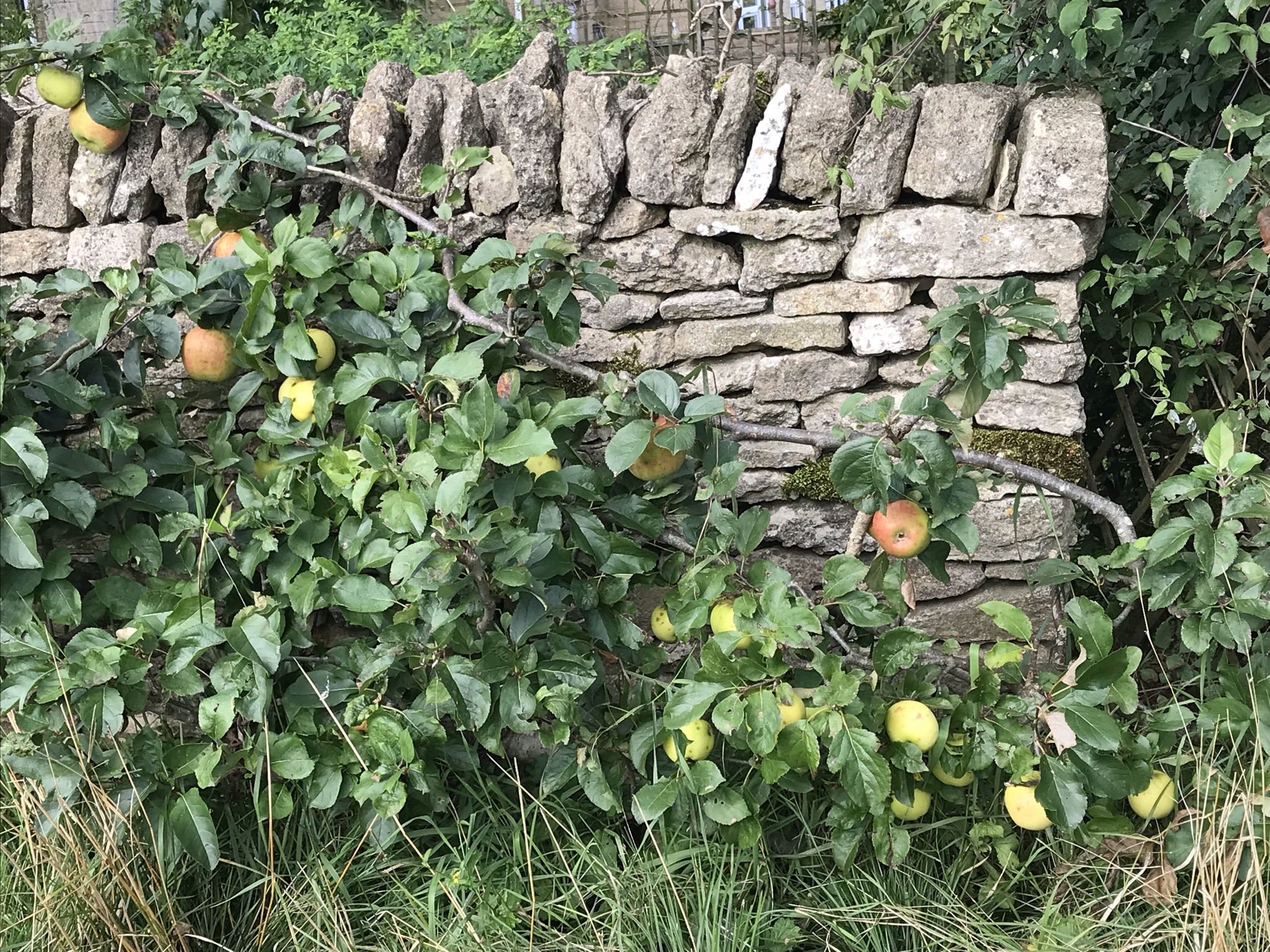
Given the lack of soft fruit, I wasn’t surprised that in early summer there seemed to be relatively few apples and plums developing on the trees, and when it came to thinning the crops I erred on the side of generosity, to make the most of what fruit there would be.  This proved to be unnecessary and, in the case of the cooking apple tree, a mistake.  The plum tree actually produced fairly well, and the apples, the cordon dessert apples as well as the cooking apple tree, turned out to have the heaviest crop we’ve ever had; and in the case of the cordons, some of the individual apples are larger than ever.

Some of the plum crop

Dessert apple cordons

More cordons

Of course, this came at a cost.  Because I didn’t thin the fruitlets particularly thoroughly (though goodness knows I took a lot of them off the tree!), the cooking apple tree’s branches are now overloaded, bending down low and, in some cases, breaking off.  They’re big apples, and can be heavy.  It’s difficult to get underneath the tree where it overhangs the veg beds, as it’s bent down to the ground; some of those branches are going to have to be removed during the winter pruning, just to allow us to get under there, and to get the tree back into shape.  A lesson learnt: next year, don’t allow too many apples to develop near the ends of the branches, to stop them being pulled down.

Don't even try to sit under the apple tree!

Those branches nearest the veg beds have been a bit of a problem for a while now.  When I designed the vegetable plot, I put in the main access point, a little path through the bed along the edge, just where those branches are.  It was a geometric thing: the plot is three times as long as it is deep, so the beds are laid out in three equal-sized groups, and the central group has a path running down the middle which is aligned with the entrance path.  As the tree grew, it became increasingly difficult to get in and out without banging my head on the branches.  Over the summer, the obvious solution dawned on me: don’t do anything to the tree, instead move the entrance!  I’m in the process of creating two entrances, one each side of the tree, aligned with the paths separating the three bed groups.  You can see one of the paths, still under construction, at the bottom left of this picture of part of the plot.

Also visible in the pictures, and also still under construction, are some of the new woodchip paths that I’m creating in there, using woodchip from the felled ash tree.  The paths were originally gravel, but over the years this has disappeared into the soil.  There were also plank edges to the beds – some of the planks are still lying about, partially in use but no longer retaining any soil.  They were a mixed success, falling over a lot, easily kicked over and needing to be put back up again, and in the end I more or less gave up on them.  The final straw came last autumn when our local tree man removed the large overhanging branches from next-door’s ash tree; if a guy is prepared to climb 10 metres/30 feet up a tree and lower the sawn-off branches down, you can’t really ask him if he would mind not disturbing the bed edges while he does it (and could he possibly not disturb the parsley growing underneath? In fact the parsley survived very well).  Reasonably enough, the beds looked rather dishevelled afterwards.

Rather dishevelled (after last autumn's tree work)

Charles Dowding, whose no-dig methods I’m trying to follow to some extent, reckons that wooden edges are unnecessary and act as a haven for slugs and snails; he demarcates the paths and beds by using woodchip for the former and mulch for the latter.  You need an awful lot of mulch (compost, manure, leaf mould etc), but it does seem to work.  Some of the paths still need weeding before I can get the woodchip down – in particular there are a number of productive alpine strawberry plants (visible in one of the photos above) which will be pulled up once they’ve stopped fruiting – but already things are looking a lot better, and the woodchip should keep the weeds down.  It also allows me to widen the paths, which have been too narrow to be practical.  And I can now walk past the apple tree instead of ducking down under it!

Starting to look better!