Tuesday, 16 May 2023

Bird bothers - and the body in the bushes

We’ll come to the body in the bushes later, but we’ll start with another, rather sad, body – that of a baby robin which flew into the patio doors.  It was our first sighting of a fledgling from the patio robins’ nest.  The other robins, on the veg patch side of the garden, also had a fledgling which was hiding in the apple cordons; I haven’t seen it since, although baby robins are secretive little birds so lack of sightings doesn’t mean that it has come to harm.  We buried our little casualty by the front wall, which is probably not too far from the nest where it hatched.

We’ve also had bothers with birds helping themselves to our crops.  The two plum tree pigeons have been picking the embryo plums off the tree; at first we didn’t trouble too much, as that pair are fairly relaxed about our presence and we didn’t want to frighten them off, but one day we spotted six pigeons feeding in the tree, which was just too much.  I have a stash of old CDs, from the days when companies used to send them out in the hope that people would download their products (remember that?); I kept them as pigeon-scarers – when hung up, they rotate in the wind and the sunlight flashes off them, which birds don’t like.  It seems to be working.  Once the plums grow larger, the pigeons will lose interest in them and I can take the CDs down.

CD tree

The male partridge is still periodically about (we assume that the female is brooding eggs somewhere).  He too is very trusting of us, so I was unwilling to intervene too much when he took a fancy to one of my lettuces; on the other hand, I grow the lettuces for us, not him, so I wandered over and gave him a telling-off.  He just looked up at me quizzically and went on eating, so I gently shooed him away and covered the lettuces with some wire netting.  He took the hint and settled down to enjoy the sunshine on the adjacent path.  Not so very bothersome, in the end.  Later he came up to stand outside the greenhouse, where he likes to preen; I hope he doesn’t take it into his head to go inside.

Meanwhile I got down to the task of taming the winter honeysuckle (Lonicera purpusii).  It’s a lovely bush in winter and early spring, but once the fabulously scented flowers have faded I tend to ignore it, and as a result it has got much too big and sprawling, with lots of dead or sparsely foliated branches.  It could take a lot of cutting back and, in case it succumbs to the treatment, I have a layering from it, nicely potted up, that could be planted in its place.  The pigeons like eating it too, which doesn’t bother me much – it leafs up very early, and I’ve always assumed that they like the leaves, but on close inspection I see that it also produces oddly-shaped orange/red berries (rather like the summer honeysuckles), and they may be looking for those. 

Winter honeysuckle berries

While I was hacking away, I noticed something feathered deep in the undergrowth behind the bush.  The cover there is quite dense, ideal for nests and baby birds waiting to be fed, and my first thought was that it was a little blackbird, or perhaps a song thrush (we’ve had at least one song thrush fledgling being fed in that part of the garden this year).  Then I noticed a couple of flies on the feathers.  Flies avoid live birds – they might get eaten – so this was a sign that whatever it was, was dead.  A female blackbird?  No – it was too big.  MUCH too big.  Brown, with a small patch of white feathers – surely not a sparrowhawk?  A foray into the bushes from the other side of the shrubbery revealed that it was indeed a female, or perhaps a one-year-old, sparrowhawk – striped tail spread out.  Sparrowhawks will fly into deep cover in the hope of flushing out prey, and we presume that this one misjudged its flight and either crashed into a branch or perhaps broke its wing and was unable to fly.  It hadn’t been dead long. 

I’ve mused in this blog in the past about the difficulty of burying pigeons in our shallow soil, especially given the need to put them somewhere where they won’t be inadvertently dug up; and a female sparrowhawk is decidedly larger than a pigeon.  After some thought I decided to put it in the long bed in front of the veg patch; I’ve tried no-dig here, but there are weeds there that have needed digging out so I’m less concerned about disturbing the soil in that bed.  I was able to dig a hole wide and deep enough to accommodate the body, and have marked it so that I don’t disturb it (so no potatoes or roots!  I’m thinking that it’s a good place, partly shaded by the apple tree, to plant lettuces on top).  I’m fairly used to dealing with occasional remains of a sparrowhawk kill in the garden, but I’ve never had to deal with the actual sparrowhawk before.  And I hope I don't have to again!

Thursday, 27 April 2023

Tulip time


Tulip 'Exotic Emperor'

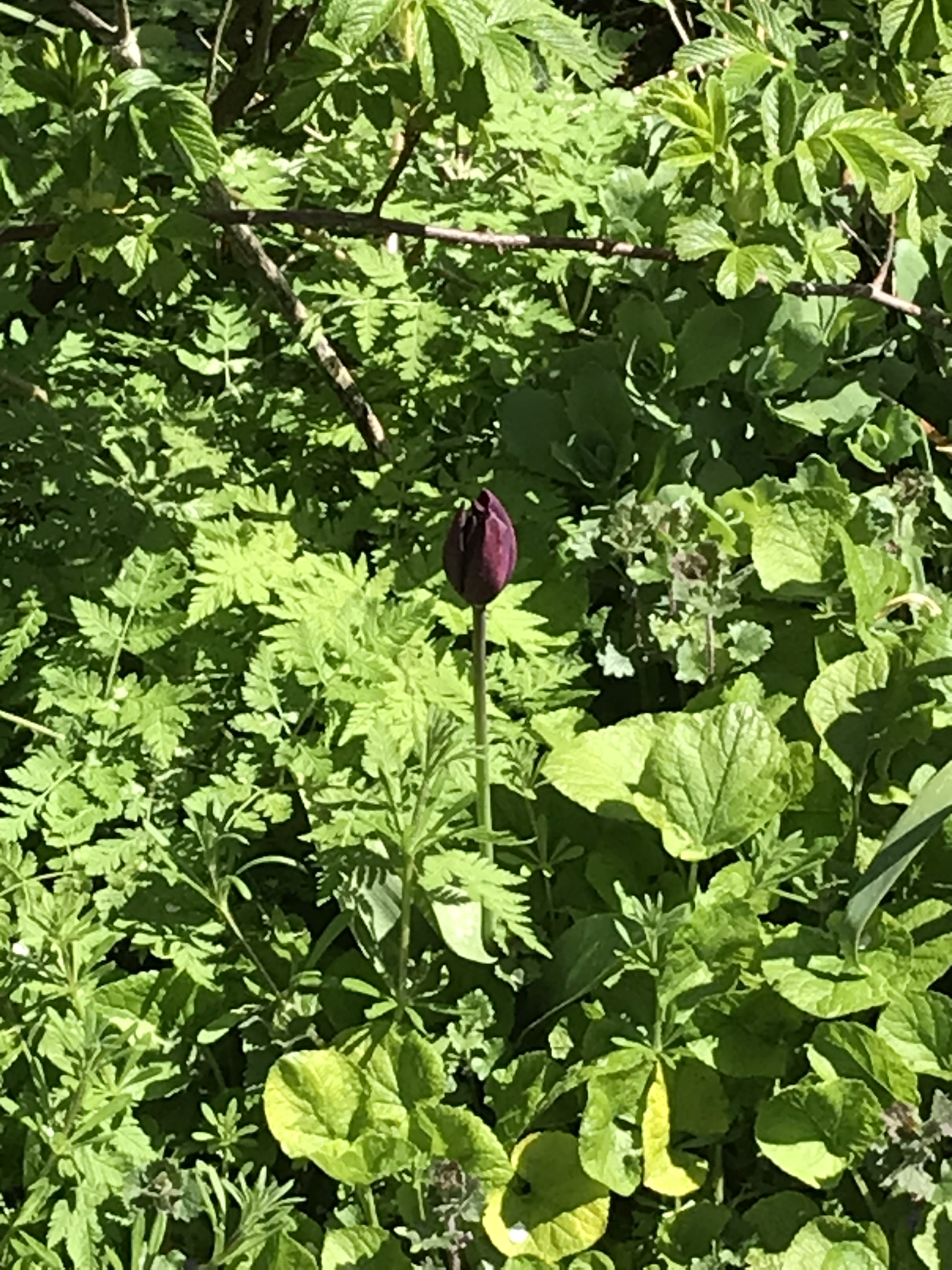
As the daffodils fade, it’s the turn of the tulips to take centre stage.  One of my favourite flowers: lovely colours, often a lovely shape, with a glowing sheen on the petals and a habit of fading gracefully, like old silk.  Not that there are too many in the garden this year; I deliberately only bought five varieties last winter, which I couldn’t plant out (in pots) until February because of the freezing weather earlier in the winter.  Unsurprisingly, they’re coming up late and in so-so condition.  The ‘Exotic Emperor’s, an early variety, are just coming into bloom, whereas a long-standing clump of dark red tulips, which I think are ‘Couleur Cardinal’, planted down the far end of the vegetable patch, has been flowering for a couple of weeks.  Some of them are in a vase indoors, but there are still some uncut.  (There’s also a paler tulip in that group, and I don’t know what it is - 'Angelique'?) 

Tulip 'Couleur Cardinal' - and one interloper!

The first tulips in flower were the little red ones in the (overgrown) shady border by the summerhouse.  There are also some pale orange species tulips in that bed, but they flower much later.  Nearby, in the bottom bed, there are a few ‘Menton’ in bud, and a single dark purple ‘Havran’, the last survivor of a previous planting.  Another singleton is ‘Sweetheart’ in the front garden; all the others have disappeared, which is a pity as it’s a pretty tulip. 

Early red tulips

A solitary Tulip 'Havran'

The ’bottom of the veg patch’ tulips are being encroached on by the lily of the valley, which has spread in under the wall from next door’s garden.  It too is nearly in flower; we don’t usually manage flowers to pick in time for May Day, though I can normally make a posy of them not long after.  This spring’s miserable temperatures (today is typical, cold and wet) don’t seem to have dampened their spirits too much; there are buds already.

Lily of the Valley (Convallaria majalis)

There was one good gardening day this week, almost (but not quite) mild enough to work outside without a jacket, and I got some weeding in the vegetable beds done.  The robin – or more than one, I’m never sure how many we have in the garden! – was very interested, coming up close on more than one occasion to look for worms and grubs.  This one seems to have a nest in the ivy by the rowan tree, where he (or she) keeps taking food.  There is a pecking order, however, and a blackbird pair seem higher up in it than the robin; they too were foraging around when I was out of the way, and the robin had to hang back until they were finished.  (Perhaps that was encouraging the robin to come close to me while I was working, as the blackbirds are not as trusting and he could get first pickings that way.)  The blackbirds – they seem to be a different pair to the patio blackbirds, with territory on the other side of the garden – must have started their nesting very early, as today they were being followed by two quite well-grown youngsters looking for food.  The patio blackbird, meanwhile, has been singing from the top of the neighbours’ roof, in competition with the song thrush, who sings from the top of the hawthorn tree!  It’s all go round here.

Other birdlife has included a pair of bullfinches, nibbling at the plum tree shoots, and a warbler.  The two partridges are still intermittently about in the garden; I try not to disturb them, though they’re fairly tolerant of my presence (at a respectful distance). 

Tulip time coincides with dandelion time; one of my daily jobs at the moment is to go round the garden trying to weed out as many dandelions as I can see before they seed.  They have considerable wildlife value, attracting hoverflies, but I have no compunction about removing them from the garden as there are hundreds, if not thousands, in the roadside verges and fields round here.  While digging one out from the edges of the shady summerhouse border, I disturbed two little fieldmice, which scooted away into the undergrowth from their hiding-place.  The most notable visitor to the garden this week, however, was a large dog fox which wandered across the patio and off down the garden one day at breakfast time.  Probably the same one as raided a neighbour’s chickens later in the week.

Tuesday, 11 April 2023

First cut


The lawn, cut - except for the cowslip patch

After the rain, we had three dry days over the Easter weekend, and managed the first cut of the lawn on Sunday.  The forecast was for a lovely sunny day, which didn’t materialise (cloud all day!), but the grass was dry enough for a high cut.  It’s amazing how much better the garden looks with the grass trimmed to a more manageable height.  The cowslips have been left, as they’re starting to flower, but we mowed over the top of the orchid leaves, which didn’t affect them but kept the surrounding vegetation low. 

The birds were very appreciative, as the cut made it easier for them to see the worms and insect life, as well as food dropped from the various bird feeders.  The blackbirds have started gathering food for their nestlings, while the robins are still at the stage of the male giving little food presents to his mate (as an indication of how he will provide for her when she’s on the nest).  Two song thrushes have been about – maybe a pair, maybe not – and are also collecting worms.  Other birds are busily collecting moss (the cowslip patch is a favourite spot for the sparrows) and other materials for their nests; the pair of mistle thrushes have been spotted gathering nest material, and a longtailed tit came to the kitchen window one day in search of spiders’ webs with the same intent.  Both blue and great tits have been checking out the nestbox, but don’t seem to have staked a claim yet.

Other birds have been showing up, in search of food, water or shelter.  A yellowhammer was at the bottom of the garden one day, doing his ‘little-bit-of-bread-and-no-cheeeese’ song; a small warbler came by another day, a pair of bullfinches have been eating the buds on the plum tree and a pair of greenfinches seemed to be attracted by the bathing opportunities in the pond.  We even had a marsh tit on the peanut feeder.  And a swallow flew overhead on Sunday, the first of the year.  The pair of partridges have been hanging out regularly, mostly in and around the veg patch.  They can’t do much damage there at the moment; the broad beans are under fleece for protection from the squirrel, and the garlic and shallots are sprouted far enough to be fairly immune to disturbance.  Other crops are still at the seedling stage in the greenhouse.  One of the partridges was hiding under the big gooseberry bush one day, watching me in the greenhouse before being joined by his mate, but their favourite place is on a weedy veg bed, where they can nibble the weeds; this bed is currently occupied by the frame of a cloche that has lost its cover but contains a bit of rigid plastic netting (used to protect the radicchio from pigeons last autumn), and the partridges seem to regard it as a place of safety as well as warmth when the sun is out. 

One partridge, peeping out ....

... and with its mate ...

... and in their favourite shelter

Warmth and sun are going to be in short supply for a few days; we’re now having showers, heavy rain and some very blustery winds.

While the grass clippings were fresh, I took the opportunity to restart the Hotbin.  This has been a Coldbin over the winter; it reached good temperatures last summer, but when we were away in the autumn it cooled down (it requires regular feeding to stay hot) and I left it alone during the colder months.  The contents were rather half-composted but satisfyingly full of worms (how do they get into an insulated container?), and will be gradually fed back into the bin in the hope that they will provide some starter material.  The grass clippings, with some buddleja prunings, got the bin off to a good start; the temperature rose overnight from 10C to over 40C (110F), but has dropped again as the composting process started and the volume went down (the bin needs a certain volume of waste to work properly).  I’m hoping I can get it working rather better this year.

In the weedy end of the row of fruit cordons, I found seven stems of Narcissus ‘Silver Chimes’ about to bloom.  I planted these some years back with the intention of cutting them for the house, and was very pleased with them, but after the first year they seemed to disappear; they have now presumably bulked up again.  I cut them, with some of the nearby pulmonaria, for a posy for the dining room table; they’re lovely little flowers, highly scented and very pretty.  I must consider moving the bulbs to a better spot.

'Silver Chimes' with pulmonaria


Saturday, 1 April 2023

No way to treat a hedychium

Much of the weather recently has varied from drizzly to downright wet, discouraging me from getting on with bigger jobs like cutting the buddleja back.  There’s no real excuse not to do work in the greenhouse, however.

The greenhouse needs a good clear-out; much of the space is occupied by used plastic flowerpots and old compost sacks, but under the staging in the far corner is where the hedychiums have been sitting.  Hedychiums are ornamental gingers, known also as the ginger lily, and they have big exotic leaves and spikes of highly scented flowers.  They like heat and moisture and, like dahlias, in the UK they will overwinter in the ground in sheltered locations if well mulched, but in colder spots are better brought under cover and kept dryish and frost-free.  Last spring I split them and potted up seven pieces in new compost, but my good intentions with them didn’t last; they each produced one or more leaf-spikes but my watering regime was lacklustre to put it mildly, even during the summer heatwave, and they had to endure searing temperatures in the greenhouse; in autumn one of the flower-spikes started to bloom, rather half-heartedly, but finally petered out.  The greenhouse was neither heated nor insulated over the winter, and the temperature dropped to -3C at one point, which is definitely on the low side.  It’s no way to treat a hedychium.

Hedychium about to flower last autumn - or not ....

Last week I bit the bullet and emptied them out of their pots to see what the damage was.  Less than might have been expected, actually.  Some of the tubers had put their roots down through the bottom of the pots and into the builders’ gravel that the pots had been standing on, and that seemed to have kept them going.  A couple of the potfuls looked beyond saving, but some of the others either seemed to have tubers with some vestiges of life in them, or roots that were still viable, and these were potted up again with fresh compost.  We’ll see.

The dahlias were also examined.  These were outdoors in various pots when the weather turned cold early last winter, rather suddenly, and I brought anything that could be put under cover into the greenhouse as quickly as possible.  One pot had been hastily housed outdoors under a table and predictably the tubers were now rotted away; some of the smaller tubers in the greenhouse were either dried out or worm-eaten, but I managed to salvage a reasonable range of varieties and potted them up.  Again, fingers crossed; ‘Sam Hopkins’ already has new shoots coming.

Alongside the dahlias and hedychiums I found a pot of freesia bulbs that did nothing at all last year and had been subjected to the same lack of summer watering and freezing winter temperatures as the tubers.  I picked the pot up and was about to empty the contents out to recycle the compost when I noticed a few shoots poking through.  I left well alone, watered it and put it with the other pots to be fed and watered in the coming weeks.  You never know …

Sunday, 19 March 2023

A touch of spring


Mid-March, and spring feels not too far off.  The weather is tending to be rainy on the whole, with only the odd sunny and mild day from time to time, but the signs of spring are definitely here. 

This hyacinth was one of two little pots purchased last year to cheer things up indoors; after flowering, they were put outside while I dithered about where (and whether) to plant them in the garden.  Twelve months on they’re still there, and have overwintered in a disregarded spot behind the garden bench (which has spent the winter on the terrace); I noticed that this potful is again in flower and popped it on the garden table to be seen from the dining room.  It has a self-sown forget-me-not in its pot and needs a bit of tidying up, but it’s a welcome spot of colour. 

Also providing colour in the garden are the daffodils – those in the sun are now out – and the pulmonarias.  I really must move the latter, which are self-seeded and popping up at the back of the fruit area but deserve a better site.  And you have to look closely, but the violets at the bottom of the garden are also in bloom.

Self-seeded pulmonaria

In the veg plot, the mystery of the non-appearing broad beans seems solved.  It is indeed the squirrel’s doing.  The beans, sown quite deeply, are now starting to send up shoots; a neat row of little holes shows where the squirrel is digging them up and nipping the leaves off.  I’ve covered both beds with fleece in an attempt to protect the remainder, but I will have to sow another batch to compensate for the losses.  Meanwhile, I’ve made a start on spring growing by sowing some lettuce seed for germination indoors.

There has been a noticeable increase in the number of insects – mostly bumblebees but some hoverflies – flying from flower to flower (the winter honeysuckle and hellebores are favourites).  The birds have also started to collect nesting material in earnest; the female blackbird was gathering moss this morning, and two male blackbirds, one at the drive entrance and one down near the bottom hedgerow, or possibly in next door’s garden, have started singing quietly, by way of practising before the serious business of using their song to declare their territory.  The boundaries of the robin territories are still being defended; there was a four-robin scrap on the patio this morning.

One still outstanding March job in the garden is pruning the buddleja.  I thought of making a start on it this afternoon, but as I walked past I realised that there were two partridges sheltering behind the bush.  Usually they would sprint off at the first signs of human activity nearby, but these two just sat and looked suspiciously at me, and I let them be.

Monday, 13 March 2023

Blackthorn winter


From the middle of February, when we left on holiday, until early March, the weather has been mostly mild (for February) and dry; but the past few days have been cold and intermittently snowy, culminating in strong winds and rain today.  The snow here didn’t amount to a great deal – a couple of centimetres at most of wet stuff, although it was much worse further north.  Some news reports spoke of ‘unseasonable’ weather, but it’s not at all unseasonable; it’s what used to be known as a blackthorn winter, cold weather that coincides with the flowering of the blackthorn in the hedgerows, and it’s quite common.  The forecast for the next few days is wet but much milder, except for tomorrow night when temperatures are set to drop to minus 5C.  I had been planning a seed-sowing binge in the greenhouse, but I’m going to wait until that is past and temperatures start to rise a bit.

I’m pleased to see that my garlic and shallots, planted before we went away, are sprouting nicely; the broad beans, however, which I hastily sowed outdoors just prior to our departure, are showing nothing at all, which isn’t encouraging after a month.  I found one bean which had been dug up, and it was starting to sprout, so I’m thinking it’s not the fault of the seeds; I suspect four-legged intervention (the squirrel?).  I still have seed, so will do a repeat sowing. 

The snowdrops are still in flower, but close inspection shows that they are fading; there has been a good show of crocuses, though they have been knocked about by the bad weather.  The first daffodils to flower, the miniatures, opened their flowers once the snow had gone, and have put up with today’s wind remarkably well; the window box is looking good, with ‘Blue Pearl’ crocuses (now mostly gone over), ‘Tete-a-tete’ daffodils just opening and rosemary ‘Miss Jessop’s Upright’ still in flower.  The hellebores are also still doing well; the clump at the side of the house includes a couple of self-sown whites, which I always keep meaning to dig up and plant elsewhere but never get around to it.  And the winter honeysuckle, Lonicera purpusii, is also still in flower and attracting the occasional bumblebee; it’s a fine sight, even in the snow (centre in the photo above).

Mixed miniature daffodils on the patio

Window box - daffodils and rosemary to the fore

Hellebores - mostly seedlings, including whites

In our absence the number of blackbirds in the garden seems to have dropped to a single pair, the others presumably being migrants who have headed off home for the spring.  I’ve been helping our residents by putting out the last two apples from our winter store to keep them going through the cold weather.  The two robins have also enjoyed them.  The fatballs have gone down well with most of the birds, especially the blue tits and long-tails, as well as the sparrows; the robins and blackbirds occasionally try to use the feeder, and the dunnocks and pigeons pick up what gets dropped.  Lefty and his lady have resumed coming to the patio for breakfast, although I think most of what I put out this morning was blown away before they could get to it; the plum tree pigeon pair are also still around, sitting and occasionally mating in the plum tree and sometimes venturing right up to the house as long as Lefty isn’t being too territorial.  The sparrows have started to collect nesting material, dropping bits of dry grass that blow around in the breeze.  There have also been three chaffinches active at the bottom of the garden; I hope there might be a chaffinch nest down there this year.

Monday, 6 March 2023

An obstacle removed

A return to the UK after 3 weeks in Norway, and it’s remarkable how much colder England feels – although the temperatures are fairly similar overall (similar to lowland Norway, where we’ve been for the past week, at least), the dampness here makes it feel chillier.  An early March update in the next post, but meantime here is what I was up to in early February.

The weather back then was ideal gardening weather - some lovely bright days with surprisingly warm sun and frosty nights.  It was a good time to tackle one of those jobs that had been hanging over me for ages; not urgent work, but necessary to get it out of the way so that other things could be done successfully.  To be precise, dealing with the tree at the entrance to the Dump.

The bottom of the garden has a copse of damsons, probably suckers from the plum tree that were allowed to get out of hand and are now small trees in their own right.  One of these grew at the entrance to the Dump corner (where the compost bins, lawn mowings pile and other unsightly garden stuff live), with enough space for access between it and the upright post that originally supported the trellis screening the mess behind.  Over the years, however, the tree started to lean, initially against the post but eventually getting lower and lower until I had to duck down to get in there.  With a wheelbarrow full of lawn clippings, this got tricky, and something had to be done.  The problem was not only having to cut through the trunk – which wasn’t particularly thick, but definitely a saw job – but to detach the top growth from the tangle of branches of the other trees around.

Before ....

... and after

So, out with the bowsaw.  In the end it was easier than I expected.  It took a fair bit of hacking to cut through the trunk, and then I just pulled the upper part of the trunk, branches and all, over the trellis and on to the lawn.  It came away from the other trees without too much damage.  After that, all the branches had to be cut off and larger pieces chopped up; these were heaped on the various woodpiles that I maintain down among the damsons to provide homes for the wildlife.   The trunk likewise was left on the ground in the Dump by the wall, in the hope that it will give shelter for beetles as it decays.  And now I can enter the Dump, with wheelbarrow if necessary, without bending down!

It's that time of year when robins seem to be everywhere in the garden; all outdoor work is accompanied by singing nearby, sometimes at very close quarters, and great interest in what’s going on.  While I was attending to the tree, the bottom-of-the-garden robin serenaded me until a couple of other robins turned up to try to chase him off, and a great deal of fast acrobatic flying through the branches ensued.  What seemed to be the same robin, unchallenged by his competitors, was still around the following day when I was planting out the garlic in the veg plot, an activity that generated a lot of interest from him, though I expect he was disappointed when I covered the bed with fleece (to stop the birds from pulling the cloves up).

Down on the edge of the damson thicket, I found a little clump of Cyclamen coum, in flower.  I didn't put it there; I'm guessing that mice, or ants, moved seed from the plants up by the pond, but it's a welcome sight nonetheless.  I just hope that the violets don't swamp it.

Cyclamen coum

The good weather meant that growth continued apace, even in early February; daffodils were showing buds, although experience says that they can sit around like that for weeks before actually flowering (and, three weeks later, I’m still waiting for the first bud to open, although it should be any day now).  Winter aconites were in flower, and in odd corners there were the first blooms on pulmonaria and primroses; and the little clump of Crocus angustifolius alongside the drive which always takes me by surprise.  Totally unexpected, though, were the several orchid clumps in the lawn, already showing well-grown leaves; the lawn, left unmown to let the wildflowers come through last summer and autumn and now looking very rough and turfy, is in need of attention, but I need to consider whether to mow over the orchid leaves or let them be!  Would it affect flowering? I don’t know!

Snowdrops, winter aconites (and leaves of unwanted geraniums!)

Daffodils under the plum tree

Pulmonaria, hiding by the wall

A primrose, also hiding in the grass

and Crocus angustifolius, bright and cheerful!

One of the many orchid clumps, already showing leaves in the lawn