Tuesday, 16 July 2013

Hotswolds

After such a run of dismal summers - since 2007 - we'd almost forgotten what summer weather was like.  It continues to be hot and dry, meals are still outdoor events and the watering can is in regular use.  There were a few thundery-looking clouds on Sunday afternoon but the sky then cleared again.  I've been weeding in the shade when possible and generally trying to keep everything alive.

Peony 'Sarah Bernhardt'
The roses are in full flood, and in the long grass yesterday I spotted three blooms on peony 'Sarah Bernhardt', which I had omitted to stake (and feed).  Poor Sarah has a hard life; I must do better for her next year.  The best of the blooms is now in a vase indoors: a huge pink, scented powderpuff and really impressive.  The Polemonium is seeding nicely in among all the grass and self-sown geraniums; that's another plant in need of rescuing next year.

On the edibles front, the broad beans are just coming to picking size, the gooseberries are nearly ripe and there are two big trusses of blackcurrants which I've protected as best I can - but not quite well enough, as the thrush demonstrated to me yesterday by slipping inside the mesh and plucking one to feed to its little one.  Baby thrush is very demanding and very vocal, so I couldn't be too angry.

There are still young blackbirds being fed too, and at least two dunnocks, not to mention all the sparrows.  A week ago we had a huge flock of young starlings fly into the holly tree, and another day there was an even huger flock of crows passed over.  The swifts continue to feed around here; two of them were coming very low round the house the other day.

Monday, 8 July 2013

Al fresco

The sun is shining, it's very warm and Andy Murray has won Wimbledon.  It's summer.

Hay while the sun shines
We've had unbroken summery weather since late last week; since Saturday all meals have been al fresco at the bottom of the garden (though work regime starts again tomorrow and workday breakfasts are always on the run).  Temperatures today were mid-20s in the shade, though an easterly breeze kept it bearable.  Farmers are making the proverbial hay while the sun shines (I should add that the nettles in the foreground of the photo are in the field edge on the other side of the fence, not in my garden!), attracting a fair number of seagulls and crows, and the sparrowhawk sitting on the telegraph pole, but I saw a blackbird gathering food there too, so the usual resident birds are benefitting also.  The young starlings have started to appear, and the sparrows and robins continue to feed their little ones; chaffinches are about, and there was also a family of goldfinches (including little ones wanting feeding) round the pond this afternoon.  Have I mentioned before that we've had the usual young greater spotted woodpeckers around? and we heard a green one yaffling somewhere the other day.  There have been a few swifts around too, as well as the usual house martins and swallows, and a partridge has appeared in the past few days.

Most of the roses are now in flower, the Big Yellow Thing, the Phlomis and the Stachys are coming out and I keep hoping that the peony will open soon too.  Today I noticed that the Thalictrum, half-hidden behind rose 'Mme Hardy', is fully out, complementing the Buddleia alternifolia which is just starting to bloom.  This weekend's work included thinning the apples -  not too much to do there this year - and to start pruning the cordons.  It's a bit early for that, but I discovered a lot of aphid attack and some nasty-looking blotchy leaves on them and thought that some more air in there would be helpful (not to mention getting rid of as many of the horrible bits as possible); each tree was also treated to two bucketfuls of water as the ground is starting to get really dry.  I also planted out some beans - trying 'Moonlight' and 'Ferrari' this year - and some of the ornamentals I bought the other week - Dianthus 'Devon Dove' (white) and 'Cranmere Pool' (two-tone pink) among others.  The old herb patch is turning into a scented garden, although there are a few non-scenteds (notably the courgettes!) in there this year.

Still too many weeds and not enough time to get them out.

Wednesday, 3 July 2013

Just-in-time weeding

I practise just-in-time weeding.  Given the task of keeping on top of what has become a very weedy plot, I manage by targeting specific weeds just before they can set seed and make the problem worse.  The vetch is very nearly all out (that is to say, the flowers and most of the stems ripped up; the roots of course are another matter entirely).  The herb robert is coming out as and when I spot it, and the lesser willowherb too.  I've been tacking the creeping buttercups, and the herb bennet is next in line before its burrs can ripen.  The grasses are also in flower; in what is meant to be an open space by the hedge they are waist-high in some places, with their plumes providing a romantically summery haze around the geraniums (which are also weeds in this case).  So far I'm keeping ahead of the seeding ...

Windy spells have knocked the poppies around, but the roses continue to come out: the albas and Old Blush China are in flower, Mme Hardy is just starting and Comte de Chambord and Gallica Officinalis are showing colour on the buds.  And the honeysuckle, which I always forget to mention because it's out of sight at the bottom of the garden, is in full flower, as is the purple Verbascum under the ash tree (it has made a rather better showing this year). 

The sweet peas planted last week seem to have settled in.  To my surprise I also found two winter squash seedlings; these had failed to germinate indoors and before we went on holiday I dumped the seed tray outside out of the way.  Only noticed last week that two of them had in fact come up; so they have been put into a clear bit of ground in the veg plot.  I'm also trying to provide a better screen for the gas tank.  Some years ago we bought a Photinia (I say 'we': it wasn't actually my choice) and it has sat unloved in its pot since then for want of anywhere to put it.  A Buddleia and several ash seedlings germinated in there, and it looks as if the root competition has kept the Photinia's rootball small; this made it ideal to plant in the very shallow, stony soil in front of the tank.  I hope it's happier there.  I'm also trying a row of rosemary plants in front, which should like those conditions and help hide the tank once they grow up.

Pondlife 1: Damselflies on the iris
There were several damselflies (I counted four at one point) around at the weekend, especially near the pond.  The pond life is doing quite well; there are at least two smooth newts in there, and the iris and waterlilies are in flower.  On the bird front, there is still much feeding of little ones, with the sparrows, blackbirds and robin very active; a baby robin flew into the summerhouse at the weekend and I had to leave the door open to let it escape (which I think it did, though you can never be sure).

The weather has been on the cool side mostly, but is to warm up for the next week or so.  Dare we hope for summer?

Pondlife 2: Waterlily

Wednesday, 26 June 2013

Umbellifer proliferation

My rather erratic seed-sowing has been more successful this year than usual.  I tried two of the currently fashionable Umbellifers, Orlaya and Ammi, and both have given me a few plants.  Although the Ammi are still very small, I've planted out both lots in the new bed at the bottom of the garden, where I have vague notions of romantically billowing drifts of the stuff.  There's already one Umbellifer in there, Sweet Cicely, which was supposed to billow romantically under the Rugosa rose at the end of the bed; however the rose is showing more interest in suckering than in growing upwards, or flowering, and Cicely is towering over it.  A very impressive plant she is too; I've left a few seedheads on in the hope of a few more plants.  Meanwhile there's also lots of cow parsley over the fence.  Maybe I've overdone the Umbellifers.

Poppy 'Allegro'
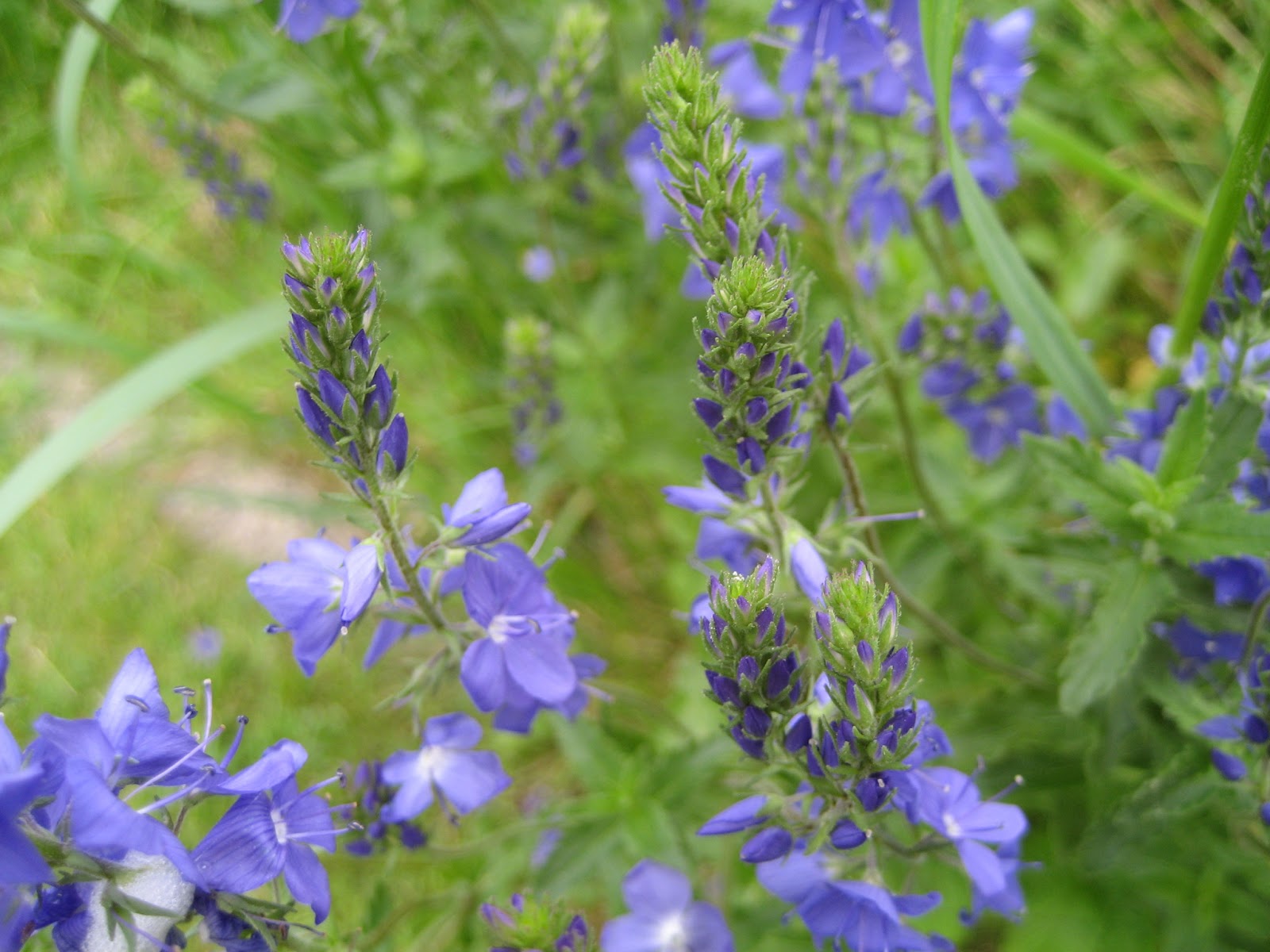
The earlier spring flowers are now over, and the big red poppies, the Veronica, Sweet Rocket, foxgloves
and the Penstemons are coming out (also the Alchemilla mollis, of which I have far too much).  The early single roses are going and the more showy ones are starting: Gertrude Jekyll and Alba Semiplena, with buds starting to show on Felicia and Queen of Denmark.  The Wisteria is still going strong, as are the Aquilegias; a couple of new self-sown ones have come up under the hedge, a pale pink and white bicolour, and a deep purple and white which is very striking.  Need to find a better home for them.
Veronica

Clearing out and ripping up continues.  The front bed by the drive entrance has been tidied, and the 'Tutankhamun' sweet peas planted to scramble up the side of the Philadelphus (which needed a lot of dead wood cut out).  I hope that works.  The other, bigger, sweet peas have been planted on two wigwams, one down by the honeysuckle and one in what was the herb garden (for want of space anywhere else at the moment).

Rose 'Gertrude Jekyll'
Left to my own devices the other weekend, I went plant-shopping :)).  Some scented pinks, a couple of old favourites, Geranium renardii and Allium karataviense, which I used to have but lost, and some Perovskia which I fancy will withstand the cold east winds down at the bottom of the garden.  (It occurs to me that Angelica might be good here too, since it grows wild in Norway - but it might be too big, and anyway it's yet another Umbellifer ...).  I also came away with a few other impulse buys to brighten things up a bit.  We'll see how they do.

The weather went cool and windy - very windy at times - again, with a lot of showers, but the last couple of days have been warmer and bright.

Bee on the vetch
The birds are still feeding little ones and greatly enjoying their breakfast on the patio.  There seem to be more bees (and bee mimics - can't tell the difference) this year; I'm gradually working through the vetch, pulling it up before it can seed, although the bees are still very keen on it.  They do have the comfrey, though, and the cotoneasters which they also like; and there are now plenty of other flowers for them to feed on.  A couple of butterflies have appeared from time to time - whites, or perhaps female orange-tips (I've seen a male a few times) - and there was an electric blue damselfly in the garden today.  And this evening a hedgehog was snuffling around under the plum tree - the first I've seen this year.  Good to know we've got one around.

Wednesday, 12 June 2013

Was that summer?

The rain finally went away, followed by mostly bright and sunny weather with some pleasant temperatures, at least when the sun was shining and the wind not blowing.  The sunshine is still tempered by cool winds, though it did feel reasonably summery for a few days.  Back to mizzly rain and bright spells, and a rather fresher feel.  Was that summer?

One of the 'posh' Aquilegias
The Wisteria
Tulip 'Orange Princess'
Work in the garden has mostly been trying to keep on top of the weeds as they come into flower; there have been clear-up campaigns against the cow parsley (pretty, but lots and lots of it clearly visible in the field beyond the bottom of the garden, so I don't need to grow it myself), the nettles, the herb robert and the herb bennet.  I also need to tackle the vetch that is flowering rampantly under the dining room window, but the bees have been enjoying it so much that I've left it for them for the moment.  The bees are also flocking to the comfrey which is in full flower.  Other colour is coming from the last of the spring flowers - Doronicums and honesty, and the Brunnera (which also needs to be cut down before it seeds too much).  Coming out now are the Aquilegias, Sweet Rocket, Wisteria and the first roses - 'Mary Queen of Scots' and Rosa altaica (in spite of the hard pruning I gave it).  The last of the tulips are also still here.  Those in the big pot have taken a bit of a battering from the wind, but 'Black Hero' is continuing to stand up well; it's rapidly becoming a favourite with its nearly black, shiny, dark flowers.  On the patio, 'Professor Roentgen' was already past its best when we got back from holiday, but I've been impressed by 'Orange Princess', which has lovely glaucous leaves and has also stood up well to the weather.  'Super Parrot' hasn't been a big success; the leaves have gone over very fast, and the flower stems are too short for the flowers to show properly (perhaps lack of water?).

Another big 'tidying up' job has been cutting back the big Osmanthus, which was getting to 10ft tall and in need of bringing down to size (and into shape).  In the event I took out rather more growth than I had intended, but at least lots of light will get in there now and give it a better chance of a healthy future. 
The big Osmanthus, before pruning

I'm starting to think that this is likely to be a year of cutting back and digging out - there's a lot that needs renovation.  I would like to get some more colour in the garden too, though.

The birds are still feeding little ones; there are two baby blackbirds around, and probably more in a nest in the ivy on the neighbours' garage wall, facing the kitchen window - a hen blackbird has been taking food in there.  She doesn't seem put off by the large skip that is sitting on our drive in front of her nest (part of indoor renovations going on!), and the associated activity around it.  The sparrows' broods are also coming on well and, while we haven't seen any young starlings yet, they are being very vocal in their nest high up on the gable end.  A thrush has appeared from time to time, and a jay visited briefly the other morning, to the great concern of the blackbird, which fought it off.

We have a self-sown Shining Cranesbill in the path under the dining room window.  I wonder if I can get it out and transplant it?


Tuesday, 28 May 2013

Hole in the wall, hole in the ground

Longthwaite,May 2012 and (below) 2013
Back after nearly two weeks in the Lake District.  Spring is even later up there than here, with many of the trees still bare; you can see the difference in the same photo shot taken a year apart!  Last year's weather was warm and sunny; this year was mostly damp and chilly.  The weather pattern continues to be that the sun is warm when it's out, but the wind is cold.  We had a couple of hailstorms, and there was light snow lying on the highest central fells one day, which you don't normally see in late May ....

Down here, the weather picture was the same but possibly with even heavier rain.  Some seed trays that I left out had the compost washed out of them.  This past weekend again had some lovely sunshine but with that rather fresh breeze; today has been miserably wet.  The forecast is for more of the same.


Custom-built hole in the wall
Before we went away, the tumbledown wall at the back of the vegetable garden was (very expertly) mended.  Since next door's ash tree has taken to leaning on it, rebuilding it as it was wasn't an option; so the tree now has its own custom-built hole-in-the-wall (with a little trellising inserted by the neighbours to keep their dog in!) so that it can lean without causing more damage (we hope).  The apple cordons are flowering on regardless; one job outstanding is to tie them up properly as they're lying rather flat at the moment (the stakes having been removed to allow access to the wall).  They've suffered remarkably little damage from having so much stone fall on them!

Another sort of hole appeared just before our departure: something small and probably furry had dug a hole at the bottom of the big ash tree at the end of the garden (fortunately without disturbing any of my new planting).  By the time we got back the hole had disappeared, but another has materialised alongside the brick edging of the 'hot' bed.  I wonder what's down there?  During our holiday we were entertained by the antics of two red squirrels on the peanut feeder, but whatever has dug these holes is a lot smaller and, I suspect, a lot less cute.

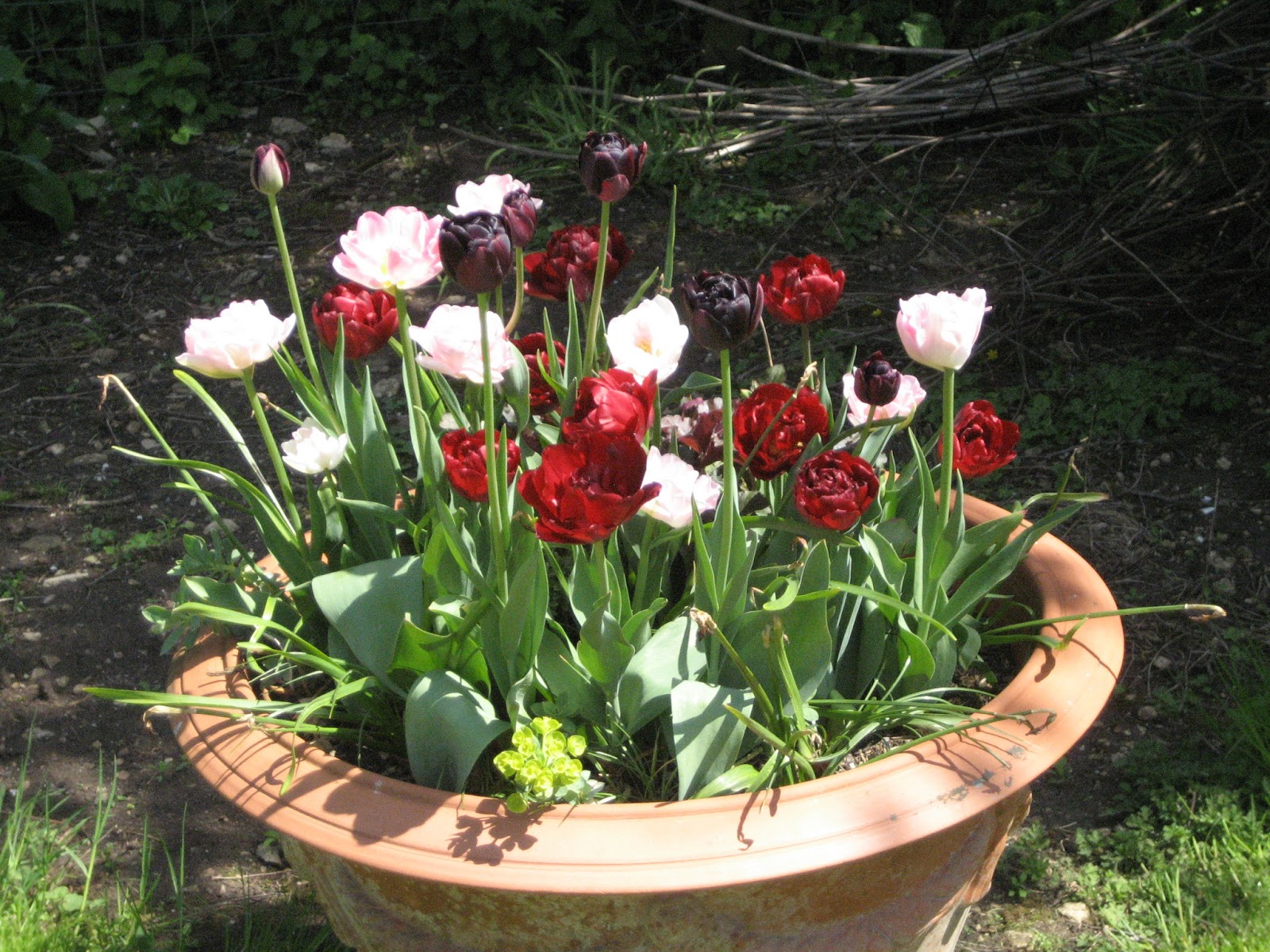
The tulips in the big pot
In my absence there hasn't been too much change in the garden.  The grass, both in the lawn and in the flowerbeds, has grown well (all that rain!), but the dandelion problem wasn't as great as I had feared; none seemed to have seeded and I was able to deadhead them before the damage was done.  The main flower change is that the tulips have come out nicely.  Down at the bottom of the garden, the grouping of 'Angelique', 'Uncle Tom' and 'Black Hero' in the big pot has lived up to expectations: the colours work well together and can be seen well from the house.  The perennials put into that pot to provide winter interest are recovering from their exposure to the east wind; the Heuchera and the Euphorbia myrsinites (the latter just peeping out in the picture) had been looking unhappy but are coming along quite well now.

The plants put into the bottom-of-the-garden bed seem to have settled in.  I'm thinking that they will need some more spring colour in there next year; the crocuses and Anemone blanda are too small to make a decent splash.  Some more tulips in there next year would be good - perhaps move the ones in the pot and see if they will come again next year?

Good value hellebores
The blue camassias have also flowered, and are nearly over.  Also on the way out at last are the hellebores; I dead-headed most of them before we went away but left the big one because it looks so good.  It has been flowering since well before Christmas; now that's what I call good value.

The birds, especially the blackbirds and the robin, seem glad to have us back; they're still feeding youngsters and come straight down when food is put out.  A thrush also visited today.  There are signs that the sparrowhawk has been about again: pigeon feathers, bits of another female pheasant and some brown feathers that suggest that the hawk has been in someone's chicken coop and brought a take-away in here to eat.  The magpies are also still here (bringing back unpleasant memories of seeing a crow raid a Lake District mistle thrush's nest). Just before we went away we spotted five swifts flying overhead; but there have been no signs of them here since, so they were probably en route for somewhere else.

The rain has topped up the water levels in the pond nicely.  After my last look in there I had feared that the wildlife had gone, but I see that there are water snails active in there, and a newt was sculling around on the bottom, so all is not lost after all.


Wednesday, 8 May 2013

Breakfast on the lawn

The weather actually improved for the early May Bank Holiday weekend; while Saturday wasn't anything special, we had pleasant sun on Sunday and on Monday, for the first time in years, we managed breakfast (and lunch) outside, enjoying the birdsong and the scent of the Osmanthus.  Admittedly a jumper was needed when the sun went behind a cloud, but that day and yesterday were lovely, warm, sunny spring days.  Of course it couldn't last, and today has been chilly with showers (and more of the same is forecast).

The bottom-of-the-garden border has been planted up, after a fashion.  I can't say it has been well-planned.  It was more a case of finding a home for various waifs and strays hanging around in pots and in odd corners.  So some more Deschampsia has gone in, to balance the existing clumps clustered around the Phlomis (which has picked up well after the winter), and the Francoa has been moved from its increasingly dark position under the Osmanthus.  I also dug up a few clumps of the Lysimachia clethroides (I can never remember its name, so am recording it here to jog my memory!) which was parked rather unceremoniously on the edge of the vegetable garden years ago because I had nowhere better to put it, and they have now gone in there too,  I hope it isn't too much of a dog's breakfast, though it's bound to look rather bitty for a while until the plants bulk up.

The Lysimachia needed re-siting because work on the tumbledown wall at the back of the vegetable garden was about to start, and it was very likely to be trodden on in the process.


The wrong tulip - Tulipa tarda?
The wrong tulip pairing - 'Pole Position' and 'Flaming Flag'
The yellow colours are still predominant, although from certain angles the yellow is challenged by the bright purple of the honesty along the side hedge.  The main season tulips are also starting to come out.  Not all of these are a big success, to be honest.  The little red tulips planted in what I always hope will one day become a 'hot border' are coming along nicely; they have lovely slim, twisted glaucous leaves, and their buds are promisingly red.  However one of them isn't the same species.  It is already out, and it looks like Tulipa tarda to me; not really a problem, as it's a nice tulip, but it's just a bit solitary.  The big mistake is the pot pairing up 'Pole Position' (described as purple with a white edge) with 'Flaming Flag' (described as white with a purple edge).  On paper this sounds like a very tasteful pairing, but sadly there's purple, and again there's purple ... and it's not the same purple.  'Flaming Flag' is a pretty tulip, with shades of lilac and white and a distinct darker flame mark up the centre of the petals; it's a little on the small side, but attractive. 'Pole Position' doesn't do it for me, however.  I would describe it as burgundy rather than purple, especially when it first comes out, and the white is rather off-white; and neither colour is very nuanced.  There's none of the subtle shading, nor the luminosity or sheen, that you get with the best tulips.  As far as I'm concerned it's a candidate for the back of the grid, not the pole position.  Problem is, will I be able to distinguish between the two sets of bulbs when I come to replant them?  Probably not.

My hopes of a last flush of flowers from poor old Viburnum carlcephalum before it dies are not going to be fulfilled.  The buds are shrivelling and the new leaves dying.  It's definitely on the way out.  The dead branches cut off earlier had a marked mushroomy smell that indicates a fungal problem. I'll try to get the roots up; I hope I don't find the signs of honey fungus in there :(.

Damson flowers against a sunny spring sky
On a happier note, the plum tree and the damsons in the hedge are coming into bloom; with their fresh green foliage, against a blue sky, they're a cheering sight after the cold winter.  It's all the more cheering because the pollinating insects are at last coming out to feed; several bees were busy, also hoverflies and something I couldn't really identify (I must get better clued-up on bugs).  I found the first ladybird of the year (a 2-spot) in the lawn while digging up dandelions; there was a white butterfly (or maybe an orange-tip - I couldn't tell from the quick glimpses I got) fluttering about and a peacock butterfly was sunning itself on one of the manhole covers.  Less pleasingly I also found four lily beetles (now deceased!) on Lilium henryi.  The increased insect life has been much appreciated by a small bat which has been visiting during the evening.

On the bird front, sadly there are no more signs of the baby blackbirds, and the parents aren't taking away food any more.  The sparrowhawk has been about (more pheasant feathers at the bottom of the garden), and was seen flying into the hedge one day; there has also been a pair of magpies around.  The robins still seem to be busy, and the starling nest in the roof is noisy with little ones.  The sparrows are also nesting in their various corners of the roof.  The goldfinches and a greenfinch have been about, and a wren sings noisily down by the summerhouse from time to time (it's amazing how much sound such a small bird can make).  This week has also seen the return of the house martins and swallows, always a welcome sight - and definitely a sign of spring springing!