Wednesday, 20 November 2013

Autumn leaves


We returned, in early November, from more than two weeks away, to find rather more leaves still on the trees than I had been expecting.  There were plenty on the lawn, but still more to come, even though there had been a lot of wind at the end of October.  Apparently the second half of October was mild, which has delayed leaf-fall.  A trip through the Slad Valley early last week showed the beech trees still in magnificent golden leaf, and even now in our garden most of the leaves are still to fall from the apple and hazel trees.  Two big leaf piles are now gently and slowly rotting down, helped by the addition of handfuls of comfrey leaves.

It may have been mild in October, but after our two weeks in Mediterranean temperatures, November’s chill and damp was a bit of a shock.  Daytime temperatures are currently in low single figures, with occasional frosts at night; enough for a thin layer of ice on the pond but not persisting during the day, even in the shade.  A mix of blue skies and murky chill.

The garden is somewhere between late autumn and early winter.  The last of the Nerines were still in good condition on our return; they’ve been in a vase since and are only now fading.  The only flowers still really performing now are the yellow chrysanthemums, although the pinks and the Choisya ternata have had a late flush of flowers, and there are odd late blooms on the Calendulas, Gaura and a couple of other plants.  The winter shrubs are starting to flower: Viburnum ‘Dawn’ and the winter jasmine.  We’ve also had a good crop of toadstools in the lawn, which suggests a warm and damp autumn; and the lawn is badly in need of cutting, but it's probably too late for enough dry weather to make that possible.

The beans and squashes have been harvested (as I thought, the winter squash plant succumbed before its fruits could come to anything) and composted.  There were a few usable broad beans even last week.  All the eating apples are now picked, before the birds could start on them, as well as most of the cooking apples; the fieldfares and redwings are here for the winter, and the fieldfares are happily feeding on the remaining cookers.  We have a lot of blackbirds as well, so any apples left out are being pecked quite quickly; even a few left on the back doorstep weren’t safe.

The sparrowhawk has been around quite a lot, though without actually catching anything that we’ve seen.  The birds are in full winter mode, tucking into any food we put out for them.  Today we had a wren, robin, dunnock, sparrows, starlings, blackbirds, fieldfares, redwings, coal/blue/great tits, green/gold/chaffinches, lots of collared doves, woodpigeons, a couple of magpies, spotted woodpecker and a hen pheasant – not a bad total.  Sadly, no sign of our lame pigeon since our return.

Monday, 14 October 2013

A dish of strawberries

All right, a very small dish.  Of very small strawberries (the alpine strawberry 'Baron Solemacher').  But not at all bad for the middle of October.  I spotted a couple of lovely ripe ones on a plant that has self-seeded into a sunny corner near the pond, and it prompted me to go searching under the leaves; I collected a good little portion for supper, all on accidental plants rather than those in the 'proper' place.  I think that tells me that I need to get plants settled in in the autumn instead of waiting until spring, which is probably too late.  It's an obliging little plant, growing happily in shade if necessary and not fussy about soil, but the plants do need replacing every three years or so.

Given the time of year, I managed quite a reasonable harvest from the garden at the weekend.  Besides the strawberries, I picked three types of bean (the last of the French and runner beans, and some broad beans), courgettes, cooking and dessert apples (the Ashmead's Kernels are just starting to be ready), some radicchio leaves and a couple of spring-onion sized leeks (they were never thinned!); the potatoes and garlic are already in store, and I have had a couple of hazelnuts, although the squirrel has been seen attending to those.  Not bad given the very haphazard planting this year.

Cyclamen hederifolium
The leaves have started to fall, and the leaf-raking season has begun.  The old leaf-mould has been spread on the new bed under the ash tree where the soil is extremely dry and thin.  I hope that will help the plants along a bit.  The only flower colour in there at the moment is from the 'Bowles' Mauve' wallflower, which has flowered on and off all year, and from the sedums; the perovskia does have a (single) flower spike on it, but you wouldn't notice it (it was only planted this year, so I'm hopeful that it will put on more of a show next year).  Elsewhere, there are still flowers here and there; the purple aster has started blooming, the dianthus seem to be getting second wind and there are still a few roses about, the sweet peas and phlox are tailing off.  The little cyclamen are looking good, though.  And the echium is beginning to fade; it will be cut down before it can seed too much.

Bees on the echium
The weather has been more autumnal - cooler, with wet and windy spells, but with some sunshine; Saturday was almost warm, but it has been wet since.

There are still a good number of sparrows about, and the occasional starling and dunnock; the robins are tick-ticking in the background but coming less often for food.  I disturbed a partridge the other day, and the odd pheasant has wandered in.  A green woodpecker has been heard close by but not seen.  I wonder if he's staking out the cooking apples again?

P.S. Further examination of the cooking apple tree reveals a large apple next to a convenient perching branch with big beak-holes in it.  My money's on the woodpecker.
I had been going to say that the butterflies have all disappeared, but not quite; just down from the pecked apple was another apple with a comma sunning itself on it.  Probably the last of the year, I fear.

Sunday, 6 October 2013

Season of mists

Is it really a month since I posted last?  Not much has happened in the garden since then, and non-garden things have rather taken over.  Autumn is still coming gently, with some lovely sunny days like today but some very misty or downright foggy mornings and short spells of wet or windy weather to remind us of what's to come.  Some of the autumn colours are in evidence, although we're still waiting for the main show.  The mellow fruitfulness is also here - plenty of apples, although they're on the small side this year, and courgettes and beans still cropping nicely.  The single surviving winter squash is at last producing female flowers; I had despaired of any fruit at all, although it'll have to get a move on if it's to produce anything worth eating.  And today I planted the garlic - the earliest crop to go in the ground - and sowed the sweet peas, orlaya, ammi and larkspur.

Echeveria in flower
This year's sweet peas have also taken a while to get going but are producing a nice little posy a week.  The phlox is just starting to tail off, while the Japanese anemones are producing occasional flowers and the nerines are just starting.  There's a good display of cyclamen under the holly tree and a few in my little spring patch.  The buddleia is virtually finished for the year, and the bees, which have been enjoying it greatly, have transferred their attention to a self-sown echium (viper's bugloss) on the patio.  This plant is the result of some seeds I sowed a number of years ago; it's a bit of a seeder, with a fearsomely deep taproot so difficult to get out, and they're uncomfortably hairy plants to handle, but the flowers are lovely and they do attract the insects.  I've dropped a few seeds from this plant into the bit of verge by the drive entrance which I've cleared in the hope of making a sort-of wildflower patch for the bees; it's sunny and should suit the echium well if I can get it to establish there.

Also in flower is the blue echeveria which is spending the summer on the patio; it's either very happy or thinks it's going to die and wants to set seed!  It will have to be brought indoors soon, along with the brugmansia and the cordyline.  I had had ideas of putting these in a big pot for the summer, as an exotic-themed planting, but the tulips took so long to die back that no summer bedding ever went in.  The first of the winter bedding - pansies in the windowbox - is in place and looking quite settled.

Comma butterflies enjoying a rotten apple
The butterfly count has picked up.  Red admirals came late this year, and we've had some speckled woods about.  There are also at least three commas in the garden at the moment; I found them together enjoying a fallen apple which was rotting in the grass (although by the time I got the camera out only two were still there).  The apple is obviously very much to their liking; every time I passed it today there was a comma perched on it. 

The usual birds are around but not all the time, so there's obviously plenty of food for them out and about.  We have a woodpigeon with a bad leg who has been coming regularly for a few weeks now; he likes to pick up the seeds dropped from the feeder, and to soak in the birdbath, which we assume eases his leg.  He seems quite accustomed to us.  We've also had a vole visiting the patio occasionally, especially when we put bits of cheese out for the birds!  He hides under the lady's mantle, scooting out for food and scooting quickly back in again.

Tuesday, 3 September 2013

Sliding gently towards autumn

The day after my last post was the first morning of condensation on the windows and heavy dew outside - autumn not far off.  There are the first hints of leaves starting to turn in the woods, and the plum tree is starting to turn too.  Ah well, much to enjoy until winter comes!  The weather is still good, having turned very warm in the last few days though it isn't going to last.

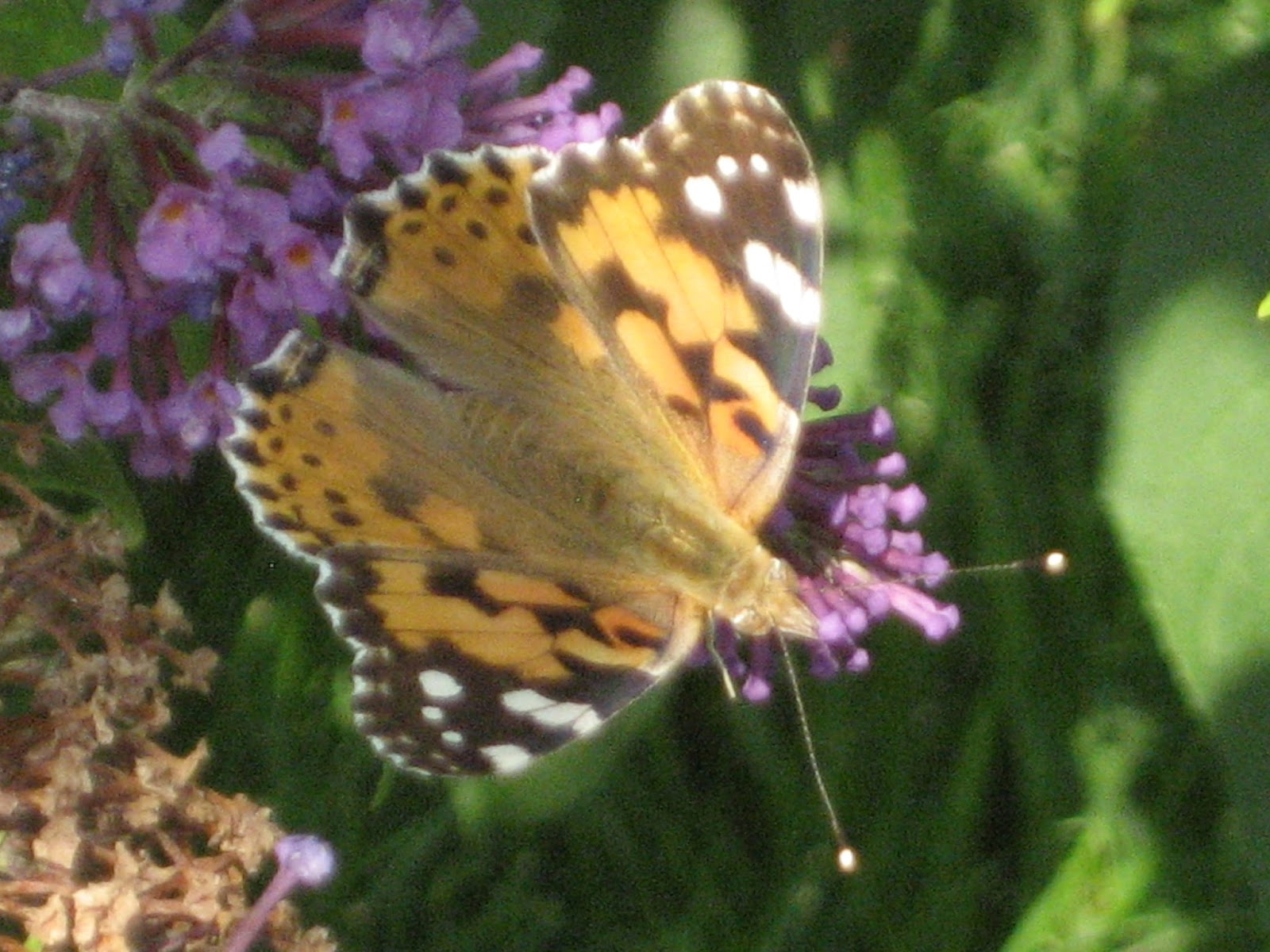
Painted Lady
The butterfly count has perked up a bit.  We've had quite a few peacocks and tortoiseshells, and a painted lady (but no red admirals that I've seen).  The bird tally has been reasonably good too.  One morning we had a couple of bullfinches at the last tatty remnants of the raspberries, and two warblers apparently picking up the flies.  And another morning saw a male yellowhammer, resplendently golden, tentatively staking out the patio.  The robin is still about and getting territorial, and there are still young blackbirds not fully in their adult plumage.  Judging from the sounds coming from the roof area, there are still baby sparrows to come.  They've had a bumper year.  And there are still house martins and swallows about (the swifts left in early August).


The late summer plants are only just starting - phlox, echinacea and the like.  Lilium henryi is just finishing.  In the veg plot the beans are starting to crop quite satisfactorily, and there are a lot of apples but very small ones.  The plums are coming to the end; this is easily the latest they have ever cropped!

Thursday, 22 August 2013

On the wing

The big explosion of butterflies predicted in the last post hasn't happened.  There are plenty of whites and a few peacocks; and today there was a tortoiseshell.  But no red admirals.  I hope we get some more butterflies.  On the other hand, there are plenty of wasps - most of them eating the plums (of which there are lots, fortunately).

I came home today to find flying ants on the patio.  The sparrows and the robin were delighted.  The birds have become less insistent on being fed in the mornings, and just today I was wondering whether it was time to ease back on the food; when I put out this morning's offerings there were no takers at all, although the food does all disappear over the course of the day.  But the ants were obviously a real treat, although a brief one; a couple of hours later they were gone.

A less welcome winged visitor appeared briefly in the small apple tree one day this week - a big female sparrowhawk.  Fortunately none of the other birds were around (they probably saw her coming).  She might have been responsible for the dead vole found round the back of the garage a few days ago; there again, it could very probably have been next door's cat.  There's probably a vole residence somewhere around there, as something small and furry scooted into the undergrowth when I was poking around there at the weekend.

Rose 'Golden Showers' - in its good phase
On the plant front, the Crocosmia is tailing off, the white-flowered plant whose name I can never remember (it's somewhere in a previous post) is just starting, and the autumn flowers (Sedum, Echinacea) are not quite there yet.  All I've been able to come up with for vases are a few sweet peas ('Royal Wedding', a two-tone violet blue, is doing nicely), some calendulas and rowan berries; and I couldn't resist cutting a couple of stems of the 'Moonlight' runner bean, which has pretty ivory and cream flowers.  I'm not surprised beans used to be grown as ornamentals.  There are also still some intermittent roses on the repeat-flowering plants, especially 'Golden Showers'.  It has done its usual thing this year: the first flush of flowers, and all the leaves, succumbing to black spot and looking dreadful, but then the plant recovers and produces a second flush with lovely clean foliage and more flowers.

   On the subject of foliage, building work has necessitated a lot of my pots being moved.  Some are grouped on the patio, and are making quite a statement just from their foliage: bronze sedge, variegated hosta, grey-leaved Anthemis and the purple Heuchera.  It sounds a horrible mix, and it's not a combination I would willingly go for, but it does show how much of an impact foliage can make.

Monday, 12 August 2013

Peasant gardening

Oh dear, just realised it has been nearly a month since I posted last.  The big heat lasted about three weeks in all, followed by mostly warm weather, mostly sunny with a few showery days and a couple of big downpours; some thunderstorms too (one of which damaged our broadband access, which is my excuse for not having updated this).  There have been cool winds at times which have kept us eating mostly indoors, but we've been taking our chances when we can.

The garden is currently in its quiet mode, with the midsummer flowers gone and the late summer ones still not yet there.  The Crocosmia 'Lucifer' is out in all its glory, as is its companion Lilium henryi, and the Francoa is in bloom, but otherwise things are a bit quiet.  The next event will be the Buddleia, which is just coming into flower.  I have succumbed to a few impulse plant buys recently but not yet done anything with them; and I'm afraid I just haven't got round to summer displays in the pots this year, partly because the tulips were so late in dying back.  There's only the windowbox with its usual display of Mesembryanthemums, which have done miserably this year (too dry?? - but the reason I plant them is that they're supposed to be drought-tolerant!).

My vegetable gardening this year is best described as peasant gardening.  The veg plot has been left rather unattended this year, so most of it is out of commission; there's a couple of rows of broad beans with some dill and coriander at their feet, a little wigwam of the runner/French bean cross 'Moonlight' (in very pretty flower but not yet fruiting) and a couple of French beans; two patches of potatoes (which won't have liked the dry weather), some garlic which is ready to be dug up, some leeks which were never thinned, and two winter squash plants, one coming on nicely and one still tiny.  Most of these have been tucked into whatever relatively weed-free corner I could find.  The courgettes (one huge plant and two still quite small) are cohabiting with the sweet peas and pinks in the old herb garden. It's all rather haphazard - rather like those little plots you see in Italy where someone has put in a row of beans, a couple of tomato plants and a few cabbages in whatever bit of ground they can find.  Next year it will be better .... (as I always say ...).

I managed to salvage a couple of colander-fuls of gooseberries and a few raspberries, even though a fledging blackbird tried to defend the latter from me; he really didn't want to leave them when I approached.  The plum crop looks like being good this year, but the apples will be small.
A nice sit down


The birds seem to have thrived this year.  The robins and blackbirds are now moulting but the sparrows are still feeding young and even mating.  There are plenty of young starlings about, too.  Some of the woodpigeons have become quite trusting, even bathing in the patio birdbaths (which are really much too small for a woodpigeon); we came home one day and found two of them just having a nice sit down on the lawn quite near to the house.

The lavender, which is now just going over, has attracted large numbers of bees
Small Whites on the lavender
(particularly honey bees or something very like them) and, in the last couple of weeks, white butterflies (mostly small whites but the occasional large white too).  There have been one or two peacocks and one day we had a comma, but the big explosion of butterflies is still to come - should be in the next few days as the Buddleia gets going. 

Tuesday, 16 July 2013

Hotswolds

After such a run of dismal summers - since 2007 - we'd almost forgotten what summer weather was like.  It continues to be hot and dry, meals are still outdoor events and the watering can is in regular use.  There were a few thundery-looking clouds on Sunday afternoon but the sky then cleared again.  I've been weeding in the shade when possible and generally trying to keep everything alive.

Peony 'Sarah Bernhardt'
The roses are in full flood, and in the long grass yesterday I spotted three blooms on peony 'Sarah Bernhardt', which I had omitted to stake (and feed).  Poor Sarah has a hard life; I must do better for her next year.  The best of the blooms is now in a vase indoors: a huge pink, scented powderpuff and really impressive.  The Polemonium is seeding nicely in among all the grass and self-sown geraniums; that's another plant in need of rescuing next year.

On the edibles front, the broad beans are just coming to picking size, the gooseberries are nearly ripe and there are two big trusses of blackcurrants which I've protected as best I can - but not quite well enough, as the thrush demonstrated to me yesterday by slipping inside the mesh and plucking one to feed to its little one.  Baby thrush is very demanding and very vocal, so I couldn't be too angry.

There are still young blackbirds being fed too, and at least two dunnocks, not to mention all the sparrows.  A week ago we had a huge flock of young starlings fly into the holly tree, and another day there was an even huger flock of crows passed over.  The swifts continue to feed around here; two of them were coming very low round the house the other day.