Thursday, 7 June 2018

Hello, old friends

I'm always taken by surprise when a plant that I had forgotten about, or forgotten how much I liked it, comes into flower.  This has happened quite a lot recently, probably because for the past two years we've been away on holiday at this time of year and missed much of what was happening in the garden.  Here are some of my old friends that have pleased me recently:

Tulip 'Menton'
Tulip 'Menton' is an old new friend; planted a couple of years ago but then not seen because of the holidays.  A few are still surviving down in the bottom border, and very attractive they are too - pleasing colour and elegant shape.  And alongside them are the alliums - A. hollandicum 'Purple Sensation' mostly - which I've missed for the same reason.  They make a really good show.  There are also some foxgloves in that patch; I had been hoping for white flowers but only one white is there.  It's a useful reminder of the good design principle of mixing shapes (globe alliums, tall foxgloves, rounded brunnera) to good effect - though I have to admit it's entirely accidental.  (Note to self: a bit too much purple and pink down there at the moment; it needs something else, preferably bright or light to be seen from the other end of the garden.)

The wisteria has flowered really well this year; at its peak the scent was wonderful.

Wisteria

The poached egg plant (Limnanthes douglasii) has seeded into a very striking patch by the drive:

Limnanthes douglasii
Two of my favourite plants, partly because they have good foliage: Geranium renardii, with sage-green corrugated leaves and white flowers with purple flecks, and Allium karataviense 'Ivory Queen', with lovely broad glaucous leaves and white pom-pom flowers:
Geranium renardii
Allium karataviense 'Ivory Queen'


The roses are also starting to come out.  Of the earlies, I always forget about R. altaica, with its lovely creamy-white flowers, because it can't be seen from the house, and the same is true of nearby Solomon's Seal, which was planted alongside a path that got overgrown long ago and now no longer exists.  I must rescue it from under there!
Rosa altaica
Solomon's Seal (Polygonatum)

Nectaroscordum siculum (I think this may be subsp. bulgaricum) is also coming into bloom:


Nectaroscordum siculum
And of course the poppies (Papaver 'Allegro') are always striking, with their flamenco flounces:

Papaver 'Allegro'
But plain green can be attractive too!  Here is Hosta 'Krossa Regal' on the patio - lovely corrugated leaves.
Hosta 'Krossa Regal'
There have been a couple of new friends too - although I think one may be very temporary.  Many years ago I planted some Tulipa saxatilis; they produced lots of leaves but no flowers, and eventually they were shaded out by nearby shrubs.  I tried moving some of them to a less shady place, with the same result.  Recently I've thought about digging them out, but their current location is low down the priority list at the moment and in fact is serving as a bit of a dump for odd bricks.  So I was surprised the other week to see one single flower, at last:
Tulipa saxatilis among the bricks
- but I'm still going to dig them out at some point.  They've had nearly 20 years to make a show!

The other new friend is again, I suspect, a plant I've missed out on by being on holiday.  It's Iris sibirica - a lovely soft blue with yellow filigree markings and white edging, doing really well down by the summerhouse.  I fight shy of irises, never being able to remember which need moisture and which like it dry, and not having many dry and sunny places for them - but this one is a winner.
Iris sibirica

Recent cut flowers from the garden have been aquilegias - I now have a good mix of plains (pinks, blues, purples, one white) and bi-colours - with sweet rocket (Hesperis matronalis); and another vase of the sweet rocket with blue veronica, Astrantia 'Hadspen Blood', Cornflower 'Black Boy' and Erysimum 'Bowles' Mauve'.

Veronica and friends

Mostly aquilegias


Sunday, 3 June 2018

Birds meet glass

Living in the country brings all sorts of wildlife encounters, but last week's was one of the oddest yet.  It was a warm evening, and we left the back door open while we went out to the summerhouse for ten minutes or so.  The back hallway opens straight into the dining room, and on the dining room windowsill is a clear glass bowl, about the size and shape of a small goldfish bowl.  It's purely decorative and contains nothing but a scrap of pink ribbon that was dropped in there and forgotten about.  But when we came back inside from the summerhouse it contained - a swallow.  It was alive, and apparently unhurt, but having presumably flown into the bowl it was unable to turn around and get out through the relatively narrow neck.  Being upside down in a glass bowl clearly wasn't part of its plans for the evening, so we took the bowl outside and tipped it out; it flew off, greatly relieved I imagine, but we had a brief opportunity to see its lovely colouring and markings (I never realised that they have white dots around the tail).  We suppose that it flew indoors in search of a nest site, but goodness knows why it flew into the bowl; did it think the ribbon was a tasty butterfly?

Two other birds encountered glass in the past couple of weeks.  Two woodpeckers (great-spots) had a fight and chase across the garden, and one of them slammed into one of the summerhouse windows (it probably thought it could fly straight through and out one of the other windows).  It lay in the long grass at the side and I feared the worst, but after a while it sat up and eventually took itself off, presumably with a big headache.  (What is it with woodpeckers and our summerhouse windows?  The old summerhouse once claimed two woodpecker fatalities in as many weeks.)  Less fortunate was a dunnock, found dead with a broken neck under one of the side windows.  Interestingly these were all adult birds; usually it's the youngsters that make that mistake.

There are plenty of young birds now in the garden.  A family of three young blackbirds, all independent, have been around one side of the garden while a male has been feeding two younger ones at the other side.  The male is known as 'Tailless Dad'; he seems to have had a close encounter with (probably) one of the local cats but, despite losing his tail and some other feathers (these were left under one of the gooseberry bushes, so he was probably ambushed there) and occasionally favouring one leg, he seems to be functioning fine.  Robins are feeding little ones in deep cover and there have been a couple of little sparrows down on the patio; a family of goldfinches has also been in the hawthorn tree.  The status of the bluetits in the nestbox is still uncertain; the adults have been going in and out, but, as in the past, not frequently enough to suggest a viable nest.  Has our use of the summerhouse put them off?

They're not yet producing young, but the swallows, swifts and house martins are regularly feeding overhead.  And a red kite was hunting low over the garden one day.

Damselfly
Insect life is also taking off.  The big cotoneaster at the entrance to the drive has been humming with bees recently, as have the raspberry canes; the latter are attracting quite a variety of bees (I wish I was better at identifying them).  The warm weather brought out the damselflies over the pond, both the electric blue and the red ones; these are the best photos I could manage (you have to look closely!).  We've had a pair of red admiral butterflies and both large and small whites, as well as orangetips and some smaller ones that I couldn't see closely enough; and this evening there were two hawkmoths feeding on the sweet rocket (Hesperis matronalis).  They were moving too fast for me to identify them, but they were too small for hummingbird hawkmoths; perhaps elephant hawkmoths?  I did see one a few days ago and got a flash of pink as it went past, so it's possible.

So much wildlife, that the plantlife will have to wait for another post!

Friday, 11 May 2018

Full steam ahead

It's that time of year when everything in the garden suddenly starts to put on a spurt of growth (and gets out of hand as far as I'm concerned).  A couple of quite chilly days, and especially nights, was followed by a warm Bank Holiday weekend and, although it has cooled down to more normal temperatures with a stiff and chilly breeze at times, it is definitely feeling more springlike, with plants responding accordingly.  The first rose opened yesterday (Rosa pimpinellifolia 'Mary Queen of Scots' as usual), with the aquilegias well in bud, the first lily-of-the-valley flowers showing, and the other spring flowers all out.  The pink camellia has put on quite a good display, and the red one has finally produced one small flower after at least four years of doing nothing; in fairness I must say that the plant has been rather neglected and could really benefit from repotting and feeding, as the leaves are looking decidedly yellow.  I've bought it some sulphate of iron in the hope of perking it up a bit.


Narcissus 'Baby Moon'
Tulip 'World Friendship'
I was going to say that all the daffodils are over, but just yesterday I noticed that Narcissus 'Baby Moon', which I said last time had done nothing, has finally put out a couple of blooms.  It's quite pretty, though it needs more flowers to produce any impact.  All the small blue bulbs (muscari, scilla, puschkinia) are also past and deadheaded, as are the early tulips (the Emperors), but some of the later tulips are doing fine.  This year I have a pot of 'World Friendship', which I think I bought because it's reputed to do well in shade, and certainly it came into flower in a less than sunny spot, though it's now in a more prominent position; it's a nice clear soft yellow, a similar colour to 'Sweetheart' which I have in the front garden, but whereas 'Sweetheart' is a squarish flower with a broad base, 'World Friendship' is a more classic tapered tulip shape.  I would grow it again.  The pot of 'Creme Upstar' is also doing well, though I'm in two minds about this tulip.  I grew it a couple of years ago and wasn't completely convinced, but I was seduced again by the photo in the catalogue and gave it another chance.  It's a smallish, bowl-shaped tulip with a slightly loose structure; it opens cream and pale yellow, morphs into a pale-ish 'rhubarb and custard' colour pairing and finally turns pink and white, so it's not the easiest flower to integrate into a colour scheme.  Although at times I think it's pretty, I don't much care for the rhubarb and custard stage, and the final colouring is not unlike 'Angelique' which I prefer, so I think I'll drop it from my list of 'likes' (at least until the next time I'm seduced by the photo).
Creme Upstar - just opening

Creme Upstar - pale rhubarb and custard

Creme Upstar - definitely pink!

Pink epimedium
It's all too easy to overlook some of the plants that are out of sight most of the time, so I've taken the opportunity to remind myself of the 'other' epimedium (afraid I can't remember the name - it has dark pink flowers) and the smilacina nearby, which has lovely foliage (here with the flower buds just showing).

Smilacina

The first young birds in the garden are usually either sparrows or blackbirds, but this year it's two young mistle thrushes and one little bluetit - both still with their parents but quite confidently feeding themselves.  I wonder what has happened to the other bluetits?  They usually have quite a large brood.  The ones in the nestbox don't seem to have been around much; I hope our using the summerhouse over the warm weekend hasn't put them off.  There has been at least one male orange-tip butterfly about, and a very small blue butterfly that I couldn't get close enough to to identify; it was very active around the holly tree one day, so I'm thinking it was probably a holly blue, which is common round here.  Sounds logical, doesn't it?!

Tuesday, 24 April 2018

Exotic Orange Emperor

... and Tulip 'Orange Emperor' (supposedly)!
Tulip 'Exotic Emperor' ....
The first tulips are out, and straight away we have this year's mislabelled variety.  I was surprised to see that I had two pots of the white 'Exotic Emperor', as I was sure I had only planted one - and there was no sign of any 'Orange Emperor'.  Then three slightly later stems in one of the pots opened - pure orange.  Sure enough, that pot has a label saying 'Orange Emperor', so most of the bulbs in that pack were the wrong variety.  (It's the second year running that I've had 'wrong variety' bulbs from Sarah Raven's bulb supplier.)  It's not a big problem as I like both varieties, and at least there's no colour clash; in fact the pairing would make a good counterpoint to a daffodil such as 'Geranium' which has very similar colours and flowers at the same time.  (I planted more of those, too, in one of the pots but they haven't done anything, and neither have 'Avalanche' or 'Silver Chimes', all from Crocus; planted too late? winter too cold? or just poor-quality bulbs?  Perhaps a pot isn't the best place for the bigger narcissus.  The 'Tete-a-tete' and 'Elka' have done fine in pots, though 'Baby Moon', from another supplier, didn't show.)  A few of previous years' tulips, planted out elsewhere in the garden, have flowered - a few 'Couleur Cardinal' and 'Prinses Irene', which have been useful for cutting - but those left in one or two of the pots are either blind or have been frosted in the cold weather, coming up with very damaged leaves and little else.  At least I will have no compunction about digging them out and re-using those pots for summer bedding.

Bad Gardening Practice
The pot currently occupied by Scilla siberica 'Spring Beauty' (and the stunted leaves of  'Avalanche') had, until last autumn, contained one of the anthemis and a few too-old bulbs, and too many weeds.  The anthemis was in need of renovation, and I have its sister plant elsewhere in the garden anyway, so I unceremoniously heaved the whole lot out in one big rootball and dumped it - and never got round to moving it (this is Bad Gardening Practice).  Despite them being exposed to the worst that the Beast from the East threw at them, with not even a pot for protection, the anthemis is still ok and a couple of the tulips are in bud!  I now feel bad about having mistreated them; maybe I should mount a salvage operation.

On the subject of plant labelling, I've found a few good strong young plants growing under the ash tree by the drive (without labels).  They look like something I would have put there last year, and probably as small plants rather than seeds.  I can't think what they are; the leaves looked initially rather like very young hellebore leaves but I wouldn't have put hellebores there.  I will leave them and find out in due course!  (More Bad Gardening Practice.)

After the Novemberish weather of a couple of weeks ago, we moved swiftly into July - decidedly warm sunshine for a few days.  That ended with a terrific thunderstorm on Saturday evening; we were having supper in the summerhouse (making the most of the good weather) and sat it out, with a good bottle of wine, enjoying the lightshow and congratulating ourselves on having mowed the lawn earlier.  The weather has now reverted to normal - a chilly wind yesterday and rain today (and for much of this week according to the forecast).  The greenhouse bubblewrap has been taken down; it's nice to have the view back!


Crossbred primula
Anemone blanda
The combination of heat and rain has really spurred on growth.  The blackthorn is in flower in the hedgerows, and in the garden the plum is in bloom and other plants are springing into life.  The epimediums, brunnera, bergenia and comfrey are blossoming, there are the first Anemone blanda in the bottom bed, and the aquilegias are throwing up flower stems.  The cowslip (and other cross-bred primulas) patch in the lawn is in full bloom; and the two primroses outside the gate have produced a third plant with slightly pinkish flowers (it looks a bit as though it has gone through the washing machine too many times).  (The leaves in the photo belong to the shining cranesbill, a local wildflower that I've been encouraging.)

In the veg patch, the shallots have taken well, thanks in part to the fleece covering (now removed) that kept the birds off; the broad beans are germinating and the potatoes have gone in, a little belatedly.  There's an excellent crop of rhubarb.

The wildlife is also responding well to the better weather.  A male brimstone butterfly has been about again, and a small brownish butterfly passed through (too far away to identify) one day.  The birds are busy building nests and defending territories; song thrushes have been singing in the evenings, and the usual birds have been joined by a pair of chaffinches and one of coal tits, several goldfinches and a greenfinch.  A pair of dunnocks seem to be in the bottom hedge whenever I go down there, and the blue tits are still using the nestbox; and a group of house martins and a swallow have been feeding overhead, so summer can't be too far away!


Thursday, 12 April 2018

Not gardening weather

It has not been gardening weather, not very much anyway.  We didn't get the threatened snow, and the cold snap was actually quite short, but the temperatures haven't risen much and it has been rather wet, and this week has, frankly, been more like November than April - cloud down to ground level, chill and no sun.  Apart from a little seed-sowing, indoors and out, some work digging out and re-siting crocosmia corms (that is some tough plant - still a lot of it left) and a little weeding, garden activities have been limited to opening and closing the cold frame and hardening off some of the plants in the greenhouse.  It's about time that they had a sense of the hard world outside.  There's actually nothing in the cold frame that needs shelter now; much of what is in there only wanted protection from slugs and other nasties, and even the sweet peas can put up with the current temperatures (although they will benefit from something a little warmer).  We are promised rising temperatures next week, and about time too.

Despite that, there continue to be signs that spring is on its way.  The pyramidal orchids are showing leaves in the lawn and, like the early spotteds mentioned last time, have been marked off to protect them from mowing (not that we've started that yet - too damp).  Most of the big daffodils are out, even the ones I planted surreptitiously in the verge across the road, and there are buds on some of the early tulips.  The cold weather last month has affected some of the pot plantings, with quite a lot of scorched leaves.  The fern in the pot with Carex 'Evergold' is looking particularly brown; I expect it will regrow, but at the moment it is not a happy bunny.  The tub with the little species tulips (which I had dug up from the bottom of the garden where I'm clearing the weeds) has been raided by the mouse, judging by the size of the holes in the compost and the chewed remains of bulbs alongside, and lots of netting has been placed on top; fortunately I see that I failed to dig all of them out from their original position, so all is not lost.  The new puschkinia bulbs, planted last autumn in small pots on the patio, are doing nicely; a very pretty pale blue that goes well with little daffodil 'Elka'.  Scilla siberica 'Spring Beauty', a very dark blue, is also nice but not all the bulbs seem to have come up (perhaps, despite its Siberian origins, the cold weather was too much for it?).
Scilla siberica 'Spring Beauty'
Puschkinia libanotica

Narcissus 'Elka'

A pair of blue tits have been flying in and out of the nestbox, presumably fitting it out to their taste.  There should be plenty of food for their youngsters by the time they hatch, as there has already been a noticeable increase in insect life in the garden, particularly on the few sunny days that we've had.  I'm glad the tits don't seem to have been put off by the protective wire netting loosely positioned around the nestbox (with tit-sized holes left open) to keep the woodpecker off.  Woodie has made a couple of visits to the fatballs, but never for long.  The long-tailed tits continue to come regularly, usually as a pair, a few times with some of their relatives, and one day during the cold weather they brought all their friends - there were 10 of them.  There are also quite a lot of hedgehoggy-looking droppings on the lawn - spring is slowly coming to the garden!

Tuesday, 27 March 2018

Jostling for attention

We're not safe from cold weather yet - there is still the risk of a little snow in the coming days - but spring is definitely on its way, and with it the need to get on with all the jobs that are jostling for my attention.  The pond, which was getting clogged with weed, has been cleared up a bit; I've decided to leave a full overhaul until the autumn, to minimise disruption to the wildlife (as it was, I fished out, and returned to the water, several newts, including babies).  One major job that's now out of the way is pruning the buddleja.  It's a very mature shrub, and the operation always produces lots of prunings; I like to make as much use of these as possible, and dealing with them takes a couple of days.  Strong, long, straight stems are used to make beanpoles and stakes.  Branching tops are put aside for use as supports for peas and other small plants that need propping up.  Fragile, twiggy bits are used to make a path through the fruit bushes; these are conveniently alongside the buddleja, which makes things a bit easier, but I have to start by clearing up the twiggy remains of the previous year's path.  The cleared area gets a layer of old cardboard (flattened-out old boxes etc) - this rots into the ground over the year - and on top of this I throw down the twigs and walk on them to crush them.  It's a rough-and-ready sort of path but it works well enough.  The soft prunings - the leaves, old flowerheads and some of the very smallest twigs - go in the compost bin, and to accommodate them I always need to clear out the bin whose contents have been rotting away over the winter and re-fill it with material from the other bin, mixed with the prunings.  Reflecting, as I did so, on how I was going to use the rotted compost, I remembered that it's nearly time to prepare a trench for the runner beans, so a bagful was used to get that job done too - and that required digging out some couch grass that was colonising that bed.  And, looking up from the bean trench, I noticed that another stone has fallen out of the top of the wall behind the apple cordons; I had been planning to do some repair work there this winter, and it would be useful to get it done before the apples start producing shoots and before the lily-of-the-valley, which also lies in front of the wall, appears.  I might tackle that over the Easter weekend, weather permitting, as well as lifting, splitting and teasing the weeds out of the crocosmia.  And that's only a few of the jobs that are shouting "me, me" whenever I look out at the garden.

Meanwhile there are even more jobs needing doing in the greenhouse.  Normally by this time of the year I've started a lot of my seeds off, but so far only the tomatoes, aubergines, peppers and chillies are sown (on a windowsill indoors, and doing well so far; and a pot of basil seeds has just joined them).  The dahlias have now been potted up, or at least those that have survived the winter in good enough condition to grow on; in addition to 'Bishop of Auckland' and 'Ambition' (quite a few tubers of these now),  and 'Sam Hopkins' purchased last year, I now have tubers of the fashionable 'Cafe au Lait' (bought from the supermarket, a snip at 4 for £7).  Greenhouse planting should now be a little safer; I think I have identified, and blocked up, the mouse's entry point.  There's a very small gap between the greenhouse frame and the wall against which it stands (it's a lean-to), which I had blocked with scraps of bubblewrap (I was thinking of draughts, not rodents); the bubblewrap filling has disappeared.  I've replaced it with some more substantial bits of plastic (old yoghurt pot lids) which are not so removeable.  Sorry, mouse.

Some of the plants in the greenhouse, especially those such as the penstemons and osteospermums that were brought hastily in to protect them from the Beast, are now being stood outside during the day, and the cold frame propped open; it will soon be time to wean plants off the relative warmth of indoors and make space for the new seedlings.  The temperature in the greenhouse has dropped to low single figures several times this winter, but it can't be too bad in there as there are buds on some of the fuchsias and flowers on one of the osteospermums.  It's only the forecast of frosts in the next few days that is stopping me from taking the bubblewrap down; I tend to leave it up too long, and of course it reduces the light levels in there.

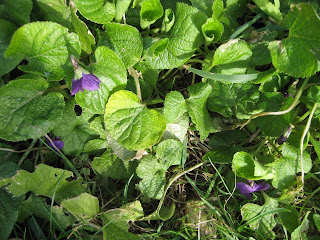
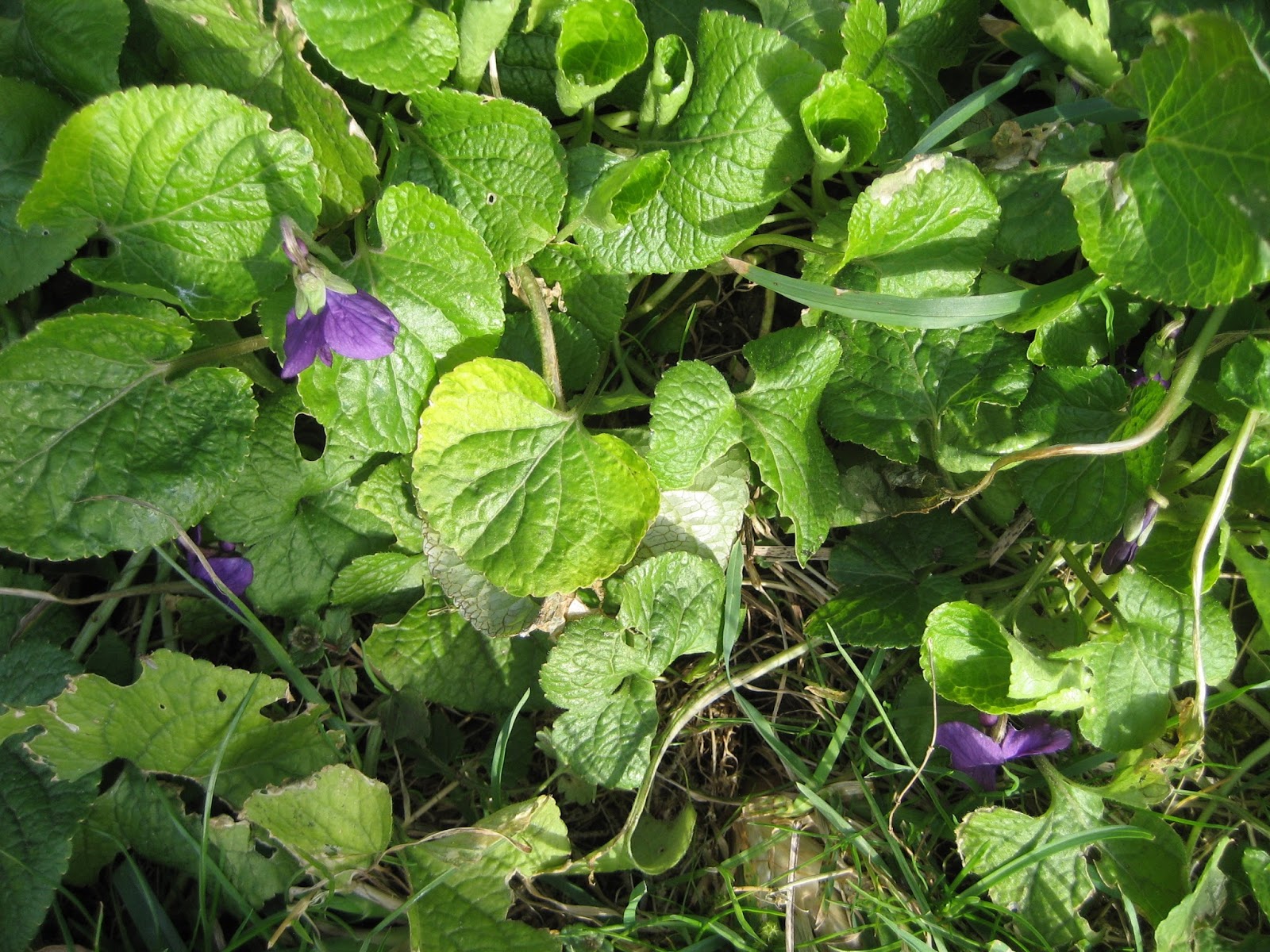
Colour is very slowly returning to the garden.  The big daffs are starting to bloom; the lesser celandines in sunny spots are coming out (they are actually weeds but acceptable ones); and a few slightly battered violets are showing among their leaves.  Two of the orchids in the lawn have also put their leaves up, so they have been protected from trampling and, eventually, mowing.  The hellebores look quite good; the one by the hedge has produced a self-sown offspring with white freckled flowers, so I may try to move that to a better place.
Lesser celandines - any colour is welcome at this time of year!

Big daffs starting to come out under the plum tree

A few sweet violets


Having said last week that I hadn't seen any signs of nesting, the very next day there was a sparrow gathering grass, and a day or two later a hen blackbird had a beakful of moss and a crow flew over carrying a stick.  The sparrows are jack-in-the-box-ing in and out of the hedge, pigeons are canoodling in the plum tree, dunnocks frisking at each other and chaffinches chasing off rivals.  The insect world is livening up too: a small ginger bee and a bumblebee have been about (the latter enjoying the crocuses), and the first butterfly of the year - a male brimstone, as usual - appeared at the weekend.

On the down side, one of our male pheasants has been killed - two wings and a bit of connecting bone were left on the lawn yesterday.  It looked like a sparrowhawk job.  I don't think it was my friendly pheasant, as one answering his description is still around, and seeing off rivals.  I wonder if his fondness for standing under the shrubs is partly that he's protected there from aerial assault?

Tuesday, 20 March 2018

MiniBeast

And, after the Beast from the East, we've had the MiniBeast: the same thing again but not so severe.  The weather started to warm up encouragingly in the post-Beast thaw, although even the more comfortable temperatures and rainfall took a week or so to get rid of all the snow.  Then last weekend the wind turned back to the east and brought more wind, low temperatures and snow; again, the actual volume of snow wasn't all that great but it formed small drifts in places, and froze to give us icy roads for a couple of days.  Conveniently for those who had to get out and about and into work, it was again the weekend that was the worst.  Three days on, the roads are clear again, although there are still significant patches of snow where drifts built up against hedges and walls, and in places out of the sun.

Still snow on the lawn

The wildlife seems to take it all pretty much in its stride, especially these past few days where the cold snap has been fairly brief.  As soon as the temperatures start to rise the birds seem to perk up, start singing again and get on with life; I haven't seen any actual signs of nesting yet, though a few birds have toyed briefly with bits of grass, as though they were aware that they would soon be wanting this stuff.  The sparrows are popping in and out of the leylandii hedge, so I would guess that they're choosing suitable nest sites in there; it's a real sparrow condominium.  I've put some wire netting loosely round the nestbox, enough to allow access by nuthatches or bluetits but not (I hope) the woodpecker.  A peek inside showed that something has been in there (there were droppings in the bottom), probably as a winter roost - but it will soon be a des res for a nesting pair.

One of the male pheasants has been about quite a lot.  He likes to stand in shelter among the shrubs, and is happy to wander about near me when I'm working in the garden.  In the snow yesterday he scraped out a spot in the lee of a euonymus so that he could stand out of the wind but warm up in the sun.
Spot the pheasant, hiding ...

Crocus chrysanthus 'Cream Beauty'
The plants bounced back from the first lot of snow and will do so again this time.  The little 'Tete-a-tete' daffodils in pots started to bloom after the Beast, and they, the crocuses and the hellebores seem to have survived the latest freeze.  The big daffs are still only in bud, and they will have been knocked back by the weather; but colour is starting to come back slowly to the garden.  I managed a small posy of pulmonaria and viburnum, the only flowers suitable for cutting at the moment.  A vase of supermarket tulips is going over, but I find that tulips mostly age well; even when they are faded like old tissue paper and on the point of falling apart, they still have interesting colour and shape.

Helleborus x hybridus
Crocus tommasinianus 'Whitewell Purple'
Narcissus 'Tete-a-tete'

Pulmonaria and viburnum
Tulips - fading but still decorative


Between the freezes I managed to get a few garden jobs done.  A sunny day was spent pruning the apple tree, with the pheasant poking around below and a buzzard circling overhead (and helicopters going to and from Cheltenham races passing by).  The autumn-sown broad beans had had a high failure rate, so the empty spaces were filled with sowings of 'Imperial Longpod' and I added a double row of the same alongside; and the shallots were planted, with some fleece on top to allow them to get roots down before the birds can get at them.  The garlic is coming up nicely, including one of the elephant garlic bulbs which has finally put up a shoot (something had nibbled the top of this, so an old inverted hanging basket has been put on top to protect it).  The leeks don't seem to have done well, though; quite a few have disappeared.  Other jobs included cutting the old leaves off the epimediums to allow the flowers to show, removing spent flower stems on the sedums, Lilium henryi and the Big Yellow Thing (bupthalmum is its proper name, but BYT is easier) and some belated tidying of rose bushes.  Outstanding jobs include pruning the buddleja, which was looking a bit sad after the first lot of freezing so I thought it best to leave it for the moment; and potting up dahlias and other things in the greenhouse; the forecast is for temperatures to remain a little below normal, but I'm hoping that the greenhouse will be warm enough to get them going.