Thursday, 23 August 2018

August - summer or autumn?

Cyclamen hederifolium
I've always tended to think of August as summer; but in recent years I've been more aware of its being summer on the slide.  (This has more to do with my perception than any change in the climate.)  It's the time of year when temperatures often start to drop a little, green leaves start to lose their greenness and early morning dews show up spiders' webs.  I haven't seen any of the latter yet, but the weather has turned much fresher and showery, and it can only be a matter of days until the webs show up.  At least the rain has got everything growing again; the lawn is amazingly green after all the heat we've had.  Two sure signs of autumn coming on - blackberries fruiting in the rough area behind the fruit patch, and the Cyclamen hederifolium starting to flower.

Blackberries
Another sign of autumn coming on is that the birds are starting to be less demanding about food.  There is still the one little sparrow fledgling being fed, and a couple of young pigeons were on the lawn the other day, but crumbs put out on the patio are taking longer to disappear in the mornings.  There are still plenty of birds about, particularly tits, dunnocks and sparrows, and some robins and finches; the neighbours have planted a lot of Verbena bonariensis, which has been attracting bullfinches (a bit of a colour clash) who then come to us for a drink.  We've also had a young green woodpecker poking around the lawn; we seem to see one most years, usually only for a few days.

Dahlia 'Cafe au lait'
The dahlias are finally starting to flower: the 'Sam Hopkins' is very fine, but the showstopper is 'Cafe au Lait' which has produced a flower a good 6in across (that's 15cm for my metric readers).  Unfortunately it's a bit pockmarked with holes, so won't be putting in an appearance at the Garden Society Show.  There are also a few asters starting to bloom, and also the phygelius, which has responded well to being repotted (as has a sucker removed from it and potted separately).  It doesn't look as though any of the hedychiums are going to oblige this year; perhaps I should have left them in the greenhouse, although it has been warm enough for them outside.  A surprise bloomer is also in a patio pot; in spring I found a few corms in the greenhouse, removed from a pot last year, and planted them into a small pot with a label saying 'crocuses'.  Once they started pushing up leaves it became obvious that, whatever they were, it wasn't crocuses, and they were in too small a pot; potted on into something of a more suitable size, they grew on well and turned into Gladiolus nanus 'Nymph', and very attractive too.
Dahlia 'Sam Hopkins'
Not crocus! ...
... but Gladiolus nanus 'Nymph'

Bean 'Moonlight'
On the edibles side, the runner/French bean cross 'Moonlight' is producing well, as are the courgettes and tomatoes.  My six aubergine plants have one fruit each and are showing little interest in producing any more; I should really have potted them on into bigger pots.  The red peppers are also tiny; my fault for allowing the first sowing to dry out and sowing the second lot late, and not potting them on.  Note for next year!

I'm particularly pleased that my little fig plant has produced a tiny fruit; if it overwinters successfully, we might have our first fig next year!

A figlet (look closely ....)

Sunday, 12 August 2018

Pros and cons of drought

After the rain mentioned in the last post, we had a further 12 dry days - mostly warm, with some cool nights, but nothing like as hot as it had been.  This weekend we've had more serious rain, today especially.  It's amazing how quickly the lawn has turned back to green, at least where the grass is growing; the moss is remaining a barren greyish-brown.  While the grass wasn't growing, it was relatively easy to see the runners of the creeping buttercup and the nasty little creeping potentilla that has world-domination ambitions, and to pull those up; even if the plants are still there, at least they won't be increasing as much as they usually do.  I also rather randomly pulled up some of the self-heal that grows in the lawn - but really I have more productive things to do than try to hand-weed a lawn.

Recent jobs have included pruning the cordons and the wisteria, and picking plums (more of them, and of better quality, than we had expected).  But mostly it has been weeding, as usual.  The recent rain loosened the soil a little, making it much easier to fork the weeds out and pick over the soil to remove root fragments (a necessity where couch grass and vetch have been growing).  The clearing of the area along the terrace edge is progressing inch by inch; the remaining seedling dahlia plants have gone in there, a case of better late than never - if nothing else, it saves me trying to keep their pots watered. 

Dahlia 'Ambition' with Panicum
A couple of the ailing plants that seemed to have responded well to being repotted have in fact died; not only my Euonymus microphylla but also the Alchemilla alpina and one of my veronicas.  The other veronica is surviving with its roots down through its pot into the gravel, so I will have to be careful when I get round to digging it up.  On the other hand my little sage cuttings have started to romp away.  I'm also pleased with Cosmos 'Xanthos' and Panicum 'Frosted Explosion', both of which I grew from seed, the former as a pot filler (lovely soft yellow) and the latter for cutting; the Panicum has been filling out vases of dahlia blooms among other things.

It would be nice if some of the weeds would succumb to the drought, although I'm not holding my breath.  One weed that does look as though it's going to succumb, though not to drought, is a largish ash sapling that seeded into the big berberis by the drive.  I've been wondering how to get it out for some time, but this year I've noticed that the branch tips are bare - a sign of ash dieback.  It's on the way out.  Sadly so is the big ash in the field at the bottom of the garden; it is definitely showing similar signs.

It's not only the plums that have done well this year; there's a good crop of blackberries in the hedge across the road, which I'm raiding daily.  They're very early this year.  The shallots have done well, and the garlic fairly well (but small); the leek seedlings are also much fatter than usual.  These were all in the same bed, and although I watered them very occasionally I can't say that they have been pampered, so I'm very pleased with them.  The courgettes continue to fruit nicely.  But the other veg have been disappointing; few beans, unless the runners get going soon, and potatoes are small.  I really need to beef up the soil in the veg garden this autumn; it's very thin and hungry.

It isn't a good year for butterflies, however.  I've been counting for the Big Butterfly Count, and the results have been disappointing.  There are good numbers of whites - and I've seen at least two green-veined whites - and a few gatekeepers and meadow browns, and the occasional common blue; but only one each of red admiral, peacock, comma, small tortoiseshell and painted lady, which is sad.  I did see a small copper a few weeks ago, and a hummingbird hawkmoth has also been on the buddleja, but the total numbers have been poor.

Sunday, 29 July 2018

The power of life and death

Dried-up pond
Summer has continued to be still mostly hot, still mostly dry (a couple of light showers apart), until yesterday.  We had 27C in the shade the other day, the greenhouse topped 35C, and other parts of the country have had temperatures in the 30s; none as hot as temperatures recorded in recent years, but a much longer spell of sun, heat and dry than we've had for a very long time.  The pond pretty much dried up - I really ought to take advantage of this and clear it out, but that means standing in the sun for longer than I want to (that's my excuse anyway).  Then yesterday evening the rain started, with strong wind, and gave the garden a much-needed soaking; the pond is starting to fill up again.  Today has been cooler and fresher, but the forecast is for warmer temperatures again later in the week.

The weather has made me bite another problem bullet, however: the number of plants sitting around in pots waiting for a home.  Some of these have been around for an embarrassingly long time, in very old compost, and the dry weather has not been good to them, nor to those eking out an existence in too-small pots.  A number of these have been hanging around in the area behind the garage, rather out of sight and out of mind; I don't venture round there as often as I should, so I tend not to notice their signs of distress.  Some had succumbed, and others weren't in a good state; the need to keep watering the survivors finally forced me to make some life and death decisions.  The dead ones were easy (straight to the compost bin).  Some others weren't really needed; a good few had been cuttings taken as insurance against losing a favourite plant but no longer required, or things potted up for the Plant Sale and not sold, and the sickly ones also went to the compost.  Some of those behind the garage have put their roots down into the gravel and are surviving (just, in some cases) on that, so they have been left for the moment.  Of the remainder, those that I decided to keep have been repotted, in some cases grouped into big pots where I hope the volume of compost will give them enough moisture to keep them going.  I've also made a resolution to pay more attention to the area behind the garage; I will try to remember to include that area in my walks round the garden, so that I spot signs of distress in time!  As it is, I think I've lost my Euonymus microphylla, which is looking very brown, even after repotting - a timely lesson.
Mixed mini-evergreens in a big pot ...

... and the tiny survivors went into these two pots
Carnations, Sweet William and parsley flowers
Yellow sedum
There is not a lot of colour in the garden at the moment.  The achillea (I think it's the classic 'Gold Plate') is looking good, as is Lilium henryi, there's plenty of oregano and the buddleja is just starting to flower, but Crocosmia 'Lucifer' is fading almost as soon as the flowers open, the Big Yellow Thing is going over and the sweet william are finished.  There are some carnations, which are looking better now that I've deadheaded them, and a sedum (don't know the variety) with yellow flowers that isn't bothered by the lack of water.  The phlox hasn't flowered yet, and there has only been one dahlia flower ('Ambition') so far; they were potted on rather late.  Indoor vases of sweet william and the carnations were boosted by parsley flowers, of which I have plenty; I always leave them to flower and seed as they're great for filling out arrangements.

The lack of colour is largely my fault for not having planted many late summer flowerers.  Every year I note the need to put in some late colour, but by this time of the year the weeds are always taking over and there's never anywhere 'clean' to put them.  This year I do have a potential spot, in front of the new terrace where I'm gradually digging out the weeds; last week I finally managed to remove a stubborn clump of Alchemilla mollis mixed with the blue Centaurea montana (plus couch grass, vetch and other nasties, all tangled up together), which has opened up a few more possibilities.  The soil has really been too dry for much planting, though, and anyway I always prefer to plant a new bed with annuals and other ephemeral planting for its first year, to allow perennial weeds to show before anything more permanent goes in.  I do have a wish-list of summer flowerers to populate it with in due course!

Courgettes (and a lettuce) on The Hill
I've been diligently saving as much 'grey' water from the kitchen as I can, and now that the raspberries are over (a great crop this year) it has been going under the apple cordons, which I think aren't going to produce very large apples.  Some of the 'Discovery' fruit are already turning red - far too early! and whether it's ripeness or sunburn I couldn't say.  A little water has gone on the leek seedlings (the shallots and garlic are now lifted) and on the courgettes on 'The Hill' which are starting to fruit, but interestingly the latter have stood up to the drought remarkably well, perhaps because they're in part shade.  The Hill itself is drying out underneath, with big cracks appearing in the sides, so I should be able to pour some of the spare soil in there to fill out the gaps.  The plums are ripening fast, and today's gales have brought quite a few down; it's a small crop but the fruit are a good size.  I have been watering the tomatoes, aubergines, peppers and chillies in the greenhouse; there are some nice little aubergines coming along, and the first tomatoes have been harvested.  Although the greenhouse has been hot, the watering has kept the soil under my diy growbags nicely moist, and I wasn't surprised to find a frog sheltering in there one warm day.

Tomatoes ('Harzfeuer')
Aubergine ('Ophelia')
I've been more diligent with the greenhouse crops this year, and it seems to be paying off.  I wasn't happy with the growbags I used last year, so the tomatoes have gone into old compost bags, upright and half-filled with (bought) compost; the aubergines have been potted into larger pots than those I've used in the past and stood in a sunny spot on the staging.  I've also been trying to remember to give them all a dose of comfrey tea every week, and I'm happy with the results so far.

Another priority for water has been the various birdbaths, which are greatly appreciated by the avian population.  There's still at least one little sparrow being fed, but the last blackbirds seem to be independent and there are a couple of young robins fending for themselves around the patio.  A pair of bullfinches have been down and a family of goldfinches appears from time to time.  And Lefty, our lame pigeon, has been feeding a couple of youngsters, and treating himself to a nice sit down in the shade when his offspring leave him alone.


Saturday, 7 July 2018

Hay while the sun shines

I see I haven't said much about the weather for a while, not since the chilly spell in mid-May.  Things soon warmed up - a few days in the Lake District in May was one of the warmest visits we've had - and from the last week of June or so they warmed up very considerably; despite a few rainy spells, it has been mostly a dry spring and early summer.  The past couple of weeks have been warm and dry, with a stiff breeze at times to dry things up even more, and at the moment there's no end in sight to this.  The farmers have quite literally made hay while the sun shines, and parts of the garden are turning to hay too; the lawn is quite crisp in places.  Keeping the pots watered is a priority.  I have a number of plants in small pots which dry out very easily, and, quite apart from not having much suitably prepared ground in which to put them, it's difficult to dig at the moment because it's rock-hard; they're taking turns to be plunged into bowls of water. 

We have no hosepipe ban (yet), not that I use a hose much at all; but we're trying to conserve water use, and to save 'grey' water where we can.  There isn't much in the veg plot that needs watering at the moment; the broad beans (not a success this year) are almost completely past, the first lot of lettuces were bolting anyway and the potatoes, garlic and shallots will soon be ready for digging up, and it's only the 'hill' (which is bearing up well) and the runner/French beans that need occasional watering.  Washing-up water is going under the raspberry canes, which are starting to fruit.  There are still quite a lot of green gooseberries, but there are always far more than I can use and the blackbirds are very grateful for them; the red ones were protected from the birds and have been picked, likewise the blackcurrants.  For the latter, I used a couple of fabric sleeves that are designed to protect cherry branches from the birds - they even come with little plastic cherries on the end of the draw-cords that seal the ends - and they were quite successful, although some of the leaves scorched underneath (a minor problem).  Other plants in the ground are having to find their own water unless they're really looking stressed (the Lysimachia clethroides has been looking a bit limp, but it's a potential thug anyway, so that's not necessarily a totally bad thing!).

The tomato plants - 7 of them this year - are all planted on into old plastic sacks of compost, an alternative to grow-bags as I wasn't really satisfied with the ones I used last year.  So far they're looking good and fruiting satisfactorily.  The 6 aubergines are starting to flower and have also just gone into bigger pots on the staging.  They and the tomatoes (and the little chilli and pepper plants) are being watered daily.

The heat isn't conducive to much heavy work in the garden, and I've been taking the opportunity to sit in the shade and clear the winter/spring bulbs out of their pots, which should have been done some time ago so that I could get the summer plants in.  As I had thought, many of the daffodils in pots didn't survive the spring cold; 'Tete-a-tete' and 'Elka' were fine (although they were in smaller pots that were easier to protect), and 'Elka' seems to have proliferated greatly, but the bigger varieties had just rotted.  'Baby Moon', I have discovered, is a glasshouse variety anyway; fortunately they were planted in a non-frostproof pot, so I had put them under cover when the freezing weather was forecast!  We seem not to have lost the other plants in pots (the fern that had been looking sad has recovered well), with the exception of the big purple phormium, which was always going to be a bit of a risk and which is definitely finished.

Rose 'Mme Hardy' and Buddleja alternifolia
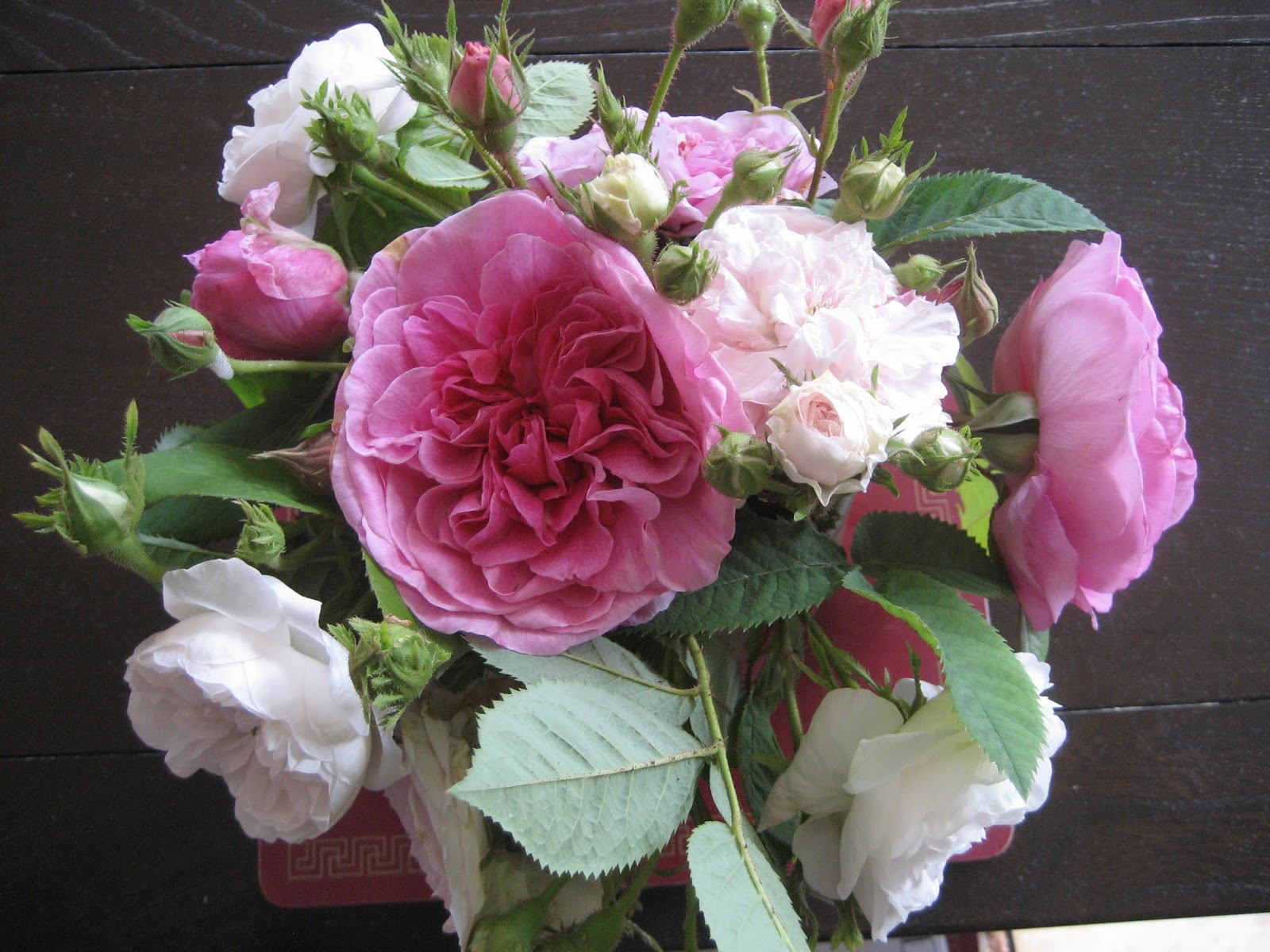
Over the past weeks we've been enjoying bowlfuls of cut roses, as well as appreciating the show they make in the garden.  I had been considering getting rid of 'Mme Hardy', which always goes horribly brown as the flowers go over, but when newly in flower it made a fine show with Buddleja alternifolia (another plant I had considered removing, but maybe I'll just curb its enthusiasm a bit instead).  There are also some sweet William in bloom, and the Allium christophii have been impressive too.
Allium christophii


The peony ('Sarah Bernhardt') has also been providing some cut flowers; and the big philadelphus ('Virginal'), which I keep threatening to dig out, managed a few sprays as well.
Philadelphus 'Virginal'

Peony 'Sarah Bernhardt'

In this heat I've been ensuring that the birds and other wildlife have plenty of water, especially as the pond level is dropping extremely low; it hasn't been full since winter, and now a lot of the liner is showing.  Is it significant that there were a lot - I counted 9 - of dragonfly larva skins on the pond plants the other day?  The quality of what little water there is must be pretty poor, and presumably they felt the need to get themselves out of there and fly off to find better water in which to lay eggs.  Almost the reverse of rats deserting the sinking ship!  And one day we had a grass snake slither across the patio; it must have been looking for some water as well.
Dragonfly larva skins


There are more butterflies around now: a small tortoiseshell, a red admiral, a couple of ringlets, plenty of small whites, a female orangetip and something that was either a meadow brown or a small heath.  Most striking have been a few scarlet tiger moths that were here over several days; one was found dead on the lawn, which made for an easy photograph! - the scarlet parts aren't always visible when the moth is at rest.
Scarlet tiger moth (deceased)
Scarlet tiger moth (alive and resting)
The birds are coming to the end of their breeding season.  A thrush had been singing daily in the big ash tree but has fallen silent in the last few days, and the blackbirds have stopped singing too.  There are still some little sparrows being fed, but other young birds appear to be independent now.  Time for the parent birds to have a rest in the sunshine.

Sunday, 24 June 2018

Gonna build a mountain ....

"Gonna build a mountain, Gonna build it high, I don't know how I'm gonna do it, Only know I'm gonna try".  Actually - despite the words of the song - I had no problem about knowing how to do it because there are plenty of instructions out there on the Internet, and it wasn't difficult to do.  Instead of a mountain, in all honesty it's really just a rather small mound - and the idea, I think, is that it will get smaller over time.

This is Hugelkultur, literally 'hill cultivation', and it's a central European practice, popular among permaculturalists, for creating a bed with lots of organic matter and microorganisms in it.  The attraction for me was that it's a great way of making use of unwanted branches, of which I've generated quite a lot by cutting back overgrown shrubs recently.  Basically, you build a heap with old wood at the base which breaks down gradually over a few years and turns into lovely crumbly, rich soil with a lot of the microlife that is so important for good cultivation.  As it breaks down it ought to generate some heat to help boost whatever is growing on top.

The first problem was where to site it.  My original idea was to put it up against the wall at the end of the vegetable garden, until I realised that next-door's cat would treat it as a convenient stepladder back to her own garden.  Too close to the big ash tree at the side wouldn't be a good idea either; trees don't respond well to having soil piled up over their roots (although, because of the different levels between the neighbouring garden where the tree is growing and our plot, the tree must already be dealing with that problem).  In the end I went for one of the square middle beds in the veg plot (ok, the only one of the middle beds that is actually completely usable, the rest still being at least partly overgrown), which is roughly the right size (1m square is the ideal).  The actual construction has taken place gradually over the past few months, and is now in place and planted.

First, I dug out soil to a depth of 15-20cm.  This generated quite a lot of bags of soil (which I still haven't dealt with!) but was easier than I expected. Then I put in the biggest branches.  You're supposed to start with logs, but nearly all of what I had available was much smaller than that; the biggest piece was the big holly branch that came down in last year's gales.  There were also a few other largish branches sitting in odd corners of the garden waiting to be dealt with; some of these were already rotting nicely, so I hope they will start the pile off on the right track.  The rest came from cutting down an elder tree and the cutting back of a large viburnum.  With hindsight, I probably ought to have backfilled this layer with some of the soil as there were quite a lot of gaps between the branches and I suspect the heap will fall in a bit as it breaks down.


Next came smaller branches, twigs, old buddleja canes, prunings, dead leaves, old cut-down stems from last year's perennials and general brushwood (photo shows this layer still in progress):

The next layer is supposed to be upturned turves, but my grass has far too many perennial weeds in for me to want to risk that.  This doesn't sound like the sort of structure in which I will want to be digging out weeds.  I think the idea is that this layer stops the soil from leaching through to the bottom layer, so I used last year's rotting grass clippings, which make a good dense cover.

Then some garden compost.  The rotting wood will take nitrogen out of the heap, so there needs to be something to give sustenance to the plants growing on the top:

And finally a good layer of soil (from the stuff originally dug out of the bottom).  I worried that this would just slide off, but it stayed put better than I expected.

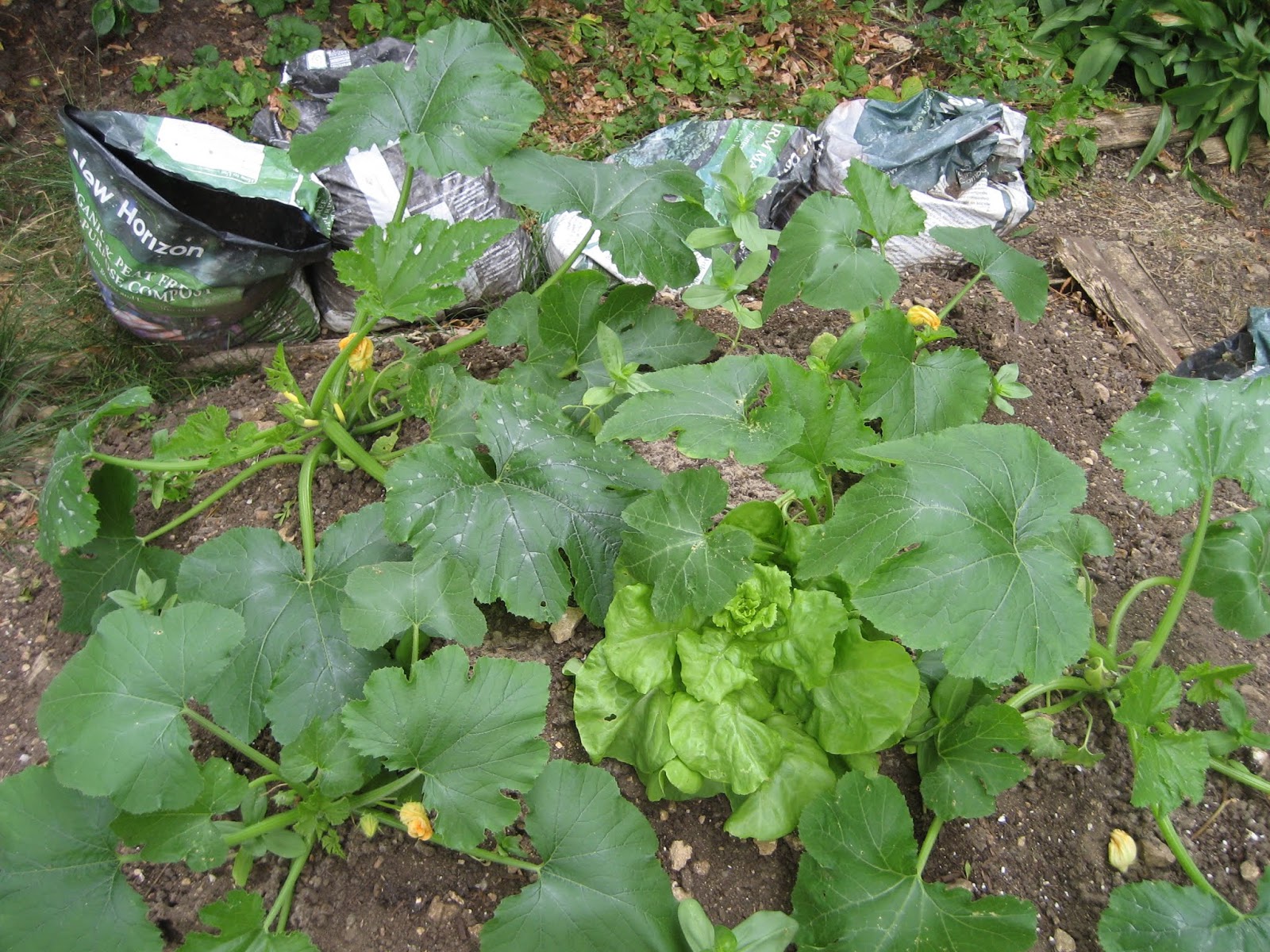
Then: what to plant on it?  The site isn't the sunniest spot, though it does get some sun.  There's no point planting anything that requires rich soil, at least for a year or two, because of the nitrogen problem.  Permaculturalists suggest potatoes, but I really can't imagine how you would dig into this heap without it falling apart!  In the end I've put some courgette plants on there, and they're already starting to flower, which looks promising; and, whether because of the layer of Slug Gone round the plants or because the soil is too dry for molluscs, there's no slug or snail damage so far.  Or maybe they don't like heights?  A lettuce has now been added and I think I'll put some more saladings and maybe some annual flowers on there too.

Much of the wood at the bottom of the heap was generated by having to deal with the viburnums that were snow-damaged in the winter, and by cutting down the main stems of a big elder tree that had self-seeded in the shrubs at the side of the house.  There is still work to be done here; once the choisya has finished flowering, it too is in line for the chop, and one of the osmanthuses needs the same treatment.  These have all grown too big, with lots of evergreen foliage on the end of long woody branches, which should have been pruned back into shape long ago; in the event they were pulled down and broken by the snow before Christmas.  The viburnum at the side of the house has been cut down to a much smaller, more manageable size (and will be pruned ruthlessly from now on!); I also found that one of the branches had layered itself and I've dug that up (rather roughly, but it seems to be surviving so far) and potted it on as I have plans for it.  There is now a lot more light in that border and there's going to be much more planting space for ground-level plants, though just at the moment the area looks a bit like a lumber yard as there are still piles of smaller branches and twigs around (material for another Mountain in due course??!).  There's also a big pile of soil and grit left over from some hard landscaping work here, and that needs weeding and spreading around to level things out.  In due course there will be opportunities for more varied planting, with bulbs and perennials between the shrubs, and I'm working out what might work in there.  Much of what is growing in this part of the garden is white- or light-flowered, so that it shows up in the dim light under the holly tree, and I think I'll keep that theme, but that still gives a lot of choice.  Watch this space!

Thursday, 7 June 2018

Hello, old friends

I'm always taken by surprise when a plant that I had forgotten about, or forgotten how much I liked it, comes into flower.  This has happened quite a lot recently, probably because for the past two years we've been away on holiday at this time of year and missed much of what was happening in the garden.  Here are some of my old friends that have pleased me recently:

Tulip 'Menton'
Tulip 'Menton' is an old new friend; planted a couple of years ago but then not seen because of the holidays.  A few are still surviving down in the bottom border, and very attractive they are too - pleasing colour and elegant shape.  And alongside them are the alliums - A. hollandicum 'Purple Sensation' mostly - which I've missed for the same reason.  They make a really good show.  There are also some foxgloves in that patch; I had been hoping for white flowers but only one white is there.  It's a useful reminder of the good design principle of mixing shapes (globe alliums, tall foxgloves, rounded brunnera) to good effect - though I have to admit it's entirely accidental.  (Note to self: a bit too much purple and pink down there at the moment; it needs something else, preferably bright or light to be seen from the other end of the garden.)

The wisteria has flowered really well this year; at its peak the scent was wonderful.

Wisteria

The poached egg plant (Limnanthes douglasii) has seeded into a very striking patch by the drive:

Limnanthes douglasii
Two of my favourite plants, partly because they have good foliage: Geranium renardii, with sage-green corrugated leaves and white flowers with purple flecks, and Allium karataviense 'Ivory Queen', with lovely broad glaucous leaves and white pom-pom flowers:
Geranium renardii
Allium karataviense 'Ivory Queen'


The roses are also starting to come out.  Of the earlies, I always forget about R. altaica, with its lovely creamy-white flowers, because it can't be seen from the house, and the same is true of nearby Solomon's Seal, which was planted alongside a path that got overgrown long ago and now no longer exists.  I must rescue it from under there!
Rosa altaica
Solomon's Seal (Polygonatum)

Nectaroscordum siculum (I think this may be subsp. bulgaricum) is also coming into bloom:


Nectaroscordum siculum
And of course the poppies (Papaver 'Allegro') are always striking, with their flamenco flounces:

Papaver 'Allegro'
But plain green can be attractive too!  Here is Hosta 'Krossa Regal' on the patio - lovely corrugated leaves.
Hosta 'Krossa Regal'
There have been a couple of new friends too - although I think one may be very temporary.  Many years ago I planted some Tulipa saxatilis; they produced lots of leaves but no flowers, and eventually they were shaded out by nearby shrubs.  I tried moving some of them to a less shady place, with the same result.  Recently I've thought about digging them out, but their current location is low down the priority list at the moment and in fact is serving as a bit of a dump for odd bricks.  So I was surprised the other week to see one single flower, at last:
Tulipa saxatilis among the bricks
- but I'm still going to dig them out at some point.  They've had nearly 20 years to make a show!

The other new friend is again, I suspect, a plant I've missed out on by being on holiday.  It's Iris sibirica - a lovely soft blue with yellow filigree markings and white edging, doing really well down by the summerhouse.  I fight shy of irises, never being able to remember which need moisture and which like it dry, and not having many dry and sunny places for them - but this one is a winner.
Iris sibirica

Recent cut flowers from the garden have been aquilegias - I now have a good mix of plains (pinks, blues, purples, one white) and bi-colours - with sweet rocket (Hesperis matronalis); and another vase of the sweet rocket with blue veronica, Astrantia 'Hadspen Blood', Cornflower 'Black Boy' and Erysimum 'Bowles' Mauve'.

Veronica and friends

Mostly aquilegias


Sunday, 3 June 2018

Birds meet glass

Living in the country brings all sorts of wildlife encounters, but last week's was one of the oddest yet.  It was a warm evening, and we left the back door open while we went out to the summerhouse for ten minutes or so.  The back hallway opens straight into the dining room, and on the dining room windowsill is a clear glass bowl, about the size and shape of a small goldfish bowl.  It's purely decorative and contains nothing but a scrap of pink ribbon that was dropped in there and forgotten about.  But when we came back inside from the summerhouse it contained - a swallow.  It was alive, and apparently unhurt, but having presumably flown into the bowl it was unable to turn around and get out through the relatively narrow neck.  Being upside down in a glass bowl clearly wasn't part of its plans for the evening, so we took the bowl outside and tipped it out; it flew off, greatly relieved I imagine, but we had a brief opportunity to see its lovely colouring and markings (I never realised that they have white dots around the tail).  We suppose that it flew indoors in search of a nest site, but goodness knows why it flew into the bowl; did it think the ribbon was a tasty butterfly?

Two other birds encountered glass in the past couple of weeks.  Two woodpeckers (great-spots) had a fight and chase across the garden, and one of them slammed into one of the summerhouse windows (it probably thought it could fly straight through and out one of the other windows).  It lay in the long grass at the side and I feared the worst, but after a while it sat up and eventually took itself off, presumably with a big headache.  (What is it with woodpeckers and our summerhouse windows?  The old summerhouse once claimed two woodpecker fatalities in as many weeks.)  Less fortunate was a dunnock, found dead with a broken neck under one of the side windows.  Interestingly these were all adult birds; usually it's the youngsters that make that mistake.

There are plenty of young birds now in the garden.  A family of three young blackbirds, all independent, have been around one side of the garden while a male has been feeding two younger ones at the other side.  The male is known as 'Tailless Dad'; he seems to have had a close encounter with (probably) one of the local cats but, despite losing his tail and some other feathers (these were left under one of the gooseberry bushes, so he was probably ambushed there) and occasionally favouring one leg, he seems to be functioning fine.  Robins are feeding little ones in deep cover and there have been a couple of little sparrows down on the patio; a family of goldfinches has also been in the hawthorn tree.  The status of the bluetits in the nestbox is still uncertain; the adults have been going in and out, but, as in the past, not frequently enough to suggest a viable nest.  Has our use of the summerhouse put them off?

They're not yet producing young, but the swallows, swifts and house martins are regularly feeding overhead.  And a red kite was hunting low over the garden one day.

Damselfly
Insect life is also taking off.  The big cotoneaster at the entrance to the drive has been humming with bees recently, as have the raspberry canes; the latter are attracting quite a variety of bees (I wish I was better at identifying them).  The warm weather brought out the damselflies over the pond, both the electric blue and the red ones; these are the best photos I could manage (you have to look closely!).  We've had a pair of red admiral butterflies and both large and small whites, as well as orangetips and some smaller ones that I couldn't see closely enough; and this evening there were two hawkmoths feeding on the sweet rocket (Hesperis matronalis).  They were moving too fast for me to identify them, but they were too small for hummingbird hawkmoths; perhaps elephant hawkmoths?  I did see one a few days ago and got a flash of pink as it went past, so it's possible.

So much wildlife, that the plantlife will have to wait for another post!