Sunday, 18 November 2018

The catch-up

Autumn colours
After a few weeks away, there's a lot to catch up on in the garden.  We returned to a garden full of fallen leaves; the weather had been fairly normal for October/early November, but there had been some wind and some frost which had taken their toll of the remaining deciduous foliage.  The leafmould bins are full and there are still a lot of leaves to sweep up, and still some to fall; the ash trees have shed everything, but some of the shrubs are still showing good colour.  The frost had blackened the dahlia foliage, a precondition for digging them up.  Most of them have now been lifted and are drying off in the greenhouse but there are still a few in the pots outdoors; they were planted up with other half-hardies such as argyranthemums and osteospermums, which will need to be potted on.  The dahlias mostly seem to have made good-sized tubers, and they look quite healthy too (for the moment; we'll see how they survive the winter!).  Two of the hedychiums had been moved back into the greenhouse before we left, in the hope that their flower buds would open; they seem to have started to open but then the plants apparently thought better of it and stopped (probably too cold - the max-min thermometer showed that the temperature had dropped to 2C at one point).  The third hedychium, which shared a pot with a couple of (tender, and now dead) tithonias and an osteospermum, has now been brought into the greenhouse; it's looking a bit sorry for itself, but I know from experience that this year's stems won't do anything next year in any case, so they can be cut off and I expect the one little new shoot, which seems healthy, will keep the plant going over winter.

The pond, which nearly dried out in the summer, is full again - there has been plenty of rain, with some sunny days too.  And we had a quite spectacular hailstorm one day.

The tulip bulbs are still to be planted, but there's still time for that; the half-hardies have to be cleared out of the pots first.  The sweet pea seeds were sown today, only half of what I normally sow; I always have more than I have (sunny) room for, and it would make more sense to sow some now and some in early spring, to spread the flowering period.  More broad bean seeds have been sown, to plug a few gaps in the bed, and I'll sow some pots of herbs and salad leaves for the greenhouse.  I ought to take some cuttings of the half-hardies too; and at some point I need to bubble-wrap the greenhouse.

I haven't finished trimming the long hedge, either, but this week is going to be a bit on the chilly side for that.  Plenty to get on with!

Nerines and panicum
Predictably there isn't much to cut for the house, but some winter jasmine has provided one vase, and nerines with the last of the Panicum 'Frosted Explosion' another.  The nerines have done better this year; I fed them in the summer and cut back the wisteria to give them more light, and that seems to have done the trick, generating eleven flowerheads (last year there were only four or five).  The Viburnum x bodnantense 'Dawn' is in flower, too, so that can also be pressed into service when the nerines fade.


Another change in the garden is the return of the birds.  Before we left, they were mostly showing not much more than polite interest in the food put out for them, and were turning up in very small numbers, but in the last week or so we've had 20-odd species in and around the garden, and all offerings are being gratefully received.  The redwings and fieldfares are here (time to cut some holly for Christmas, before the redwings eat all the berries), along with several blackbirds which may well be migrants; we've had various tits, pheasants, partridges, chaff- and goldfinches and a female bullfinch showed up one day.  And of course the robins are being very territorial - though it's only a few weeks before they will start pairing up again!

Tuesday, 9 October 2018

Ins and outs

A lovely autumn day, a little mist over the fields in the morning, then sunny and warm enough for lunch outside on the bench.  Not for very long, though, because there's too much to do; it's time for old plants, and leafmould and compost, to come out and new ones to go in.

It started yesterday, with the first big sweep-up of fallen leaves.  This meant that last year's leafmould had to come out of the wire containers so that the new stuff could go in - which is always very satisfying.  Some of the old leafmould went down as mulch around the leeks, and over the garlic that was planted a couple of days ago in the patch where the runner beans had been taken out.  In theory the beans should have fixed some nitrogen in the soil, but I think I read somewhere that actually not much nitrogen remains available to the next crop, so plenty of old compost went in around the garlic, especially the elephant garlic (I'm still in competition with a neighbour on that).  That particular bed has a patch of poor soil in it; it's one of the old 'L' shaped beds that I'd been meaning to square off, and I finally managed this, but the newly created corner has a lot of grit from the old path in it.  I've tried to compensate with some of the soil originally dug out when creating the Hill, and I'm hoping that the added compost and leafmould mulch will do the trick.

Today's job was digging out the compost bins.  The bin that had been cooking over the summer had done really well; usually there's a lot of twiggy stuff, leathery avocado skins, egg shells and other things that take longer to break down in there, but the summer heat had obviously kept the temperature high and there wasn't anything like as much as usual to transfer to the new pile.  That meant that I was able to use some of the new compost to prepare the broad bean bed.  The broad bean crop has been erratic over the past couple of years, with both poor germination (despite using fresh seed) and poor growth, so I've gone back to my old practice of sowing the overwintering beans in the cold frame (in toilet roll half-tubes) in readiness for planting out once they've germinated.  About half have done so already, and they will go into the ground in a couple of days once the soil has settled after my digging.

So there's plenty of space in the compost bins for the other plants that have been taken out: the courgettes (which still had a few tiny fruits on them but mildew was taking over and the plants wouldn't have lasted much longer - anyway I have as many courgettes as I can use!), aubergines and tomatoes.  I've picked all the remaining green tomatoes and am hoping that some will ripen indoors.

A visit to the garden centre last week had me rummaging in the end-of-season 50p seed packet box; treasures found there included a packet of phacelia seed, which I've sown in this summer's garlic bed as a winter green manure.  Pleased to see the first signs of germination today; I hope the sunshine will encourage it!

All the dahlia flowers were picked for the Harvest Supper tables, but a few more are coming through, especially those of the Bishop's Children (they've been slow to do much, but they're starting to produce bright, cheerful flowers).  The nerines, which I've tried to give more light to this year (keeping the wisteria leaves off them), have produced a few flowers which are just starting to open, and Penstemon 'Garnet' (syn 'Andenken an Friedrich Hahn') is making a good showing.  Elsewhere the Sedum 'Autumn Joy' (which isn't called Sedum any more, but I can't remember its new name) is doing well, if floppily, and the Choisya ternata is also in flower.  With the first autumn tints and the bright red apples, the garden is looking a little brighter than it does most autumns!

First nerines
Penstemon 'Garnet'

Borage and dahlias 'Bishop's Children' series


Sunday, 30 September 2018

After Ali, autumn

Storm Ali was indeed wet and windy, but Storm Bronagh, hot on its heels, passed us by and, since then, we've had mostly bright days and chilly nights, and no further rain.  It's some of the nicest autumn weather we've had for a long time.

Autumn colours are starting, autumn fruits are ripening:
Amelanchier leaves turning
This year's giant apple - 698g (just over 1.5lbs)


Still more giant apples to come! ...

... and a lot of little eaters too

There are still a few solitary butterflies appearing (red admiral, comma, brimstone), and a big dragonfly came past the other day.  A green woodpecker has been visiting the big apple tree, a mistle thrush has been noisily staking its claim to the ash tree and a willow warbler put in a brief appearance a week or so ago; there has been some territorial activity among the robins but otherwise the bird population is largely occupied elsewhere.  There's plenty of fruit and insects around for them.

The rain has encouraged the late flowers (and some of the weeds too).  Dahlias and tithonias made a colourful vaseful for the house:


Tuesday, 18 September 2018

Plan B

So it's the morning of the Garden Society Show, and we're carefully unwrapping the three small but lovely Discovery apples that had been cocooned, still on the tree, in fleece to protect them from insect damage.  (It has been a good year for insects, especially flies and wasps.)  Disaster.  The first wrapping was full of ants, which had nibbled the apple; the second was full of earwigs.  With those two gone, the state of the third was neither here nor there; we needed three well-matched apples of the same variety.  Plan B was to pick fruit from the big cooking-apple tree instead.  The ripest of these, just starting to blush nicely, were also those with the most blemishes, so it had to be three that were still green.  They were indeed big and beautiful, though without the 'eat me' appeal of the Discoveries.  And, to our amazement, they not only won the class but also the 'Best Fruit and Vegetable' prize.  Even more amazing was that the runner-up exhibit was my three little yellow courgettes, despite being the smallest in that class.

Today's harvest
Since then we've had a week away in warmer climes, and, despite picking the courgettes of any usable size on all the plants before we left, have returned to several much larger beasts including a couple of offensive weapons-size ones.  In the past I've had my doubts about 'Orelia', the yellow one, which seemed to be a weak grower and with fruits prone to rotting off at the tip, but this year it's done very well.  I wonder if the drier weather has prevented the rotting off.  At any rate, the plants have produced well this year, and one of my pre-trip jobs was to make a batch of ratatouille using some of them with some of our aubergines ('Ophelia', which ripened first) and tomatoes.  Since our return I've decided it's time to start also picking the 'Bonica' aubergines and 'Apache' chillies, as well as a whole lot of our newly-ripened red (and a few stripy orange) tomatoes.


Display of local produce, Maribor, Slovenia
The markets in Slovenia had fine displays of local fruit, veg and flowers, and I've returned with renewed appetite (literally and figuratively) for harvesting, storing and using our produce.  I'm prone to letting seedlings sit too long waiting to be potted on or pricked out, and to letting plants go over without having used them to the full; I have a cold frame full of seedlings which I'm reluctant to put into the ground (because of the slugs) or into the greenhouse (because of the greenfly), and outdoors my full-grown lettuces have bolted in my absence.  So, starting as I mean to go on, I've already picked a big fistful of parsley and chopped it ready for the freezer, and will be potting on my lettuce seedlings asap.  And making more ratatouille.
Dried flowers in Ljubljana market


The apples this year are small (except for our usual giant cookers), but plentiful and, ants and earwigs apart, good quality.  We also have our biggest ever pear crop ripening nicely.

Apples and pear cordons

Autumn is approaching fast; the plum tree, which I managed to prune before we went away, is dropping its leaves and the late flowerers such as the dahlias are getting into their stride.  One overwintered dahlia tuber which I had labelled 'Bishop of Auckland' is not; I had started having doubts as soon as the leaves appeared, green not purple, and indeed it is 'Ambition' (this is good as I currently only have one other tuber of this variety).  It also looks like one of the hedychiums is going to produce a couple of flowers at last; the heat of the summer would have been to its liking, but it probably likes more moisture than I had been providing.
'Ambition' not 'Bishop of Auckland'!

Autumn leaves under the plum tree


Another sign of autumn is that the Met Office has just announced the first named storm of the new season: Storm Ali, with rain and gales, is due later this week.  We've just had the tail end of Hurricane Helene pass by, which has brought down some of the big apples and some firewood from the ash trees, and it rather looks as though, in all, it's a wet and windy week.  Time to get those apples into store.

Although there still aren't as many flowers in the garden as I would like, the dahlias and my seed-grown asters are providing this week's indoor colour:

Aster 'Milady'
Dahlias 'Ambition', 'Sam Hopkins', 'Bishop of Auckland'

Thursday, 23 August 2018

August - summer or autumn?

Cyclamen hederifolium
I've always tended to think of August as summer; but in recent years I've been more aware of its being summer on the slide.  (This has more to do with my perception than any change in the climate.)  It's the time of year when temperatures often start to drop a little, green leaves start to lose their greenness and early morning dews show up spiders' webs.  I haven't seen any of the latter yet, but the weather has turned much fresher and showery, and it can only be a matter of days until the webs show up.  At least the rain has got everything growing again; the lawn is amazingly green after all the heat we've had.  Two sure signs of autumn coming on - blackberries fruiting in the rough area behind the fruit patch, and the Cyclamen hederifolium starting to flower.

Blackberries
Another sign of autumn coming on is that the birds are starting to be less demanding about food.  There is still the one little sparrow fledgling being fed, and a couple of young pigeons were on the lawn the other day, but crumbs put out on the patio are taking longer to disappear in the mornings.  There are still plenty of birds about, particularly tits, dunnocks and sparrows, and some robins and finches; the neighbours have planted a lot of Verbena bonariensis, which has been attracting bullfinches (a bit of a colour clash) who then come to us for a drink.  We've also had a young green woodpecker poking around the lawn; we seem to see one most years, usually only for a few days.

Dahlia 'Cafe au lait'
The dahlias are finally starting to flower: the 'Sam Hopkins' is very fine, but the showstopper is 'Cafe au Lait' which has produced a flower a good 6in across (that's 15cm for my metric readers).  Unfortunately it's a bit pockmarked with holes, so won't be putting in an appearance at the Garden Society Show.  There are also a few asters starting to bloom, and also the phygelius, which has responded well to being repotted (as has a sucker removed from it and potted separately).  It doesn't look as though any of the hedychiums are going to oblige this year; perhaps I should have left them in the greenhouse, although it has been warm enough for them outside.  A surprise bloomer is also in a patio pot; in spring I found a few corms in the greenhouse, removed from a pot last year, and planted them into a small pot with a label saying 'crocuses'.  Once they started pushing up leaves it became obvious that, whatever they were, it wasn't crocuses, and they were in too small a pot; potted on into something of a more suitable size, they grew on well and turned into Gladiolus nanus 'Nymph', and very attractive too.
Dahlia 'Sam Hopkins'
Not crocus! ...
... but Gladiolus nanus 'Nymph'

Bean 'Moonlight'
On the edibles side, the runner/French bean cross 'Moonlight' is producing well, as are the courgettes and tomatoes.  My six aubergine plants have one fruit each and are showing little interest in producing any more; I should really have potted them on into bigger pots.  The red peppers are also tiny; my fault for allowing the first sowing to dry out and sowing the second lot late, and not potting them on.  Note for next year!

I'm particularly pleased that my little fig plant has produced a tiny fruit; if it overwinters successfully, we might have our first fig next year!

A figlet (look closely ....)

Sunday, 12 August 2018

Pros and cons of drought

After the rain mentioned in the last post, we had a further 12 dry days - mostly warm, with some cool nights, but nothing like as hot as it had been.  This weekend we've had more serious rain, today especially.  It's amazing how quickly the lawn has turned back to green, at least where the grass is growing; the moss is remaining a barren greyish-brown.  While the grass wasn't growing, it was relatively easy to see the runners of the creeping buttercup and the nasty little creeping potentilla that has world-domination ambitions, and to pull those up; even if the plants are still there, at least they won't be increasing as much as they usually do.  I also rather randomly pulled up some of the self-heal that grows in the lawn - but really I have more productive things to do than try to hand-weed a lawn.

Recent jobs have included pruning the cordons and the wisteria, and picking plums (more of them, and of better quality, than we had expected).  But mostly it has been weeding, as usual.  The recent rain loosened the soil a little, making it much easier to fork the weeds out and pick over the soil to remove root fragments (a necessity where couch grass and vetch have been growing).  The clearing of the area along the terrace edge is progressing inch by inch; the remaining seedling dahlia plants have gone in there, a case of better late than never - if nothing else, it saves me trying to keep their pots watered. 

Dahlia 'Ambition' with Panicum
A couple of the ailing plants that seemed to have responded well to being repotted have in fact died; not only my Euonymus microphylla but also the Alchemilla alpina and one of my veronicas.  The other veronica is surviving with its roots down through its pot into the gravel, so I will have to be careful when I get round to digging it up.  On the other hand my little sage cuttings have started to romp away.  I'm also pleased with Cosmos 'Xanthos' and Panicum 'Frosted Explosion', both of which I grew from seed, the former as a pot filler (lovely soft yellow) and the latter for cutting; the Panicum has been filling out vases of dahlia blooms among other things.

It would be nice if some of the weeds would succumb to the drought, although I'm not holding my breath.  One weed that does look as though it's going to succumb, though not to drought, is a largish ash sapling that seeded into the big berberis by the drive.  I've been wondering how to get it out for some time, but this year I've noticed that the branch tips are bare - a sign of ash dieback.  It's on the way out.  Sadly so is the big ash in the field at the bottom of the garden; it is definitely showing similar signs.

It's not only the plums that have done well this year; there's a good crop of blackberries in the hedge across the road, which I'm raiding daily.  They're very early this year.  The shallots have done well, and the garlic fairly well (but small); the leek seedlings are also much fatter than usual.  These were all in the same bed, and although I watered them very occasionally I can't say that they have been pampered, so I'm very pleased with them.  The courgettes continue to fruit nicely.  But the other veg have been disappointing; few beans, unless the runners get going soon, and potatoes are small.  I really need to beef up the soil in the veg garden this autumn; it's very thin and hungry.

It isn't a good year for butterflies, however.  I've been counting for the Big Butterfly Count, and the results have been disappointing.  There are good numbers of whites - and I've seen at least two green-veined whites - and a few gatekeepers and meadow browns, and the occasional common blue; but only one each of red admiral, peacock, comma, small tortoiseshell and painted lady, which is sad.  I did see a small copper a few weeks ago, and a hummingbird hawkmoth has also been on the buddleja, but the total numbers have been poor.

Sunday, 29 July 2018

The power of life and death

Dried-up pond
Summer has continued to be still mostly hot, still mostly dry (a couple of light showers apart), until yesterday.  We had 27C in the shade the other day, the greenhouse topped 35C, and other parts of the country have had temperatures in the 30s; none as hot as temperatures recorded in recent years, but a much longer spell of sun, heat and dry than we've had for a very long time.  The pond pretty much dried up - I really ought to take advantage of this and clear it out, but that means standing in the sun for longer than I want to (that's my excuse anyway).  Then yesterday evening the rain started, with strong wind, and gave the garden a much-needed soaking; the pond is starting to fill up again.  Today has been cooler and fresher, but the forecast is for warmer temperatures again later in the week.

The weather has made me bite another problem bullet, however: the number of plants sitting around in pots waiting for a home.  Some of these have been around for an embarrassingly long time, in very old compost, and the dry weather has not been good to them, nor to those eking out an existence in too-small pots.  A number of these have been hanging around in the area behind the garage, rather out of sight and out of mind; I don't venture round there as often as I should, so I tend not to notice their signs of distress.  Some had succumbed, and others weren't in a good state; the need to keep watering the survivors finally forced me to make some life and death decisions.  The dead ones were easy (straight to the compost bin).  Some others weren't really needed; a good few had been cuttings taken as insurance against losing a favourite plant but no longer required, or things potted up for the Plant Sale and not sold, and the sickly ones also went to the compost.  Some of those behind the garage have put their roots down into the gravel and are surviving (just, in some cases) on that, so they have been left for the moment.  Of the remainder, those that I decided to keep have been repotted, in some cases grouped into big pots where I hope the volume of compost will give them enough moisture to keep them going.  I've also made a resolution to pay more attention to the area behind the garage; I will try to remember to include that area in my walks round the garden, so that I spot signs of distress in time!  As it is, I think I've lost my Euonymus microphylla, which is looking very brown, even after repotting - a timely lesson.
Mixed mini-evergreens in a big pot ...

... and the tiny survivors went into these two pots
Carnations, Sweet William and parsley flowers
Yellow sedum
There is not a lot of colour in the garden at the moment.  The achillea (I think it's the classic 'Gold Plate') is looking good, as is Lilium henryi, there's plenty of oregano and the buddleja is just starting to flower, but Crocosmia 'Lucifer' is fading almost as soon as the flowers open, the Big Yellow Thing is going over and the sweet william are finished.  There are some carnations, which are looking better now that I've deadheaded them, and a sedum (don't know the variety) with yellow flowers that isn't bothered by the lack of water.  The phlox hasn't flowered yet, and there has only been one dahlia flower ('Ambition') so far; they were potted on rather late.  Indoor vases of sweet william and the carnations were boosted by parsley flowers, of which I have plenty; I always leave them to flower and seed as they're great for filling out arrangements.

The lack of colour is largely my fault for not having planted many late summer flowerers.  Every year I note the need to put in some late colour, but by this time of the year the weeds are always taking over and there's never anywhere 'clean' to put them.  This year I do have a potential spot, in front of the new terrace where I'm gradually digging out the weeds; last week I finally managed to remove a stubborn clump of Alchemilla mollis mixed with the blue Centaurea montana (plus couch grass, vetch and other nasties, all tangled up together), which has opened up a few more possibilities.  The soil has really been too dry for much planting, though, and anyway I always prefer to plant a new bed with annuals and other ephemeral planting for its first year, to allow perennial weeds to show before anything more permanent goes in.  I do have a wish-list of summer flowerers to populate it with in due course!

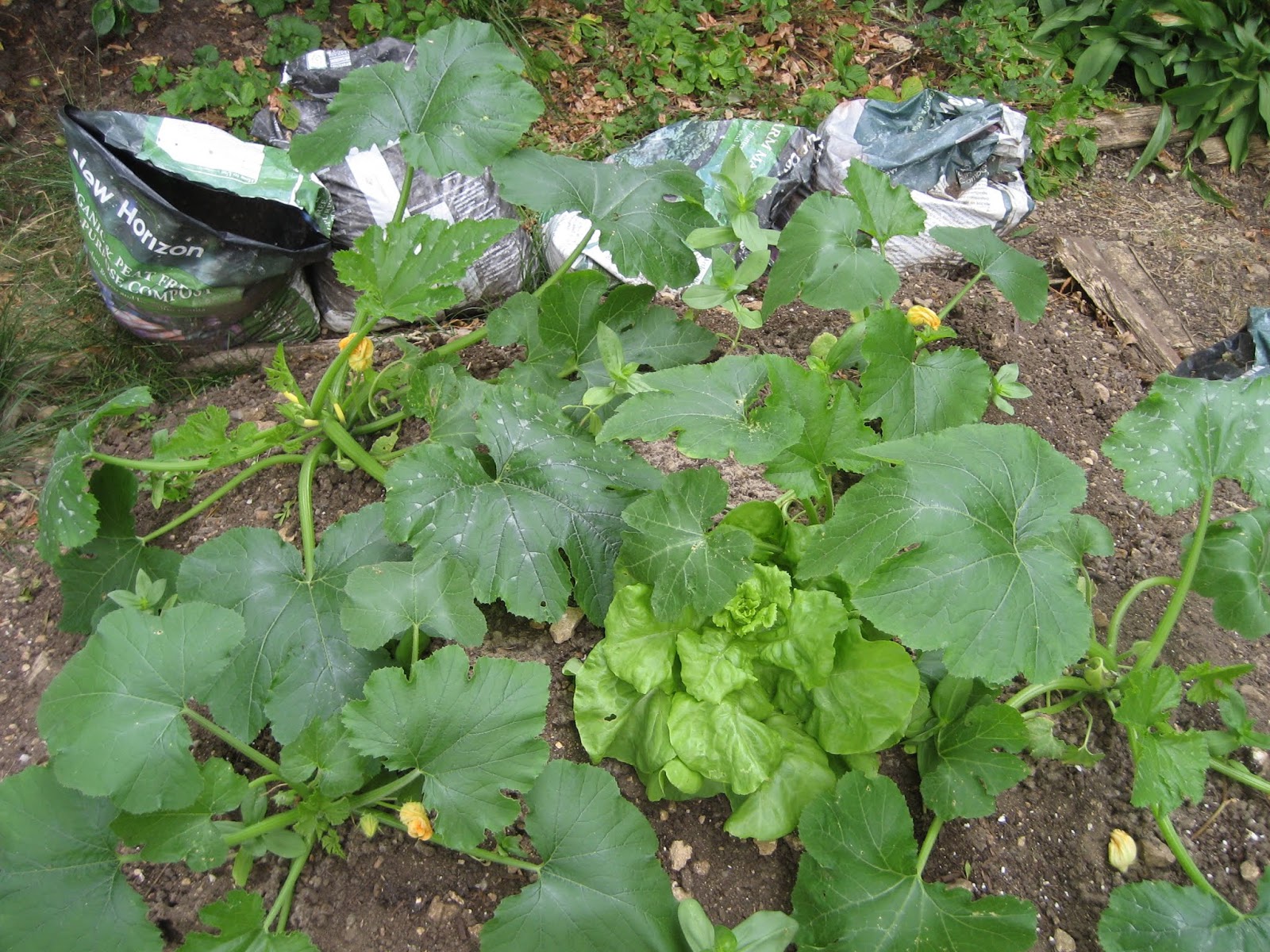
Courgettes (and a lettuce) on The Hill
I've been diligently saving as much 'grey' water from the kitchen as I can, and now that the raspberries are over (a great crop this year) it has been going under the apple cordons, which I think aren't going to produce very large apples.  Some of the 'Discovery' fruit are already turning red - far too early! and whether it's ripeness or sunburn I couldn't say.  A little water has gone on the leek seedlings (the shallots and garlic are now lifted) and on the courgettes on 'The Hill' which are starting to fruit, but interestingly the latter have stood up to the drought remarkably well, perhaps because they're in part shade.  The Hill itself is drying out underneath, with big cracks appearing in the sides, so I should be able to pour some of the spare soil in there to fill out the gaps.  The plums are ripening fast, and today's gales have brought quite a few down; it's a small crop but the fruit are a good size.  I have been watering the tomatoes, aubergines, peppers and chillies in the greenhouse; there are some nice little aubergines coming along, and the first tomatoes have been harvested.  Although the greenhouse has been hot, the watering has kept the soil under my diy growbags nicely moist, and I wasn't surprised to find a frog sheltering in there one warm day.

Tomatoes ('Harzfeuer')
Aubergine ('Ophelia')
I've been more diligent with the greenhouse crops this year, and it seems to be paying off.  I wasn't happy with the growbags I used last year, so the tomatoes have gone into old compost bags, upright and half-filled with (bought) compost; the aubergines have been potted into larger pots than those I've used in the past and stood in a sunny spot on the staging.  I've also been trying to remember to give them all a dose of comfrey tea every week, and I'm happy with the results so far.

Another priority for water has been the various birdbaths, which are greatly appreciated by the avian population.  There's still at least one little sparrow being fed, but the last blackbirds seem to be independent and there are a couple of young robins fending for themselves around the patio.  A pair of bullfinches have been down and a family of goldfinches appears from time to time.  And Lefty, our lame pigeon, has been feeding a couple of youngsters, and treating himself to a nice sit down in the shade when his offspring leave him alone.