Monday, 11 October 2021

Don't sit under the apple tree

It has been a decidedly mixed growing year, and the fruit crop has been no exception.  One unexpected success was our first fig (just one); a little on the dry side, but a reasonable size.  There are several little figlets for overwintering, so I have some hopes of a few more next year.  The raspberries did quite well (one of the canes has now started to flower, very unseasonably – what’s all that about?).  However there were no gooseberries or blackcurrants worth mentioning, and some neighbours have had the same experience.   The cold spring weather, resulting in fewer pollinators?

Given the lack of soft fruit, I wasn’t surprised that in early summer there seemed to be relatively few apples and plums developing on the trees, and when it came to thinning the crops I erred on the side of generosity, to make the most of what fruit there would be.  This proved to be unnecessary and, in the case of the cooking apple tree, a mistake.  The plum tree actually produced fairly well, and the apples, the cordon dessert apples as well as the cooking apple tree, turned out to have the heaviest crop we’ve ever had; and in the case of the cordons, some of the individual apples are larger than ever.

Some of the plum crop

Dessert apple cordons

More cordons

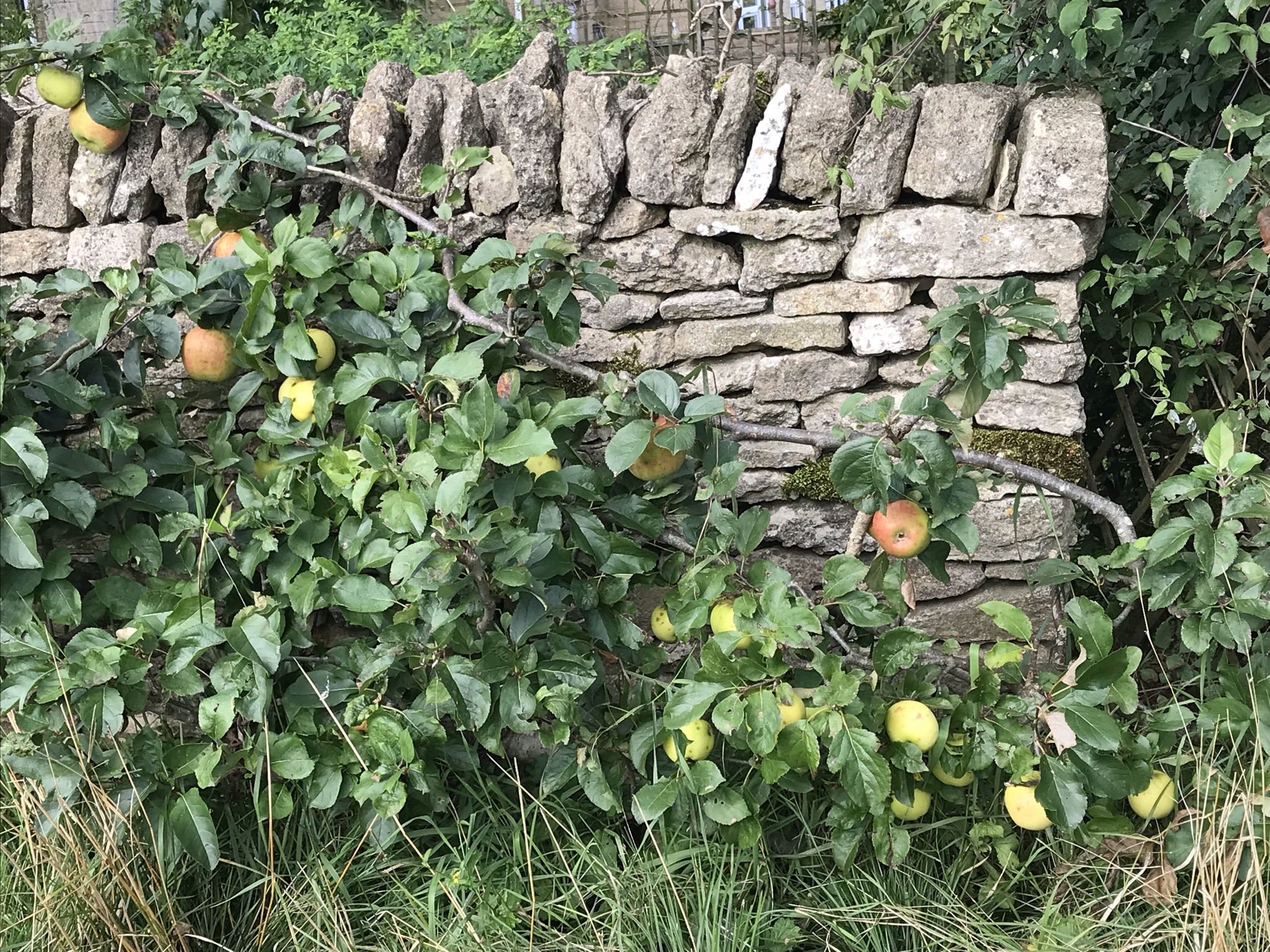
Of course, this came at a cost.  Because I didn’t thin the fruitlets particularly thoroughly (though goodness knows I took a lot of them off the tree!), the cooking apple tree’s branches are now overloaded, bending down low and, in some cases, breaking off.  They’re big apples, and can be heavy.  It’s difficult to get underneath the tree where it overhangs the veg beds, as it’s bent down to the ground; some of those branches are going to have to be removed during the winter pruning, just to allow us to get under there, and to get the tree back into shape.  A lesson learnt: next year, don’t allow too many apples to develop near the ends of the branches, to stop them being pulled down.

Don't even try to sit under the apple tree!

Those branches nearest the veg beds have been a bit of a problem for a while now.  When I designed the vegetable plot, I put in the main access point, a little path through the bed along the edge, just where those branches are.  It was a geometric thing: the plot is three times as long as it is deep, so the beds are laid out in three equal-sized groups, and the central group has a path running down the middle which is aligned with the entrance path.  As the tree grew, it became increasingly difficult to get in and out without banging my head on the branches.  Over the summer, the obvious solution dawned on me: don’t do anything to the tree, instead move the entrance!  I’m in the process of creating two entrances, one each side of the tree, aligned with the paths separating the three bed groups.  You can see one of the paths, still under construction, at the bottom left of this picture of part of the plot.

Also visible in the pictures, and also still under construction, are some of the new woodchip paths that I’m creating in there, using woodchip from the felled ash tree.  The paths were originally gravel, but over the years this has disappeared into the soil.  There were also plank edges to the beds – some of the planks are still lying about, partially in use but no longer retaining any soil.  They were a mixed success, falling over a lot, easily kicked over and needing to be put back up again, and in the end I more or less gave up on them.  The final straw came last autumn when our local tree man removed the large overhanging branches from next-door’s ash tree; if a guy is prepared to climb 10 metres/30 feet up a tree and lower the sawn-off branches down, you can’t really ask him if he would mind not disturbing the bed edges while he does it (and could he possibly not disturb the parsley growing underneath? In fact the parsley survived very well).  Reasonably enough, the beds looked rather dishevelled afterwards.

Rather dishevelled (after last autumn's tree work)

Charles Dowding, whose no-dig methods I’m trying to follow to some extent, reckons that wooden edges are unnecessary and act as a haven for slugs and snails; he demarcates the paths and beds by using woodchip for the former and mulch for the latter.  You need an awful lot of mulch (compost, manure, leaf mould etc), but it does seem to work.  Some of the paths still need weeding before I can get the woodchip down – in particular there are a number of productive alpine strawberry plants (visible in one of the photos above) which will be pulled up once they’ve stopped fruiting – but already things are looking a lot better, and the woodchip should keep the weeds down.  It also allows me to widen the paths, which have been too narrow to be practical.  And I can now walk past the apple tree instead of ducking down under it!

Starting to look better!

Monday, 27 September 2021

Last of the summer wine

Weatherwise, it hasn’t been a great summer here, on the whole, and the signs are that it’s downhill from here.  After a very warm ten days or so in July, we had a mostly disappointing August – remarkably dull, grey and with a chilly wind from the north, for much of the month.  September has been better, with a couple of warm days but mostly just nice autumnal weather: plenty of misty mornings, pleasant days and cooler evenings once the sun has set.  Although the summer has been dry overall, it hasn’t been exactly the sort of weather that we might have hoped for, and now change is on the way, with wet and windy autumnal conditions for the next few weeks.

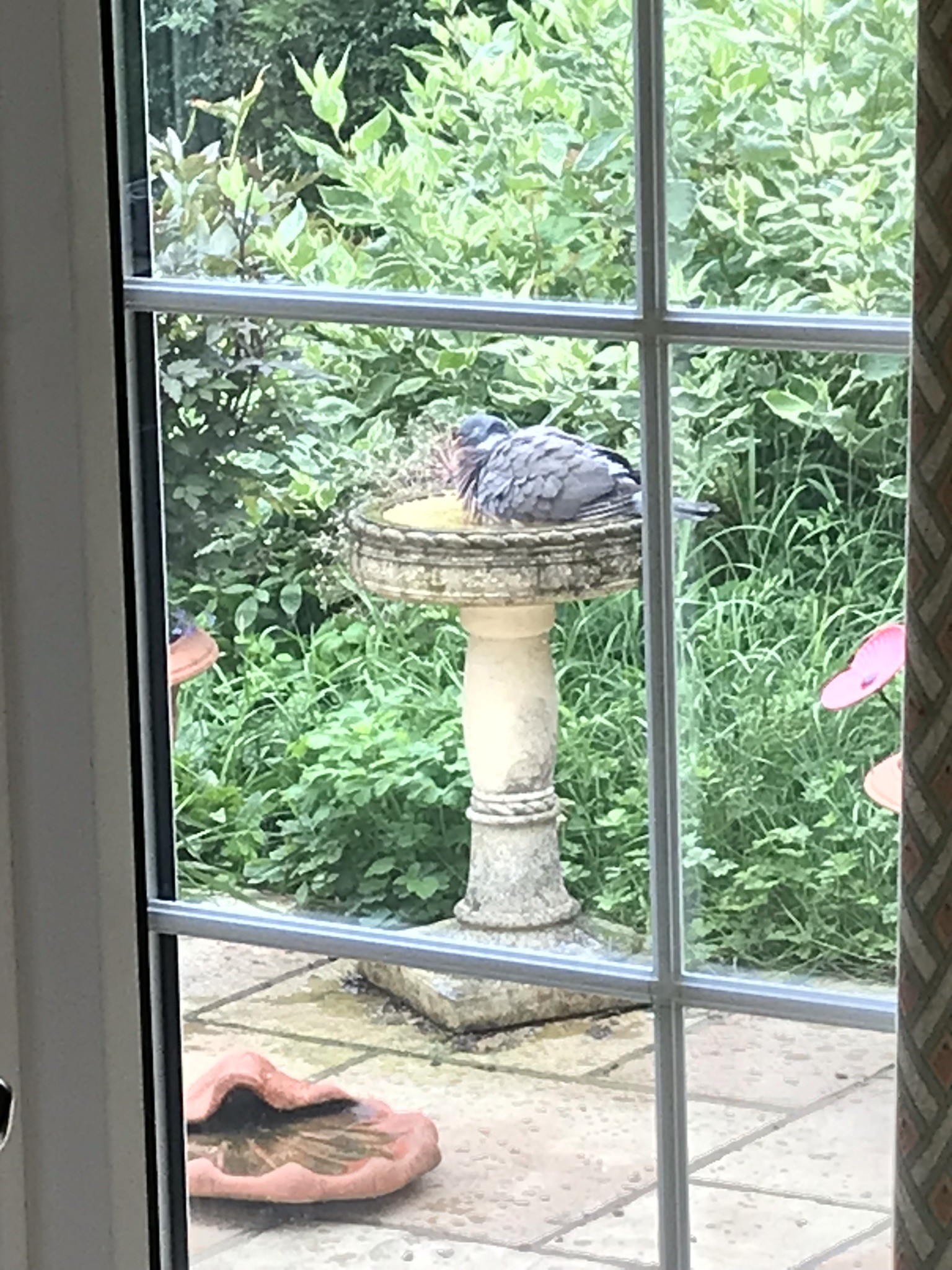
Lefty's morning bath

The depressing August weather was all the more depressing for coinciding with the end of the birds’ breeding season, when the juveniles start dispersing and the adults take themselves into hiding while they moult.  For a few weeks the entertainment of their comings and goings declines quite noticeably, as does their interest in the bird feeders, though they do enjoy the birdbaths; moulting must be a slightly uncomfortable business, and a nice bath seems to help.  The birds are still around, but often relatively inconspicuous (and mostly silent) in the tree canopies or out in the hedgerows, where there’s plenty of food for them, though a family of long-tailed tits did turn up on the fatball feeder one day.  They’re always a cheerful sight, clustering together with their tails sticking out in all directions, until they decide they need to be somewhere else.  A couple of warblers (chiffchaffs?) have been catching insects from the treetops, and a pair of tawny owls calling mournfully in the evenings.  The robins are marking out their winter territories with melancholy-sounding songs; sadly the thin robin who mostly hangs around the patio seems to have damaged its right foot, with the claws all clenched together as a sort of peg-leg, though it appears to be managing well enough.  Perhaps I ought to call it Righty the Robin, on the same lines as Lefty the lame pigeon.

Long-tailed tits on the fatballs

Lefty, with his lady, seems to have raised at least two youngsters; we watched them pester him (unsuccessfully) for food one day.  He wasn’t having any of it, even when one of them jumped on him like an overenthusiastic toddler, and they went off to find their own supper.  The pigeons at the bottom end of the garden, meanwhile, who are quite tolerant of our comings and goings, spent much of the late summer trying to nest in the plum tree.  It wasn’t much of a nest, just a few sticks high in the canopy, and the cold August winds destroyed it at least once, but finally they seem to have succeeded: a youngster has been calling to be fed from the nest over the past few days.

The August winds also gave a further battering to the poor old buddleja, which nevertheless managed to flower well enough to attract a good number of butterflies.  Red Admirals and small tortoiseshells were well represented, and there was a painted lady, but few peacocks this year; however I did finally manage a definite identification of a small skipper, which I thought I had seen several times in the past but which were flitting about too fast for me to see them properly (which is why they’re called skippers).  This one sat on the buddleja for long enough for me to get my phone and take a photo. We ought to have a healthy population of large whites in future, too; the netting over the brassicas failed to keep them off the broccoli, and their caterpillars have eaten the plants bare.

Small skipper on the buddleja

Red admiral

Painted lady

Large white butterfly caterpillars - no broccoli this year!

If the butterflies provide garden interest by day, and the owls by night, it's the hedgehog that we look for in the evenings; we've seen him or her a few times when we've been returning from supper in the summerhouse after dark.  Slugs do not seem to have been a problem this year, and this may be the reason why!


Monday, 30 August 2021

Ashes to ashes

The three big ash trees round our boundary are all suffering from ash dieback.  While the one next to our driveway was the least affected, it was the only one that was actually ours, the others belonging to owners of neighbouring land.  If it fell, as it probably would have done at some point, it would have landed either on our house, our garage, the neighbours' house and garage, or the overhead electricity wires that run past our property.  None of those options would have been good.  

Last day of the tree

So we finally managed to engage Michael the local tree-man to cut it down; a sad decision, but a necessary one.  It involved a very large cherry-picker to deal with the higher branches (that's the red thing in the 'before' photo).  Suddenly the view from the kitchen window is a lot lighter, and currently dominated by a very large pile of firewood; that should see us through a winter or three.  And the smaller branches produced a load of woodchip, which I'm using to renew the paths in the veg plot.

Afterwards

The stump is still there - realistically it was just going to be too difficult to grind it out - and from a quick count of the rings I reckon the tree was about 150 years old.  You can see the dark patches where the dieback had taken hold, and some of the firewood has nasty-looking bits in where the wood was affected.  The stump will become some sort of feature until it rots away; once the area has been cleared of sawdust (I can find a use for that too), I'll need to clear it of weeds and give some thought to how to plant if up.  It will now be considerably sunnier than in the past, though the tree roots mean that only the tiniest seedlings, or seed, can go in there, which limits the options.


As for the other trees, we're making noises to the owners about removal; neither of them would hit the house (just) if/when they fall, but they would make a big mess of most of the garden.  Sorry, trees - and the wildlife that enjoys them - but the alternatives aren't good either.

Thursday, 5 August 2021

The volunteers

As usual, I’ve sown more seeds than I can realistically handle.  Some are still in trays, waiting to be put into their patio pots; at least I’ve managed to keep most of them watered, although I’ve had to scrap some that got too leggy or sad-looking.  Next year I really must cut back.  Especially as some plants are showing me that they can take care of all the germinating and growing on by themselves.

Panicum seedling, flowerhead just opening

I have some panicum (grass with big feathery flowerheads) and antirrhinum seedlings still not planted out; but last year’s plants of both varieties have self-seeded, and are making better growth than my seedlings, so I needn’t have bothered.  The panicum was an F1 hybrid so its seedlings won’t have come true, but they look perfectly satisfactory to me.  Last year’s sweet William plants have also seeded, and I’ve planted some of those out at the far end of the veg plot for next year; this is useful as the rather old seed that I sowed in June didn’t germinate.

Violas under the sweet peas

The sweet pea pots were re-used from last year, with the new plants put in last year’s compost and a bit of fertiliser added to give them some feed; last year there were some violas in there, to provide some colour at the feet of the sweet peas, and their offspring are doing very well this year.  Violas and pansies are great self-seeders, and there are several coming up around the garden; like the panicums, they’re the products of F1 hybrids but still often fine plants.

Another, very pretty, self-seeded viola

Last year I let my parsley plants, under the ash tree at the side of the drive, seed themselves around.  Perversely they seem to have done most of their seeding into the gravel of the drive itself.  I’ve left them there (will pull them up before they seed in their turn), especially as I haven’t got round to sowing any this year (need to do that …) and these are the only usable parsley plants I currently have.

There are also some plants that seem to have germinated from seed that never came up last year but obviously survived the winter and germinated this year; I have a couple of dill plants that have appeared in places where I sowed seed last year.  Probably also in this category is a solitary bupleurum plant.  A couple of years ago I planted out a few bupleurums – they’re good flower-arranging filler plants – but didn’t take good care of them and they died; I can’t actually remember where I planted them, but this year a single bupleurum appeared in a row of lettuces.  Apparently they need cold weather for seed to germinate, so this seed might have been hanging around in the garden for a couple of years and only been started off by this year’s particularly cold spring.  I’m keeping the plant going in the hope of saving seed from it; and next time I will try to take better care of the resulting plants!

Bupleurum rotundifolium (with lettuce)


Thursday, 22 July 2021

Winging it

During this last week or so we have been having summer – temperatures up to 30C (86F), even in our rather chilly garden, almost unbroken sunshine and the watering can in constant use.  It prompted the ants nesting in the greenhouse to take to the air one hot afternoon, to the delight of the birds: sparrows and blackbirds busily picking them up, and house martins and swifts swooping overhead for the higher-flying ones.  A couple of enterprising sparrows positioned themselves on the garage guttering directly above the greenhouse roof vents to catch those that flew out that way.  With the patio having been relaid, there are no longer any nests there for the birds to enjoy, but I’ve been putting out any others that I come across (there was a nest in one of the dahlia pots) to be dealt with by our avian visitors.

There have been a great many insects in the garden this year.  Our bees, sadly, buzzed off, we don’t know why; they had seemed happy enough and we left a lot of the lawn uncut so that they could feed on the clover, but our beekeeper neighbour confirmed that they had deserted their nestbox.  We’ve told him that we’d be happy to host another hive next year if he has one in need of a home.  However there have been plenty of bumble- and other bees, hoverflies and the like, and we’d like to think that leaving so much grass to grow long has helped.  (It’s now time to cut most of it down; there are ants’ nests appearing in the cowslip patch, and the blackbirds will be most appreciative if we expose them and let the lawn recover.)  I’ve also left the parsley to grow tall, partly for the flowers which look good in arrangements of cut flowers, partly for the seeds and partly to keep the pollinators happy; at a distance they just look like a froth of yellowy-green flowers but, closer to, you see that all sorts of insect life is in there.

Parsley in flower

Insect life on the parsley

... and a ladybird

The ladybird is particularly welcome.  I had the usual infestation of blackfly on my broad beans and on the leaf beet that is still in the veg patch from last year, flowering but still with a few edible leaves; however the ladybirds obligingly laid their eggs on those plants and the larvae cleaned up the beans completely and did a reasonable job on the spinach.  I see that there is also a larva on one of my aubergine plants in the greenhouse, dealing most effectively with the greenfly.

Hungry ladybird larva on the aubergines

Until a couple of weeks ago this had been a very poor year for butterflies, but the heat has brought more of them out, especially the whites, meadow browns and gatekeepers; there has been an occasional peacock, red admiral and tortoiseshell, but very few.  I'm hoping that more will turn up when the buddleja flowers, but a couple of weeks ago we had a very windy day which snapped a lot of the buddleja stems, so it's looking rather sorry for itself.  One day I spotted a very small blue butterfly but am struggling to identify it; the size suggested a Small Blue but it’s the wrong month, and the other contenders (Chalkhill Blue, Silver-studded Blue, Brown Argus, etc) seem to be too large or too early/late.  It was very pretty.  There is no shortage of cabbage whites, especially under the netting that I’ve put over the brassicas! – there are a couple of very fine cabbages in there and I’d like to keep them caterpillar-free.  The netting is also to deter the pigeons, though if I took it off the bluetits might deal with the caterpillars, so it’s a tricky trade-off. 

There are plenty of little bluetits and wrens around, and still a few baby sparrows being fed.  One day I left the back door open while I went outside to sow some seeds and, when I came back in, there was a baby wren in the dining room trying to get out of the (locked) patio doors.  It tried to hide behind the curtains, but I managed to scoop it up in a bundle of garden fleece and took it outside; I was a little bemused when it didn’t fly out of the fleece, but I found it clinging desperately to the hem of my T-shirt, most reluctant to let go.  Eventually it took off in search of mum; I hope it recovered quickly!

Thursday, 24 June 2021

The wild garden

‘No-mow May’ was a thing this year, with gardeners encouraged not to mow their lawns for a month to let wildflowers bloom for pollinators.  We always leave the cowslip patch unmown until well into summer anyway, and this year an area of grass under the plum tree has been left to allow more of the orchids to flower; but from the middle of the month we were away up north for nearly three weeks and the whole lawn was more than a bit wild when we got back in early June.  After a cold and dry April, May was cold and wet, finishing with a warm spell, so the vegetation was decidedly luxuriant on our return.  A lot of cow parsley had crept into the bed at the bottom of the garden, which was pretty but not to be encouraged, though it did set off the last of the tulips (in the big pot by the summerhouse) and the first of the alliums.

Tulips, alliums and cow parsley in the bottom border

So one of the first jobs to be tackled when we got home was to mow those parts of the lawn that were meant to be mown and to get things back to normal.  In the process, we discovered that it wasn’t only the grass that had gone wild.  On the trunk of the plum tree was a heaving mass of honeybees. 

The 'cast' on the plum tree

Fortunately we have a beekeeping neighbour, who was summoned to advise; he informed us that it wasn’t a swarm but a ‘cast’ (don’t ask me the difference), apparently a group of bees who have followed a queen bee to find a new home.  There needs to be a certain (large) number of bees for them to survive, and unless this lot started breeding fast, they would die over winter.  So our neighbour and his friend, fully kitted out in case the bees turned nasty (in fact they were extremely docile but you never know with bees), brought along a bee box and scraped most of the cast, including the queen, into it; it was then lodged in the lower branches of the plum tree for the other bees to find their way into it.  Some bees came out of the box, flew over to the others on the tree trunk, and gave ‘come on guys the party’s here’ signals to get them to follow.  

Preparing the box ,,,

Getting it into the tree ,,,,

... now in place

That was two weeks ago now, and they’re still there, apparently reasonably happy but possibly not reproducing fast enough.  We’re happy for them to stay if they can form a viable colony, but if not they will be re-homed in another existing hive elsewhere in the village.

We’re just pleased that they thought our garden a good place to live; maybe our ‘no-mow May’ helped!

When we got round to mowing the grass verge outside the front of the house, we found more wildness: five early spotted orchids had appeared in the grass there.  They have been carefully mown around; we hope they’ll seed about.  Presumably they seeded in from the group in our lawn, where we have early spotteds, pyramidal orchids and common twayblades (a very un-showy orchid, one of which has sent up a tall green flower spike).

Early spotted orchid, in the verge

It’s not only the bees and the orchids that have been proliferating; our birds are busily feeding youngsters.  The nestbox on the summerhouse wall has been home to a bluetit family (the bluetits seem to have won the battle against the great tits, although apparently it’s not unknown for one species to lay eggs in the nest of the other); they didn’t seem too bothered by our using the summerhouse for meals.  The little ones must have flown the nest in the past few days as activity round the nestbox has ceased, and at least one youngster was being fed in the apple tree today.  Down in the bottom of the garden and beyond in the field margin there is also a family of wrens, several little ones noisily following their parent for food, and a family of dunnocks; a robin also searches for food for its little ones down there.  The grass (and cow parsley stalks, and nettles) in the field behind the summerhouse is still very long and provides great cover for small birds.  Up by the house, the sparrows have several fledgelings, and a blackbird has been feeding one (but only one – blackbird broods seem to have been very small here this year) youngster.

Lunching in the garden yesterday (after a rainy and chilly spell, it was a sunny day), I noticed something very small scampering across the lawn.  I went to investigate, and the little creature hid under some foliage that the recent winds had blown out of the plum tree.  It stayed there long enough for me to grab my phone, lift the foliage and take photos.  It was a common shrew, one of our tiniest mammals; it promptly scooted off and hid in the long grass under the tree, and I let it be.


Common shrews are indeed common, but not often seen, and certainly not running across a lawn in the middle of the day!

Monday, 10 May 2021

Tulip time

Daffodils are always welcome because of the brightness they bring after the dull winter days, but I really do like tulips.  It's the variety of colour, subtlety of markings (often) and elegance of shape (usually).  They even look interesting as they fade, looking like old silk.

The big red tulips at the bottom of the garden, which I think were here when we first came and I don't know the variety, don't have quite the subtle markings (they're a plain, bright lipstick red on the outside), but I like the bold markings at the base inside; they remind me of the toy kaleidoscope I had as a child, which produced random coloured patterns when it was turned.

Inside the red tulips

The earliest tulips in the pots are now dropping their petals, battered by the rain and winds that we've had periodically over the past week.  This year I've planted a mix of varieties in the two big pots, and single varieties in the others.  'Orange Emperor' is still doing quite well; several of the bulbs have produced multiple flowers.  It's a lovely orange sherbet colour, with big, rounded flowers.

'Orange Emperor'

'World Friendship', which I grew a couple of years ago and liked, has a more elegant, typically tulip shape; although it's quite tall, it's doing well against the winds.  I think I must have planted the bulbs in two layers, as there are more stems coming through, which I hope will prolong the display.

'World Friendship'

The big pot on the patio has 'Ballerina', 'Antraciet' and 'Recreado', a mix of purples and orange; 'Ballerina' develops a darker, purplish flush on its orange petals which works well with the darker varieties.  'Recreado' isn't in bloom yet, which is a pity, but the other two varieties are looking good together.

'Ballerina' and 'Antraciet' (and 'Recreado' soon!)

Every year I try a variety new to me, and this year I have a pot of 'Doll's Minuet'.  Some of the bulbs are still to come into flower, but I like it: a vivid magenta-red with a darker flush and an interesting shape, and as they are small (about 20cm/8ins) the wind isn't troubling them too much.  They would make a great mixer with paler colours.

'Doll's Minuet'

The bulbs in the pot by the summerhouse are up but the blooms haven't opened yet.  And, so far, all the bulbs seem to be what they're supposed to be - no 'wrong varieties' this year!

Meanwhile, we're still having the occasional hail shower; one of the blackbirds was spotted eating hailstones one day!  Why??