| Colour in the windowbox |
What's happening in a Cotswold garden - plants, weather, birds, other wildlife
Monday, 28 February 2022
Refuge from a mad world
Tuesday, 22 February 2022
Dudley, Eunice and Franklin
| The Tommies |
It has been a windy week, with three (three) named storms one after the other, Dudley, Eunice and Franklin. And it’s not impossible that we shall have Gladys before too long, as the forecast is for more wind through to the end of the month. Dudley hit further north, and had little effect here; but Eunice (and, to a lesser extent, Franklin) were gale-force, with flooding along the Severn. We had little damage, other than the big hellebore being knocked sideways and a lot of twigs blown out of the plum tree. We were glad that the three ash trees had been taken down, otherwise damage would have been greater.
Last week was rainy too, and no real gardening was done; but
this week has sunny spells, and a chance to check the garden over and get on
with preparations for spring. Temperatures
have been mild again (I haven't needed a jacket much for gardening this winter!), and growth is beginning apace.
The first crocuses (the Tommies – C. tommasinianus ‘Whtewell Purple’ – and
the little group of C. angustifolius by the drive) are in flower, as well as
some of the later ones in shadier spots, and the violets are starting to bloom. I noticed that the purple primula outside at
the base of the signpost is also out; I always forget about it until it
blooms. The snowdrops, even the species
G. nivalis (which are always the last to flower here) are in full flower and
making a fine show; and I’m pleased to see that the ones I planted under the
hedge across the lane – a spot of guerrilla gardening – are doing well. The daffodils are in bud, especially the miniatures in the patio tubs; we might have daffs for St David's Day this year.
Today I managed some tidying up. The Mahonia ‘Winter Sun’ had to be deadheaded
(a rather prickly job, but worth the trouble), the peony had its dead stems removed
to the compost bin (the little red shoots of this year’s growth are already
pushing through), and the Epimedium sulphureum, now rather wide-spreading, had
its old leaves cut away to reveal the new flower spikes beneath. I think it probably needs dividing, as the
flowers are mostly round the edges of the clump. That enabled me to prune the rose that grows through
it (R. alba ‘Koenigin von Daenemark’). A
couple of brambles that were where they shouldn’t have been were also pulled
up; I’m not sure whether I removed the roots or not, but at least it will have
done something to weaken the plants.
Progress in the greenhouse: the first signs of germination in the sweet pea pots.
On the less windy days, the birds have been very lively,
getting ready for spring. A pair of
bluetits – we have several, possibly the result of a good breeding season last
year – were busily checking out the nestbox one day; it’s still too early for
them to nest, but they seem to have been getting their towels down on the
deckchair to claim ownership for the coming months.
Thursday, 10 February 2022
Bottom of the garden
| February gold - hazel catkins |
Unsurprisingly, January turned out to be one of the mildest
and sunniest on record; February is proving to be a little nearer normal
temperatures, but with some mild days between the chillier ones. Last Friday morning we even had a little
light snow, which didn’t last long, and there have been some gusty winds. But there have been enough pleasant days to
get on with some proper gardening.
Most of the jobs have been down at the far end of the veg
plot, and in the adjacent Dump corner. I’ve
been wanting to make a start on a new compost ‘bin’ – actually a builder’s white
sack in which some flint for the drive was delivered. For ease of emptying, the bottom of the sack
was slashed open, which makes a good drainage hole. First, I had to move the bags of sawdust left
over from the ash tree demolition work which were taking up the space where I
wanted to put the new ‘bin’, and I took the opportunity to start using some of
the sawdust on the veg plot paths. The
alpine strawberry plants that have been blocking paths have been heaved out and
left to wilt before being added to the compost heap; a few of their seedlings
have been planted in the little square bed in the bottom third of the plot,
replacing most of the existing but rather old strawberry plants that I had
pulled up in the autumn. This was mulched
first with mushroom compost, and the adjacent paths – now cleared of
obstructions – are gradually being mulched with cardboard and some of the sawdust.
The new compost ‘bin’ is now in place, and I’ve started filling it with garden waste in
the hope of eventually generating a reasonable quantity of mulching material
for next year – it’s a long-term business!
The honeysuckle and clematis that grow alongside have also
been thinned and pruned. Originally they
were intended to cover the trellis that concealed the Dump corner, but said
trellis has mostly disintegrated and the honeysuckle at least is now fairly
freestanding. Some alternative plan for screening
will have to be found at some point – the white sack is a bit obvious - but not
just now (too much else to do).
In the veg beds I’m trying not to dig out existing weeds,
but some digging will be necessary in that bottom corner to control the
encroaching lily of the valley, and up at the other end I need to remove the
alkanet that has self-seeded. It’s an
attractive plant with blue flowers – properly blue, not the ‘purple-going-on-blue’
that you see on so many plants, and I leave it to flower for the bees, but it’s
a bit of a thug and I need to be ruthless. Generally, though, the 'no dig' practice does seem to be keeping weeds down; I just need to extend that practice to the outer edges of the plot!
Above all this activity, the hazel trees – which provide a
fairly effective screen between the veg plot and the Dump – are giving a great
display of catkins; long and pale gold in the sun. The catkins look good in a vase with
snowdrops, but they do shed a lot of pollen on the tablecloth.
Up in the greenhouse, the sweet pea seeds have been – rather
belatedly – sown; whereas I would normally put them in the cold frame, this
year I’ve tucked them up in an unheated propagator on the greenhouse staging. Once planted out in their outdoor positions
(probably in the two pots near the back door, which has been successful for the
past couple of years), I’ll sow some more seeds alongside, for succession of
flowering – and to replace any that don’t come up first time!
| Sweet peas, all nicely tucked up |
Monday, 31 January 2022
End of mild January
| Helleborus x hybridus |
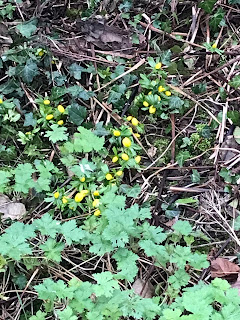
| Winter aconites |
Monday, 24 January 2022
Spring in winter
As the days get longer, nature starts moving towards spring, even though the coldest days of the winter are probably still to come. The January weather has been relatively mild for the time of year, on the dry side and with no serious wind. There have been some chilly days and some frosty nights – the max-min thermometer outside the back door registered -4C the other night – but on one sunny day last week there was a definite touch of warmth in the sunshine. Altogether it’s more early spring than midwinter at the moment, and animal and plant life is responding accordingly.
Some of the dahlias are still in the ground outside, with
the remains of the panicum collapsed on top of them; I’m hoping that that might
help protect the dahlia tubers from the worst of the cold. (I am gradually progressing towards being
physically able to bend down and dig them out.)
The panicum is rather dishevelled but modestly pleasing in a Piet Oudolf
sort of way; it’s not my preferred look for the garden, but it’s better than
the straggly strands of old couch grass that prevail in some other parts of the
borders.
| Galanthus elwesii |
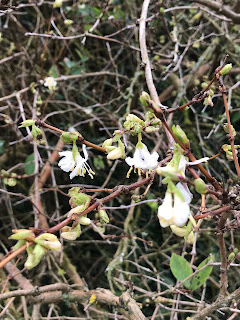
The early spring flowers are starting to put on a show; although the first snowdrop to open was one of the Galanthus atkinsii, the first clump to be in full bloom was the G. elwesii under the purple-leaved prunus. The big hellebore in the front garden is showing a few flowers, and the winter honeysuckle (Lonicera x purpusii) is looking – and smelling – good. (It really needs hacking back; it’s a big sprawling shrub which frankly has little to offer for much of the year, but its little scented flowers through the winter and the fresh new foliage in the early spring earn it its keep.) And in the veg plot, the Rhubarb ‘Timperley Early’ is starting to push up its first stalks.
| First hellebore flowers |
| Winter honeysuckle |
| The rhubarb coming to life |
There are also definite signs of spring in the bird world, rather earlier than normal. What I take to be the usual two patio robins – the thin one and the plump ‘Christmas card’ robin – seem to have paired up again and are regularly feeding together, and there have been another two at the opposite side of the house, by the garage. The sparrows that nest above our bedroom window are already refurbishing their home. Usually at this time of year we occasionally see birds, particularly sparrows, picking up a feather or blade of grass, as though they have a vague notion that this will be useful to them in due course but they’re not quite sure how, before dropping it and going on their way regardless; but this year there is definite building work going on, with strands of grass left hanging out of the gutter and the odd dropped feather drifting slowly down past the window. Lefty the lame pigeon is still coming regularly to the patio for breakfast, but his lady is now coming too; perhaps they’re also thinking of nesting?
Down beyond the bottom fence, the pile of big branches from
the big ash tree is still lying in the field; the contractors may be leaving
them until the ground dries out enough for heavy machinery to come and move
them. The wildlife seems to be enjoying
them; one day there was a small flock of finches (chaffinches, goldfinches and
a few greenfinches) poking around in the grass around them, a blackbird (we
have several at the moment) perched on top and a wren fossicking about in the
pile. Fieldfares are making the most of
the windfall apples, a pair of mistle thrushes sometimes perch in the trees and
the long-tailed tit family call by the fatball feeder from time to time. Next weekend is the Big Garden Birdwatch, and
I hope we’ll have a good turnout for that.
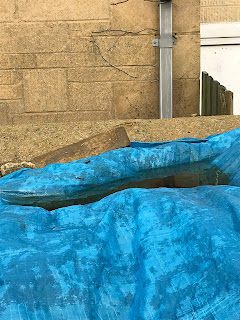
| The birds' swimming pool |
Speaking of woodpiles, the firewood stack saved from the felling of the tree on our drive has provided an unexpected amenity for the birds. The wood is covered by an old blue tarpaulin to stop it getting too wet, with various weights on top to keep everything in place (no gales this year yet, but it’s only a matter of time). Because of the irregular shape of the stack, there are dips and hollows in the tarpaulin, and one of these has filled with rainwater, creating an ideal bathtub for pigeons and the odd blackbird. It’s even the right colour for a swimming pool. It wasn’t our intention to create a lido for the birds, but they’re welcome to enjoy it.
Saturday, 8 January 2022
Opening 2022
| Open or not? |
It was a relatively warm start to 2022; a mild December finished with the warmest New Year’s Eve ever recorded (16C / about 62F in London) and 2022 began with the warmest recorded New Year’s Day (17C / about 63F n London). Not quite so warm here, of course, but still well above the norm. This was followed by a few days of much chillier weather, with a couple of frosts overnight, and now things are swinging back to single figures C during the day.
The mild
weather was evident when I went out to count the number of species with open
flowers on 1st January. Of
course, it depends on what you consider to be an open flower. One of the early snowdrops (the Galanthus atkinsii
down by the summerhouse) was showing the outside of its flower but wasn’t yet
actually opened; but really, you can’t see inside a snowdrop flower anyway unless you
get right down to its level, so does it count or not? Let’s say not, in which case there were 15: the
usual winter shrubs:winter jasmine (jasminum nudiflorum), winter honeysuckle
(lonicera purpusii), the winter viburnums, especially Viburnum x bodnantense
‘Dawn’, Mahonia ‘Winter Sun’ and the rosemary; several out-of-season blooms on
the senecio (or whatever it’s called nowadays); a few blooms on some of the
hardier perennials: Comfrey ‘Hidcote Pink’, the little red chrysanthemums, the alpine
strawberries, some rocket running to seed, and one flower on each of the purple/blue
campanula by the drive (one of the spreaders - portenschlagiana or
poscharskyana?) and the vinca major in the wall; as well as a few weeds:
daisies, euphorbia palustris, and meadow grass.
And a day or so later a creeping buttercup flowered in the lawn.
I discounted a
few plants with summer 2021 flowers still hanging on grimly, but in too poor
condition to be reasonably regarded as ‘flowering’: the rose ‘Blush Noisette’,
the gazanias (now moved into the greenhouse for protection from the frosts) and
a couple of antirrhinums. Likewise a
number of early-flowering plants were showing well-developed buds: the
snowdrops as mentioned above, the hellebores and the choisya. And the first daffodil leaves are nosing up
in the lawn just beyond the buddleja; some supports have been put in place to
stop me walking on them.
The birds have
been visiting in search of food, especially on the colder days. They are mostly the regulars – good numbers
of blue and great tits especially – though a brambling dropped by one morning. A pied wagtail was around one afternoon, scrapping
with one of the robins, and a long-tailed tit (they haven’t been much in evidence
these past few weeks) came to the fatball feeder one day. A tawny owl was calling the other evening
from somewhere very close. We have three
robins in the garden, and two of them are starting to tolerate each other’s
presence as a preliminary stage in their courtship; while we still have to ride
out the worst of the winter, they are obviously already starting to think ahead
to spring!
Friday, 31 December 2021
The turn of the year
| Mahonia 'Winter Sun', brightening up the garden |
It’s been a funny old year in several ways, and not a great one in this garden – but I’ve said a lot about that in recent posts, so I won’t repeat it here. Suffice to say that my gardening New Year resolution is to get back to basics and sort out the important stuff first and foremost. There have been a couple of sunny afternoons this week which have got me outdoors again and making a start on the overdue clearing-up jobs in the greenhouse and garden: cutting up and composting plants such as the tomato plants (which had been surviving – just – on the damp atmosphere in the greenhouse without watering), unusable brassica plants (there are still a couple of usable cabbages and developing broccoli spears) and the fallen climbing beans, and spreading the used tomato-bag compost on one of the veg beds.
The weather this
year wasn’t great either; nothing extremely dramatic, but there were long
periods of static weather systems that were either not at all typical for the
time of year or not at all helpful to the gardener. The year started cold and, except for a
couple of unseasonably warm weeks in February and again at the end of March, it
remained mostly cold through to near the end of May, April being very dry and
May being very wet. The summer brought a
spell of heat in July, but also some chilly weather, and there was little sun
in August; the autumn gave us some very wet and windy weather in October,
although September wasn’t too bad and November was overall milder and less damp
than usual. There was wind and snow at
the end of November, then December has been mostly misty, murky and mizzly, unusually
mild but with very little sun, and in the last few days quite windy.
Some plants have been enjoying the recent mild weather and a few are putting out new shoots, and the winter shrubs are all flowering well. The forecast is for rather colder but a little drier weather in early January, which might make it easier to tackle more jobs in the garden. Happy 2022!