| The parched path to the summerhouse |
| Wilting violets and lysimachia, but upright sedums behind |
| Hello there! |
| Allium bulbs, yum yum |
What's happening in a Cotswold garden - plants, weather, birds, other wildlife
| The parched path to the summerhouse |
| Wilting violets and lysimachia, but upright sedums behind |
| Hello there! |
| Allium bulbs, yum yum |
Sadly, Peter Rabbit is no more. He had been a most entertaining fixture in the garden for a few weeks, hanging out around the veg plot and occasionally venturing out onto the lawn (and into next-door’s garden, to the annoyance of their dog, who wasn’t allowed out to chase him). He nibbled some of the veg plants, which had to be protected, but seemed happy with clover and grasses on the lawn; and from time to time he would chase the pigeons, apparently just for fun (the pigeons mostly ignored him). Then, on Sunday morning he was found stretched out on one of the veg plot paths near the rhubarb, quite dead; there was no sign of him having been attacked in any way, and we assume that he had just died.
The difficulty of finding a suitable spot to bury deceased wildlife in this garden has already been mentioned. A place under one of the osmanthuses was selected, where the vegetation needed clearing in any case; a lot of the Buddleja alternifolia had to be cut out (and about time too), and a quick decision taken on the self-sown hypericum (dig out!). A suitably deep-ish hole was dug and Peter was laid to rest, with a Geranium nodosum (little pale pink flowers, likes shade) on top. We had got used to looking out for him and now miss him.
Meanwhile, the garden marches on. June had a couple of warm spells – the usual ‘two
hot days and a thunderstorm’ – but overall was rather chilly and windy, with
some showery rain; July is shaping up to be quite a lot warmer. We’ve just had a few days of heat, followed
by a drizzly day today, with more heat from tomorrow. Real rain has been in short supply, and it is
once more an uphill battle to keep all the little pots watered; I shall have to
bed the plants out temporarily into one of the empty veg beds, though I know
only too well how easy it is to leave them there and let them become fixtures that
are not easily removed! The bottom end
of the veg plot has already morphed into a sort of ‘cutting garden’, with
antirrhinums, foxgloves and sweet William making a bright corner in sweet-shop
colours and providing vasefuls of flowers. Should I leave them there? Might not be a bad idea!
| A colourful corner |
The unmown area under the plum tree is full of orchids (pyramidal orchids); I reckon there are over 60. The photo gives a poor impression and only shows a few of them, as the shade and the long grass makes it difficult to get a good view, but it’s a splendid show.
![]() |
| Orchids under the plum tree |
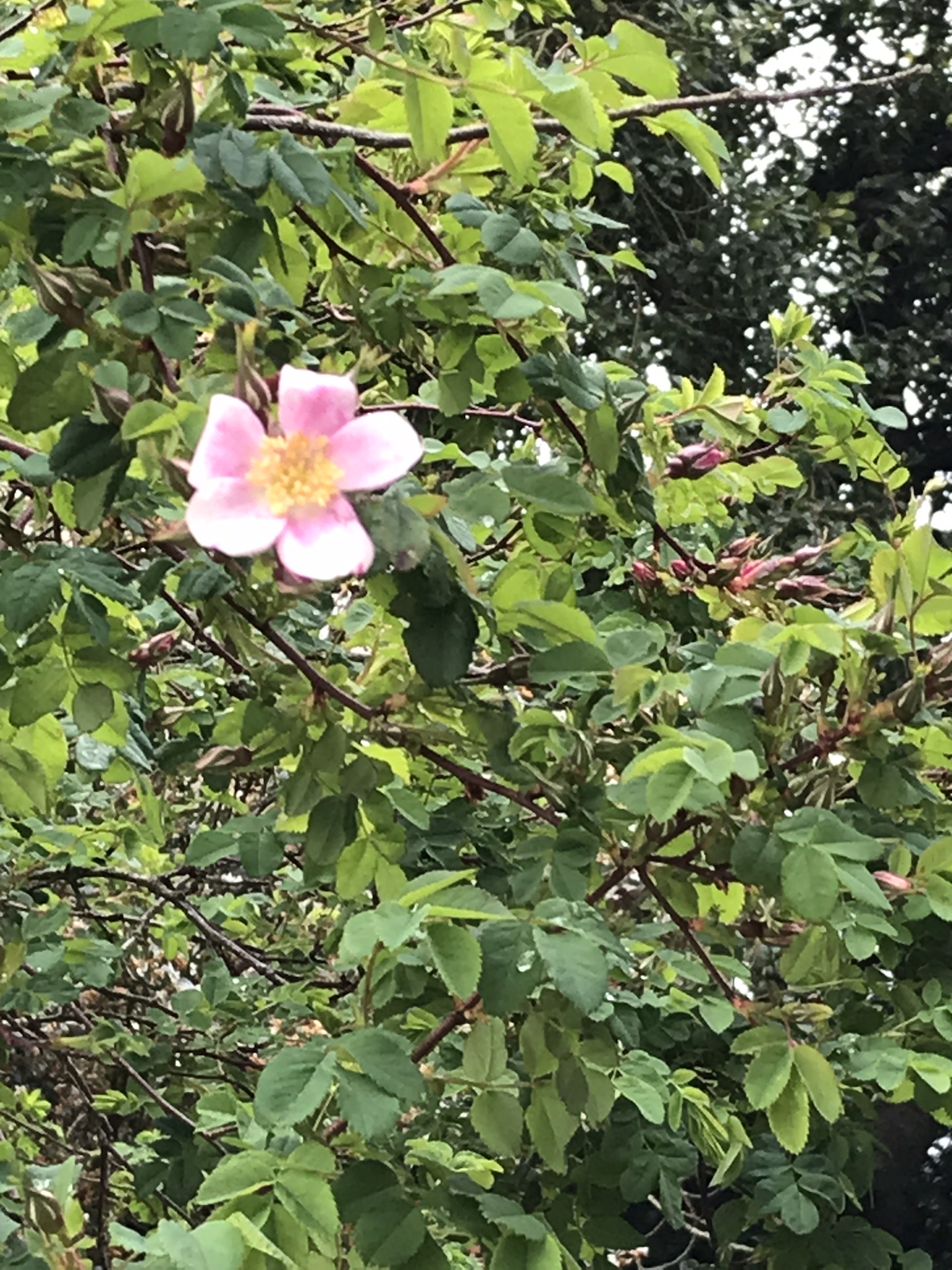
The roses are a little past their peak, but still blooming freely. I always forget to celebrate Rosa dupontii up the side of the house; it has little scent, but it’s a lovely flower (and the bees think so too, nb one in the photo!). The sweet peas have also provided a few posies for the house: red, white and blue (pity they weren’t in bloom for the Jubilee!).
| Red, white and blue sweet peas |
| Rosa dupontii |
I have done one job that has been put off for too long: repotting the azalea (A. ‘Rosebud’) in fresh compost. It might be too late, as the top growth is quite sparse, but it’s an old plant (from our last garden, so over 30 years old) and it has done well. I hope to do the camellias as well, once they’re past their flowering time.
Fine double rainbow this evening - pot of gold down in the field ....
We have a baby rabbit in the garden.
| Peter Rabbit |
It's not the first time: a good many years ago, during a couple of summers we had one appearing, staying for a week or two and then vanishing. I believe that rabbits can breed from six weeks old, and I’m guessing that they reached maturity and went off in search of company of the opposite sex. But that was a long time ago, before this blog started, and there has only been one very brief sighting of a rabbit here since then.
Then a few evenings ago, baby Peter Rabbit turned up on the
drive, checking out the woodpile by the garage.
It’s mostly covered by a rather tatty tarpaulin which doesn’t reach the
ground but is weighted down by the upturned wheelbarrow, and there are plenty
of places where Peter could get in to hide among the logs or under the
wheelbarrow (wheelburrow?). He sat
there, like an adult rabbit outside its burrow, until it became too dark to see
what he was doing. Since then he has
moved down into the veg patch, probably hiding in the long grass and garden
debris that is behind the greenhouse (old pots, pallets, builders’ sacks, etc)
and that would provide plenty of burrow-like hiding places. The last few days have been very warm and
sunny (after what seems like weeks of chilly and windy weather), and he doesn’t
seem to care much for the heat as he lies low during the warmest part of the
day. He doesn’t seem much bothered by my
being around, nor does he do much damage to plants. He had a nibble of one of my young borlotti
bean plants, and yesterday he did a little light pruning of a couple of kale
plants until I gently made my displeasure known and he bounced off towards the
apple cordons, which seem to be his daytime safe place. But unlike his Beatrix Potter namesake, he
hasn’t touched the lettuces or carrots.
I hope he stays for a little as he’s quite endearing.
Last night we also had a visit from Mrs Tiggywinkle (or
perhaps Mr T, as he was quite a large hedgehog), who came to the patio for a
drink and then trundled off again. He or
she is probably a regular here, as we see plenty of droppings but this was the
first actual sighting this year.
Plant protection against nibbling and pecking (the kale plants also look as though the pigeons have been at them) is under way. The kale is too big for bottle cloches, but the French beans, which have also been attacked, are now under cover. I think some wire netting might do the trick with the kale. The climbing beans seem ok. I’ve constructed a rather rickety-looking frame for them to climb up, which I’m hoping won’t fall over as last year’s did! It looks like my home-made dogwood supports for the sedums and achillea are doing the job; at least the achillea isn’t sprawling outwards just yet.
| A bit rickety? |
| Achillea, upright for the moment |
The flowers in the veg patch are keeping me going nicely in cut flowers: sweet William (Dianthus barbatus) and antirrhinums have filled vases, and there are foxgloves as well. The dogwood bed by the patio is looking very colourful in a rustic, romantic sort of way: mostly sweet rocket (Hesperis matronalis), largely blue and purple aquilegias and Allium christophii. The sweet rocket and aquilegias aren’t too good in vases as both are prone to dropping lots of spent flowerheads all over the place. However that bed is now starting to fade, with the peonies and roses just starting to come into bloom in their place.
| Sweet rocket, blue aquilegia and Allium christophii |
| Antirrhinums |
| Sweet William |
The first fledgeling sparrows are coming to the patio, there are young tits around, a baby robin down by the summerhouse and two young blackbirds who seem to get everywhere. Something small was in the greenhouse yesterday, fluttering about and taking refuge in the mess of old pots, seedtrays and other detritus at the far end when I popped in. I couldn’t see what it was. Baby blackbirds usually panic and flap about at the glass, but this one seemed to freeze and stay completely still, and I couldn't spot it. I was in a hurry and had to leave it, having assured myself that there wasn’t anything that it could get tangled up in, and it seemed to have gone when I got back. Possibly a wren, like my little visitor last year?
After the mostly mild and dry weather earlier in the spring, the past couple of weeks have been showery and quite chilly at times. The temperatures haven’t been all that low – in the low teens (Centigrade) – and the sun is often warm when it’s out, but that persistently cold wind from the north and east has been keeping it feeling most unseasonal. Jumpers have been taken out of the wardrobe, and one evening I relented and turned the central heating back on.
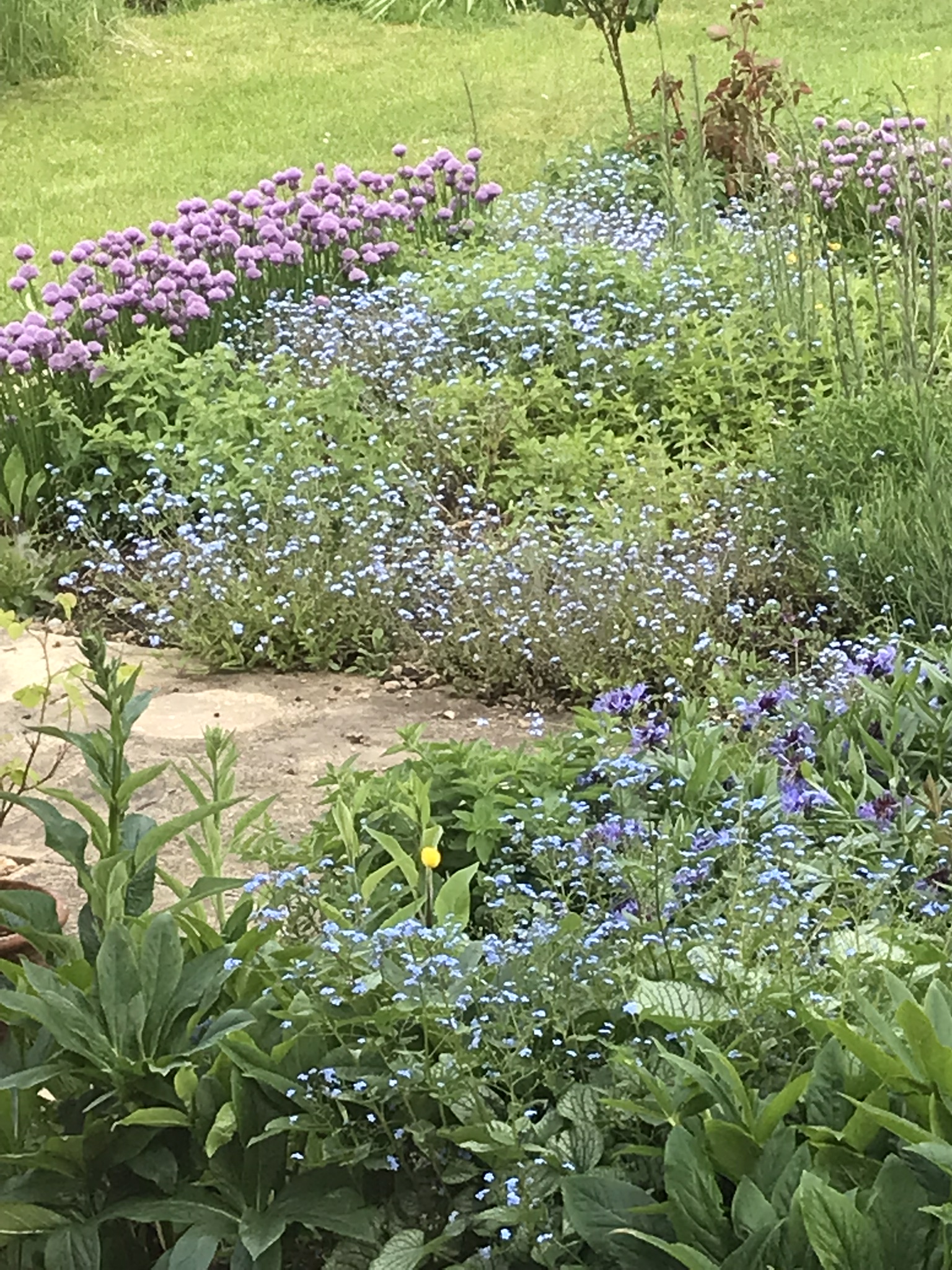
Despite the chill, the plants march on. The forget-me-nots have proliferated this
year, providing a most welcome haze of blue; together with the green of the
self-seeding oregano, and the purple chive flowers, they made for an attractive
picture in the old herb garden. However
I’ve learnt that they need to be pulled up before they finish flowering;
they’re one of those plants that are still in flower at the top of the stems
while the spent seedheads further down are already scattering their seeds. So they’ve all been removed, from this bed
and anywhere else that they’ve appeared, before too much seeding has taken
place – leaving gaps that need to be filled by something else. Interestingly, the gauzy panicum plants that
were in there last year don’t seem to have seeded, which is a pity as I didn’t
sow any this year. There’s a splendid
white foxglove (visible in the left foreground of the photo) by the terrace; I seem
to have a good number of white ones in various parts of the garden this year.
| Forget-me-nots in the old herb garden |
Over in the dogwood patch, which is still in much need of weeding, things are much more colourful, with the aquilegias (mostly various pinks and purples) and sweet rocket (Hesperis matronalis) in full flow. The peony and roses are still to come. In the veg garden, where I’ve left a couple of beds with self-sown flowers for cutting, the antirrhinums and sweet William (Dianthus barbatus) are just starting to bloom. And the wisteria flowers are now going past; they’ve been superb again this year.
| Antirrhinum bed, just starting to flower |
| First Sweet William flowers |
| Wisteria, in full flower |
In the lawn, two of the twayblades are flowering. They're very unshowy little plants, greenish-white and with a flower-spike barely 14cm / 6ins high); in fact you have to peer closely to see them properly, but any sort of orchid is welcome in the garden. One seems to have rather misshapen leaves, possibly because it was accidentally mown earlier in the month; the other is in the unmown part of the lawn, among the pyramidal orchids (there are leaves of a pyramidal orchid just behind it in the photo) and lots of speedwell!
| Twayblade one ,,, |
| ... and twayblade two (look closely!) |
The local birdlife is still busy with nesting. A female mallard wandered across the garden one day; probably come up from the pond at the bottom of the hill but still an unusual sight in this garden. The following day I was chatting to neighbours over the front garden wall when presumably the same duck came scuttling round the corner, pursued by one tiny cheeping duckling, only a couple of days old; mum was apparently looking for the rest of her brood as she was quacking quietly and poking around in the long grass. They disappeared into said grass and we left them to sort themselves out!
The wild world is relatively easy to observe at close quarters when you live in the country, but there’s close and there’s close.
I mentioned in a recent post that I’d seen a stoat in the
garden – not quite unprecedented, but extremely unusual. One morning the other week I was washing up
at the kitchen sink and glanced out of the window in front of me. The stoat was standing on the sill outside
the window, barely two feet from me with only a pane of glass between us, and
watching me carefully with its bright little eyes. After a brief moment
it turned and scuttled off across the roof over the cellar steps. It hasn’t returned (as far as I can tell);
with so many birds nesting around the place it could cause a lot of damage, so
fingers crossed.
| "What are you doing in my pot, Lefty?" |
Our other close encounter was with one of our baby blackbirds. We put out the last of our cooking apples into one of the larger pots on the patio to keep the apples away from four-footed creatures, where Dad blackbird gratefully fed them to his two youngsters. They took to visiting the pot in the hope of being fed, although it wasn’t always Dad who was there! The photo shows a rare visit to the pot by Lefty the lame pigeon, with a rather bemused young blackbird waiting for Dad. The end of the apples coincided with Dad deciding that his fledgelings were old enough to fend for themselves, although one of them was still hesitant about finding food. For a day or two I put extra food out for him (crushed bits of fatball, breadcrumbs) into places where he could see it, and he became quite trusting, following me hopefully around the garden at a discreet distance. On the third day he was so used to us that he would come up close, chattering quietly to us, and even sitting on the summerhouse veranda steps by our feet. And the next day he was gone. Initially we feared the worst (the stoat!), but it’s quite likely that he has joined his little sibling in seeking their own bit of territory; two young blackbirds who look very like our two are now hanging out in the bottom hedge and the young male is content to come fairly close to the summerhouse. I hope they’re our two little friends.
Not quite so close and not as friendly are the great tits, who are taking food into the nest box on the summerhouse wall. They were rather apprehensive when we started sitting out there as the weather warmed up, but have persevered and are raising their family, quietly and inconspicuously and presumably hoping that we haven’t noticed.
The weather is gradually getting warmer, although that chilly
wind has come back from time to time. Yesterday
was warm and sunny, with lunch on the summerhouse veranda, today wet and drizzly (but any rain is, quite genuinely, ‘good
for the garden’ – overall it continues to be a dry spring). Flowers are coming out relatively early: lily
of the valley for cutting on May Day, and the first rose of the year (‘Mary
Queen of Scots’) opening the same day. There
has been a good display of the big red tulips, which seem to have bulked up
over the years, and the honesty is spreading a little; I’ve noticed that the
orange tip butterflies seem to be attracted to it (laying eggs?) so I’m reluctant
to remove too much of it.
| First bloom on R. 'Mary Queen of Scots' |
| Bright red tulips (variety unknown) |
| A posy of Lily of the Valley for May Day |
The dahlias are being wheeled out of the greenhouse during the day to harden them off. Last autumn, forbidden to bend down too far, I had to leave some dahlias in situ, either in the ground or in their pots; a couple of pots were taken into the greenhouse complete with their contents, which protected the dahlias over winter, but the others had to take their chances outside. Those in the ground are looking rather dead; there were three ‘Bishop of Auckland’ dahlias in the biggest pot on the patio (too big for the greenhouse door) and I was confident that even the mild winter would have been too much for them, but I’ve recently noticed that all three are showing the first dark purple leaves at the base. They are sharing the pot with a couple of white osteospermums and some self-sown violas which are providing a bit of colour at the moment; I’ll leave them to cohabit over the summer, with a little fertiliser to perk up the compost, and try to disentangle them in the autumn!
My next task will be to find some red, white and blue, and
purple, flowers for the Queen’s Platinum Jubilee (purple being the Jubilee
colour). White, blue and purple I can manage,
but the red tulips will be finished by then and I think I’ll have to rely on
whatever I can find in the shops!
So far, spring has been pretty dry, thanks to a chilly east wind that's keeping rainy North Atlantic weather at bay. Some light rain is forecast for Sunday (bound to happen, it’s a Bank Holiday weekend) but it remains to be seen whether it makes much difference. There’s no rain in the forecast after that.
The plants in the ground are managing, but all my little
pots, mostly cuttings taken a couple of years ago, are looking rather dry. There are
some that are only fit for the
compost heap, while others are getting by with the occasional spell sitting in
a basin of water. The cuttings were
taken to keep my garden stocks going – some, such as Erysimum ‘Bowles Mauve’,
are short-lived and need regular replacing – with the surplus destined for the
village plant sale; but the pandemic has meant that there has been no plant
sale in the past two years, leaving me with too many plants. I don’t feel too bad about throwing the runts away, although a few can be rescued, re-potted and grown on, and given to
this year’s sale in late May.
Among the cuttings are two from the cistus that formerly
grew near the gas tank. That area has become
overrun with weeds, mostly ground elder; the cistus itself grew too large and
lanky (and cistus don’t take kindly to pruning), and finally the cold
winter a couple of years back scorched it into a miserable thing. I took cuttings (learning the hard way that
you need to wait until after it has flowered to do this successfully) and
pulled the remains of the parent plant up. The
ground elder is still there, in ground that is too stony and hard for digging
so can only be weeded by hand, waiting for me to have a lot of spare time (ha!)
to tackle it. My two little cuttings,
meanwhile, are in good shape but I’m unwilling to pot them on; I need to keep
the rootballs small so that they can go into this poor soil (not possible to
excavate too large a planting hole). Hmmm.
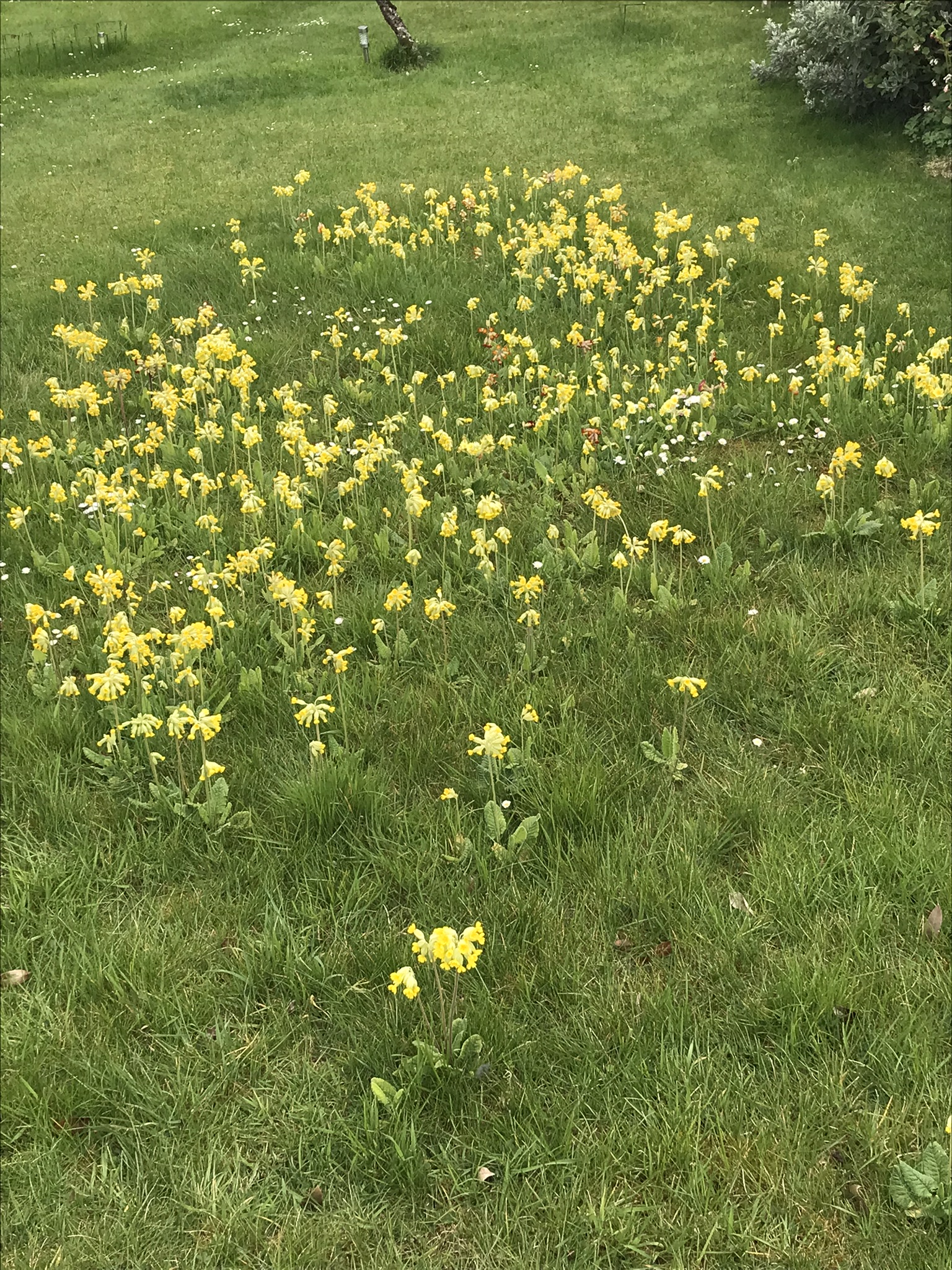
| Cowslip patch in bloom |
There’s a fair bit of colour in the garden at the moment, with the cowslip patch in full bloom and rocket flowering along the long hedge path. Down at the bottom of the garden, the alliums are about to flower.
| Alliums about to open |
Indoors, the tomatoes and courgettes are germinating. I sowed seeds of five tomato varieties, cherry
tomatoes ‘Apero’ and ‘Cherrola’, beefsteak ‘Costoluto Fiorentino’, and old
stalwarts ‘Gardener’s Delight’ and ‘Harzfeuer’; the latter two are very old
seeds, and I sowed a whole row of ‘Gardener’s Delight’ thinking that hardly any
would germinate, but some have indeed come up, as has one ‘Harzfeuer’. Too many plants, but I can gain some brownie
points around the village by giving away the surplus.
| Tomato seedlings - 'Gardener's Delight' just showing! |
The dry soil is also making things difficult for the blackbirds, who are feeding little ones but aren’t able to find many worms. We still have the last few of last year’s apples, now at least partly rotten, which we’re putting out gradually to give them some easy food to tide them over until the gooseberries come along. The apples are being left out for them in one of the large flowerpots on the patio, now empty of plants but with a good depth of compost, to keep them accessible to birds but inaccessible to four-legged garden visitors (principally the rat that was visiting a few weeks back; it may or may not be the one found dead in the garden the other week, but we’re not taking chances). Mum blackbird seems to be back on the nest, but Dad is feeding the two fledgelings from the first brood and making great use of the apples. The robins are also not averse to stealing a beakful or two when the blackbirds aren’t around (and sometimes when they are around!).
| Dad blackbird feeding apple to his youngsters |
A very unusual sighting this past week, when a lovely male siskin, all bright green and yellow, briefly stopped by the bird bath for a drink.
We’ve had a real mix of weather this month – a ‘blackthorn winter’, with cold days and frosty nights, and a warm and sunny Easter weekend; currently cloudy with a chilly easterly wind. But overall it has been mostly dry, and often pleasant enough for gardening; being busy in the garden, I haven’t had much time for posting here, so there’s plenty to catch up on.
| 'Couleur Cardinal' tulips |
Most of the late winter/early spring jobs have been
done. The apple tree has been pruned,
except for a few high branches that I can’t reach; they’re a job for another
year, as I’ve already taken out some big branches and daren’t take these out
too. The buddleja has only just been
pruned. It was a complex job. Last year the plant was knocked around by
various gales, snapping some branches and leaving others leaning into the plant
at odd angles; and the relatively mild spring has caused a lot of shoots to
grow quite tall. Getting at the old
broken stems and removing them without damaging the new ones took a fair bit of time. This year I’ve cut up the thin
prunings for composting in the Hotbin, which I’ve just restarted (it went cold
last autumn and my inability to bend down meant that I couldn’t empty it to get it going again until recently). The bin is
again firing on all cylinders, and the half-composted material from last year
has been used, under black polythene, to suppress weeds by the edge of the
patio.
I’m rather later than usual in sowing seeds; tomatoes and
courgettes are only just sown, and ornamentals and most vegetables are still
awaiting attention.
The lawn has been cut a couple of times, avoiding the large
(and growing) patch of cowslips, and an increasing number of orchids.
I’m not the only one who has been busy around here. Nesting is in full swing. A pair of robins have been busily taking
nesting material into a crack in the neighbours’ garage roof, as seen from our
kitchen window, and a blackbird was gathering grass to take into the thick ivy
round the base of the electricity pole by the drive entrance – she looked
rather like a flying haystack. A song
thrush collected moss from near the pond, and I think took it into the hedge by
the holly tree; she occasionally appears round the edge of the lawn to feed. There are two male wrens down at the bottom
of the garden, singing furiously at each other, so there are probably a couple
of nests down there too. During the warm
Easter weekend we were able to eat in the summerhouse, to the apparent
consternation of a couple of great tits who came to sit in the hawthorn tree,
staring at us through the window; they occasionally had nesting material with
them, and seemed interested in the nest box but unable to pluck up the courage
to use it. I hope they’ve found
somewhere in the ivy-covered damson thicket a little further along the
fenceline.
Our patio blackbirds are being very grateful for the
partly-rotten apples that we’re still putting out for them; they nested early
and are feeding little ones. Yesterday
two youngsters broke cover and followed Mum to the patio for food; today Mum is
back on nest-building duties, collecting a huge beakful of grass and moss and
taking it towards the hedge, for the next brood.
Despite our best endeavours, starlings appear to have found
a gap high up in the north gable and are nesting there; we blocked up their
previous entrance, but they are persistent.
They’re messy neighbours, although now that the ash tree has gone their
flight-path out of the nest seems to have changed so that their droppings now
fall further away from the drive.
A couple of nest-related mysteries. A male sparrow was found flying around inside
the (locked) porch one day. How did it
get in? One had been sitting on the
porch guttering the previous day, and I’d guess that it tried to find a nesting
site in the porch roof; there must be a crack through to the interior somewhere. The other nest mystery wasn’t
a bird, though we’re not sure who was responsible. There are a few neat round holes in the grass
at the edge of the path – there’s a photo in a previous 2020 post – which are
probably being used by a small rodent or bees, but one day a fragment of green
tarpaulin was found wedged down one of the holes. By whom?
We left it in situ for a few days, but had to remove it to mow the lawn
and didn’t put it back. I hope whoever
put it there didn’t mind.
| Tarpaulin in the hole |
Four-legged visitors are also around. One day I went to inspect the little fig tree by the wall (flourishing), and suddenly noticed a rat near my feet. It was among some old buddleja prunings, stacked there out of the way, and appeared to be asleep, but further tentative investigations showed it to be dead. I expect it didn’t feel well, tucked itself into a safe place and just fell asleep. Fortunately the ground round there is stony but diggable, so a fairly deep grave was excavated and it was quickly tipped in. Definitely alive, on the other hand, was a stoat that was very briefly spotted yesterday running along the wall from the woodstore to the gas tank.
Indoors, a friend brought a bunch of roses, which are brightening
up the dining table. I don’t grow hybrid
teas myself, but they do have the most perfect blooms!