Monday, 18 September 2023

A trip to the garden centre

A lot of catching up to do on the blog!

I’ve recently been down to the nursery where I normally buy my potting compost, to stock up for the autumn planting, and bought three sacks of my usual compost.  Good stuff (you can’t always rely on this, even from this normally reliable brand).  It hasn’t always been thus.  Back in June, I changed my routine and went to a garden centre instead.

Good stuff

In early June the weather had suddenly turned from unseasonably cold to very warm.  One week I had given in and switched the central heating on for a couple of hours, the next it was windows open and curtains closed to keep the house cool.  It was officially a heatwave (there are rules about this, apparently) – which meant a lot of carrying of watering cans up and down the garden.  The nighttime temperatures more than doubled over two weeks previously, and the more tender vegetable plants (summer beans, courgettes) were planted out, and needed watering.  In the greenhouse, the tomato plants were put into their d-i-y growbags, using up all the remaining compost that I had left over from the previous autumn – so a trip to get some more was in order.

Normally I buy my compost from a place whose main customer base is the trade, but which sells in smaller quantities to domestic gardeners; however I also wanted some bedding plants, so it had to be an outing to the garden centre.  Garden centres are dangerous places; it’s all too easy to come home with all sorts of things you had no intention of buying (especially plants).

This time I was quite clear in my mind what I needed, and stuck to it.  Besides needing the compost, I wanted to put some summer colour into the windowbox.  The windowbox is the only bit of the front garden seen by most passers-by; there is a bed behind the front garden wall, but it’s not easily visible from the road (which is usually a good thing!), and the rest of the front is gravelled.  I’ve never managed the sort of spectacular container planting that some gardeners achieve, but the windowbox had a passable display over the winter: a bronze sedge, a couple of small rosemary plants grown from cuttings and a small Euonymus ‘Emerald ‘n’ Gold’, also from a cutting, to provide a bright and cheerful note; and some Crocus ‘Blue Pearl’ and daffodil ‘Tete a tete’ for spring colour.  But the bulbs had long since died back and something more was needed for the summer.  The garden centre provided a tray of pale blue lobelia and a ‘Sunpatiens’ (sic), a bedding impatiens with nice pink flowers.  With a couple of lavenders – more cuttings – and a few of my seed-grown Cosmos ‘Xanthos’, they made a decent display.  The sedge, rosemary and euonymus were potted up, and the bulbs fished out and stored, all for future re-use.  The rosemary plants in particular will be valuable, as the original parent plant is in poor shape (the cold winter?) and ought to be dug out; I’ve taken more cuttings from it, but having the two ex-windowbox plants as insurance is useful.

Window box, planted up

I also needed ericaceous compost, to repot the two camellias in the front garden.  Neither had been repotted for years; the older one, a Camellia williamsii ‘Donation’, flowers tolerably well but has become rather woody, while the other has never flowered, and I thought some fresh compost would give it a second chance.  I’ve since repotted the latter, and it’s now looking a lot healthier, but ‘Donation’ is still waiting for attention.  If there’s any compost left over I’ll use it to repot the azalea, which is seriously elderly and was brought back from the brink last year with careful pruning and the addition of some rather old compost round it.  (I’ll be interested to see if the camellia that has never flowered blooms next spring, and if so, what colour the flowers are.  When I bought it, I was looking for a red-flowered plant, and chose one based on the photo on the plant label.  I was about to head for the checkout when I noticed another camellia with the same photo – but a different name!  So I went instead for one labelled ‘Ruby Wedding’, on the basis that it ought to be red.  But I’ve never had the chance to verify that.)

Camellia 'Ruby Wedding', repotted

While at the garden centre, I also bought a couple of bags of soil improver, intended for those front garden beds behind the front wall.  The soil there is atrocious, and a good layer of mulching with soil improver should help matters considerably.  But since then I’ve found another area that could benefit from the stuff – so I may return to the garden centre for more!

Rather than carry on down the road to my usual compost supplier, I thought I would save time by buying my ordinary potting compost from the garden centre.  Mistake.  The peat-free compost brand that they sell is a widely available one, which I’ve found in the past to be very variable in quality.  A few years ago I got some from one nursery and it was reasonably good stuff, so I got some more (same brand) from elsewhere and it was just wood shavings.  This time, when I got it home and opened up the bags, it was spongy stuff with all the consistency of chewed-up felt carpet underlay.  I used it with some home-produced compost mixed in, and it has been just about ok, but I’m glad to have returned to my usual brand.  There’s some of the carpet underlay left over, and I’ll spread it on a few of the veg beds as part of the autumn mulching process.

Caveat emptor …

Saturday, 26 August 2023

The revenant

Our fears for Lefty seem to have been premature.

He has been back – just once – to have a drink in the bird bath, and briefly limped across the patio with Mrs Lefty, but has not returned since.  D saw a woodpigeon with a trailing left leg in flight – as Lefty had – over the fields opposite the house, which supports our theory that the old bruiser is still around.

The nearby fields have been mown and there is plenty of grass seed around for him to feed on.  He did seem very dapper, as if he had moulted, and well fed, so there is obviously good living to be had in the area; but he doesn’t seem to have shown any inclination to re-join Mrs Lefty.  Perhaps he was upset by the destruction of the original nest, and doesn’t trust us enough to come back? 

Mrs Lefty, on the other hand, rebuilt her nest in the wisteria and settled down to brood two chicks, which have now flown the nest; at least one is still about, and was seen today being fed by Mum in the garden; they are probably spending most of their time over in the fields, away from the threat from us.

We’re hoping that Lefty might return when food becomes less easy to find as the weather cools.  Not that the weather now is particularly warm.  June was hot and dry, but July was cloudy and wet, with wind at times and not much sun, and August not much better.  There is not much relief promised in the forecast.  This is in stark contrast to southern Europe, which has been alarmingly hot; but the Jetstream is staying to the south of the UK, keeping us unseasonably chilly.

Despite the cool weather, July saw the return of the butterflies.  Earlier in the year they had been much fewer in number than usual, but the flowering of the large patch of oregano in the garden attracted good quantities of bees (of various types) and butterflies.  A marbled white was about for a while, and a scarlet tiger moth spent a few days here; I’ve also seen a hummingbird hawk moth on the mint and buddleja.  (And, speaking of mint, there have been tiny moths which I think are mint moths, although they seem more attracted to the oregano!).  The holly blues have been overtaken by the common blues, and we’ve had a couple of brown argus (another type of ‘blue’ butterfly) as well; meadow browns, small heaths and gatekeepers have been plentiful, with a few ringlets; and in August the summer red admirals, tortoiseshells and peacocks, and a painted lady, came out.  I’ve learnt to identify small coppers and skippers; and today I saw a speckled wood on the brambles across the lane.

Scarlet tiger moth

Marbled white

Small copper

And, after a bit of a hiatus – too much going on and needing done! – I’m also back on the blog, with much catching up to do …………..

Monday, 10 July 2023

Missing, presumed gone

Lefty, our lame woodpigeon, has disappeared and we fear the worst.  He has vanished before for a couple of weeks or so at a time, usually later in the summer, when we guessed that he might be quietly moulting somewhere and living off the abundance of seeds and fruits out in the local fields; but this time his mate Mrs Lefty is still around, solitary and looking rather forlorn, and we think it unlikely that he would have left her un-chaperoned for any length of time.  There are no signs of a fight, no giveaway piles of feathers in the garden or crushed remains in the lane, and no indication as to what might have happened to him; and no body to bury.

I feel particularly bad about it, because just before we last saw him I had intervened in his attempts, with his lady, to build a nest in the wisteria.  In fact, I pulled the sticks that formed the beginnings of the nest out of the plant, and gave it an early summer prune to remove the concealing cover from the site.  It’s illegal in the UK to disturb a bird’s nest, but I seriously doubted that the wisteria would be strong enough to support the activity of a woodpigeon’s nest – they’re heavy birds - and I knew too that the squirrel climbs the plant (and squirrels will eat birds’ eggs).  I left the sticks on the patio below the nest site so that the pigeons could use them to build elsewhere, but they’re mostly untouched.  Mrs Lefty is now periodically finding sticks and trying sporadically to rebuild in the wisteria, but I assume this is just her instinct kicking in (displacement activity) and don’t expect anything to come of it; otherwise she sits on one of their favourite perches alone, waiting in vain. 

We first saw Lefty, with his bad left leg – what looked like a dislocated hip – in 2013.   At 10 years old he did pretty well for a woodpigeon.  We don’t know whether his disability was congenital or the result of an accident or fight; if the latter, he might have been even older.  He managed well enough, limping around and taking on any other pigeon that displeased him; he was a determined and fearless scrapper, on one memorable occasion even facing down a sparrowhawk that landed on the birdbath.  We’ll miss seeing the old bruiser coming energetically hobbling down the path for his breakfast, seeing off any potential rivals and occasionally enjoying a soak in the birdbath; one of my last sightings of him with Mrs Lefty was them sitting together on the lawn, like an old married couple, preening in the sun.  

RIP Lefty.

Wednesday, 31 May 2023

Interlopers

The end of May already!  Where does the time go?  Well, some of it, but not all, goes on working in the garden, which right now is needing a lot of time spent in it.  It’s that time of year when the garden suddenly bursts into life.  A couple of days away, and we came back to noticeable prolific growth, fuelled by the rain in the early part of the month followed by sunny, warmer weather (although lately there has been a stiff wind from the north-east which is showing no signs of going away, and which is making it feel really chilly). 

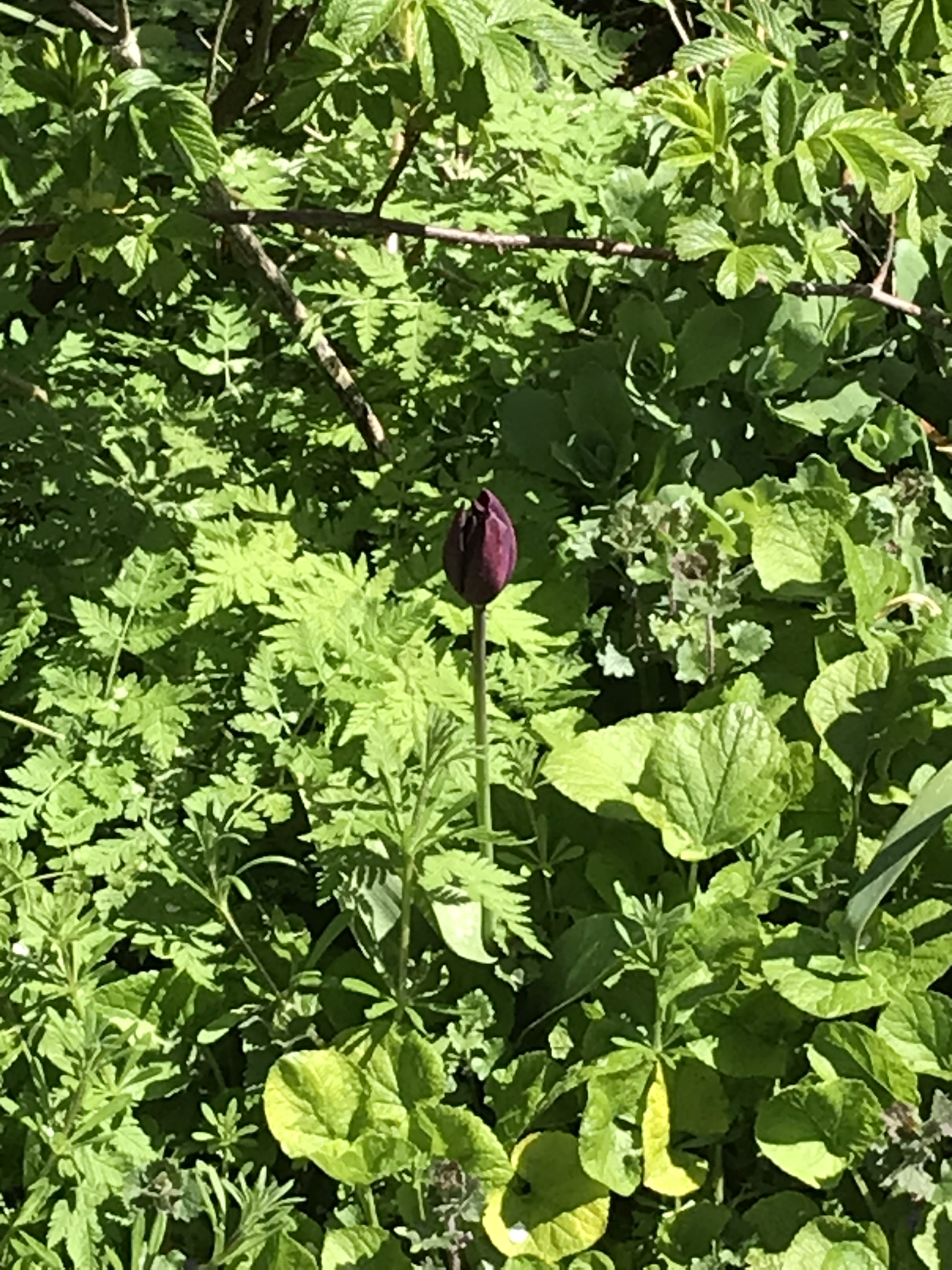
Much of the growth is predictable at this time of year, with the usual plants flowering: the wisteria, species roses, aquilegia in various colours, apple trees.  But some are interlopers.  Take tulips, for example.  The huge red tulips – I don’t know the variety, they’ve been in the garden longer than I have – formed the basis of a ‘red, white and blue’ vase for the Coronation Street Party, although they had been knocked about by the rain and wind; the little pale orange species tulips came up, very pretty as usual; and ‘World Friendship’ and ‘Angelique’ made a good show in the pots where I had planted them.  But, just as my favourite early white ‘Exotic Emperor’ tulips died back, up popped an interloper tulip in the same pot – bright yellow and very striking.  This year’s misnamed tulip (there’s usually one).  

Big red tulips - with white and blue companions

Orange species tulip (T. urumiensis?)

Unknown yellow interloper -

- with rather lovely internal markings

I have quite a good display of alliums, the big purple ones, in the bottom border this year; but in the little pot on the patio where the Allium karataviense live, an unknown pretty white-flowered plant has appeared; what is it?

Flowers in the allium pot

Another interloper, about which I have mixed feelings, is alkanet.  There’s been quite a lot of it on the fringes of the veg plot this year.  It’s a big plant, with lovely true-blue flowers and large hairy leaves, and it seeds itself undesirably about the place; and since it has a huge, deep tap-root, it’s not easy to get out.  But the bees love it, and I tolerate it (up to a point) for that, and also because I like the colour of the flowers.  I’ve now pulled up nearly all of the flowering stems, in the hope that I’ve caught it before it sets seed.  There is another, more welcome, interloper among the veggies; last year’s leaf beet plants set seed, and several seedlings are coming up all around.  I’ve moved some of the biggest ones to better spots.

Alkanet

One of the best interlopers is a single snapdragon (antirrhinum) plant that appeared in the gravel border in the greenhouse.  I let it grow, and in its nice sheltered spot it has produced a large number of lemon-yellow flower spikes, of florist-shop quality, that are providing vases for the house right now.  Sadly, it's growing where the tomato plants will shortly have to go!

Yellow snapdragons

Not quite an interloper, but a blue tit surprised us the other day by flying into the nestbox with food for its brood.  We hadn’t seen it taking nest material in, and had assumed that the box was unused this year.  A very stealthy little bird!

Tuesday, 16 May 2023

Bird bothers - and the body in the bushes

We’ll come to the body in the bushes later, but we’ll start with another, rather sad, body – that of a baby robin which flew into the patio doors.  It was our first sighting of a fledgling from the patio robins’ nest.  The other robins, on the veg patch side of the garden, also had a fledgling which was hiding in the apple cordons; I haven’t seen it since, although baby robins are secretive little birds so lack of sightings doesn’t mean that it has come to harm.  We buried our little casualty by the front wall, which is probably not too far from the nest where it hatched.

We’ve also had bothers with birds helping themselves to our crops.  The two plum tree pigeons have been picking the embryo plums off the tree; at first we didn’t trouble too much, as that pair are fairly relaxed about our presence and we didn’t want to frighten them off, but one day we spotted six pigeons feeding in the tree, which was just too much.  I have a stash of old CDs, from the days when companies used to send them out in the hope that people would download their products (remember that?); I kept them as pigeon-scarers – when hung up, they rotate in the wind and the sunlight flashes off them, which birds don’t like.  It seems to be working.  Once the plums grow larger, the pigeons will lose interest in them and I can take the CDs down.

CD tree

The male partridge is still periodically about (we assume that the female is brooding eggs somewhere).  He too is very trusting of us, so I was unwilling to intervene too much when he took a fancy to one of my lettuces; on the other hand, I grow the lettuces for us, not him, so I wandered over and gave him a telling-off.  He just looked up at me quizzically and went on eating, so I gently shooed him away and covered the lettuces with some wire netting.  He took the hint and settled down to enjoy the sunshine on the adjacent path.  Not so very bothersome, in the end.  Later he came up to stand outside the greenhouse, where he likes to preen; I hope he doesn’t take it into his head to go inside.

Meanwhile I got down to the task of taming the winter honeysuckle (Lonicera purpusii).  It’s a lovely bush in winter and early spring, but once the fabulously scented flowers have faded I tend to ignore it, and as a result it has got much too big and sprawling, with lots of dead or sparsely foliated branches.  It could take a lot of cutting back and, in case it succumbs to the treatment, I have a layering from it, nicely potted up, that could be planted in its place.  The pigeons like eating it too, which doesn’t bother me much – it leafs up very early, and I’ve always assumed that they like the leaves, but on close inspection I see that it also produces oddly-shaped orange/red berries (rather like the summer honeysuckles), and they may be looking for those. 

Winter honeysuckle berries

While I was hacking away, I noticed something feathered deep in the undergrowth behind the bush.  The cover there is quite dense, ideal for nests and baby birds waiting to be fed, and my first thought was that it was a little blackbird, or perhaps a song thrush (we’ve had at least one song thrush fledgling being fed in that part of the garden this year).  Then I noticed a couple of flies on the feathers.  Flies avoid live birds – they might get eaten – so this was a sign that whatever it was, was dead.  A female blackbird?  No – it was too big.  MUCH too big.  Brown, with a small patch of white feathers – surely not a sparrowhawk?  A foray into the bushes from the other side of the shrubbery revealed that it was indeed a female, or perhaps a one-year-old, sparrowhawk – striped tail spread out.  Sparrowhawks will fly into deep cover in the hope of flushing out prey, and we presume that this one misjudged its flight and either crashed into a branch or perhaps broke its wing and was unable to fly.  It hadn’t been dead long. 

I’ve mused in this blog in the past about the difficulty of burying pigeons in our shallow soil, especially given the need to put them somewhere where they won’t be inadvertently dug up; and a female sparrowhawk is decidedly larger than a pigeon.  After some thought I decided to put it in the long bed in front of the veg patch; I’ve tried no-dig here, but there are weeds there that have needed digging out so I’m less concerned about disturbing the soil in that bed.  I was able to dig a hole wide and deep enough to accommodate the body, and have marked it so that I don’t disturb it (so no potatoes or roots!  I’m thinking that it’s a good place, partly shaded by the apple tree, to plant lettuces on top).  I’m fairly used to dealing with occasional remains of a sparrowhawk kill in the garden, but I’ve never had to deal with the actual sparrowhawk before.  And I hope I don't have to again!

Thursday, 27 April 2023

Tulip time


Tulip 'Exotic Emperor'

As the daffodils fade, it’s the turn of the tulips to take centre stage.  One of my favourite flowers: lovely colours, often a lovely shape, with a glowing sheen on the petals and a habit of fading gracefully, like old silk.  Not that there are too many in the garden this year; I deliberately only bought five varieties last winter, which I couldn’t plant out (in pots) until February because of the freezing weather earlier in the winter.  Unsurprisingly, they’re coming up late and in so-so condition.  The ‘Exotic Emperor’s, an early variety, are just coming into bloom, whereas a long-standing clump of dark red tulips, which I think are ‘Couleur Cardinal’, planted down the far end of the vegetable patch, has been flowering for a couple of weeks.  Some of them are in a vase indoors, but there are still some uncut.  (There’s also a paler tulip in that group, and I don’t know what it is - 'Angelique'?) 

Tulip 'Couleur Cardinal' - and one interloper!

The first tulips in flower were the little red ones in the (overgrown) shady border by the summerhouse.  There are also some pale orange species tulips in that bed, but they flower much later.  Nearby, in the bottom bed, there are a few ‘Menton’ in bud, and a single dark purple ‘Havran’, the last survivor of a previous planting.  Another singleton is ‘Sweetheart’ in the front garden; all the others have disappeared, which is a pity as it’s a pretty tulip. 

Early red tulips

A solitary Tulip 'Havran'

The ’bottom of the veg patch’ tulips are being encroached on by the lily of the valley, which has spread in under the wall from next door’s garden.  It too is nearly in flower; we don’t usually manage flowers to pick in time for May Day, though I can normally make a posy of them not long after.  This spring’s miserable temperatures (today is typical, cold and wet) don’t seem to have dampened their spirits too much; there are buds already.

Lily of the Valley (Convallaria majalis)

There was one good gardening day this week, almost (but not quite) mild enough to work outside without a jacket, and I got some weeding in the vegetable beds done.  The robin – or more than one, I’m never sure how many we have in the garden! – was very interested, coming up close on more than one occasion to look for worms and grubs.  This one seems to have a nest in the ivy by the rowan tree, where he (or she) keeps taking food.  There is a pecking order, however, and a blackbird pair seem higher up in it than the robin; they too were foraging around when I was out of the way, and the robin had to hang back until they were finished.  (Perhaps that was encouraging the robin to come close to me while I was working, as the blackbirds are not as trusting and he could get first pickings that way.)  The blackbirds – they seem to be a different pair to the patio blackbirds, with territory on the other side of the garden – must have started their nesting very early, as today they were being followed by two quite well-grown youngsters looking for food.  The patio blackbird, meanwhile, has been singing from the top of the neighbours’ roof, in competition with the song thrush, who sings from the top of the hawthorn tree!  It’s all go round here.

Other birdlife has included a pair of bullfinches, nibbling at the plum tree shoots, and a warbler.  The two partridges are still intermittently about in the garden; I try not to disturb them, though they’re fairly tolerant of my presence (at a respectful distance). 

Tulip time coincides with dandelion time; one of my daily jobs at the moment is to go round the garden trying to weed out as many dandelions as I can see before they seed.  They have considerable wildlife value, attracting hoverflies, but I have no compunction about removing them from the garden as there are hundreds, if not thousands, in the roadside verges and fields round here.  While digging one out from the edges of the shady summerhouse border, I disturbed two little fieldmice, which scooted away into the undergrowth from their hiding-place.  The most notable visitor to the garden this week, however, was a large dog fox which wandered across the patio and off down the garden one day at breakfast time.  Probably the same one as raided a neighbour’s chickens later in the week.

Tuesday, 11 April 2023

First cut


The lawn, cut - except for the cowslip patch

After the rain, we had three dry days over the Easter weekend, and managed the first cut of the lawn on Sunday.  The forecast was for a lovely sunny day, which didn’t materialise (cloud all day!), but the grass was dry enough for a high cut.  It’s amazing how much better the garden looks with the grass trimmed to a more manageable height.  The cowslips have been left, as they’re starting to flower, but we mowed over the top of the orchid leaves, which didn’t affect them but kept the surrounding vegetation low. 

The birds were very appreciative, as the cut made it easier for them to see the worms and insect life, as well as food dropped from the various bird feeders.  The blackbirds have started gathering food for their nestlings, while the robins are still at the stage of the male giving little food presents to his mate (as an indication of how he will provide for her when she’s on the nest).  Two song thrushes have been about – maybe a pair, maybe not – and are also collecting worms.  Other birds are busily collecting moss (the cowslip patch is a favourite spot for the sparrows) and other materials for their nests; the pair of mistle thrushes have been spotted gathering nest material, and a longtailed tit came to the kitchen window one day in search of spiders’ webs with the same intent.  Both blue and great tits have been checking out the nestbox, but don’t seem to have staked a claim yet.

Other birds have been showing up, in search of food, water or shelter.  A yellowhammer was at the bottom of the garden one day, doing his ‘little-bit-of-bread-and-no-cheeeese’ song; a small warbler came by another day, a pair of bullfinches have been eating the buds on the plum tree and a pair of greenfinches seemed to be attracted by the bathing opportunities in the pond.  We even had a marsh tit on the peanut feeder.  And a swallow flew overhead on Sunday, the first of the year.  The pair of partridges have been hanging out regularly, mostly in and around the veg patch.  They can’t do much damage there at the moment; the broad beans are under fleece for protection from the squirrel, and the garlic and shallots are sprouted far enough to be fairly immune to disturbance.  Other crops are still at the seedling stage in the greenhouse.  One of the partridges was hiding under the big gooseberry bush one day, watching me in the greenhouse before being joined by his mate, but their favourite place is on a weedy veg bed, where they can nibble the weeds; this bed is currently occupied by the frame of a cloche that has lost its cover but contains a bit of rigid plastic netting (used to protect the radicchio from pigeons last autumn), and the partridges seem to regard it as a place of safety as well as warmth when the sun is out. 

One partridge, peeping out ....

... and with its mate ...

... and in their favourite shelter

Warmth and sun are going to be in short supply for a few days; we’re now having showers, heavy rain and some very blustery winds.

While the grass clippings were fresh, I took the opportunity to restart the Hotbin.  This has been a Coldbin over the winter; it reached good temperatures last summer, but when we were away in the autumn it cooled down (it requires regular feeding to stay hot) and I left it alone during the colder months.  The contents were rather half-composted but satisfyingly full of worms (how do they get into an insulated container?), and will be gradually fed back into the bin in the hope that they will provide some starter material.  The grass clippings, with some buddleja prunings, got the bin off to a good start; the temperature rose overnight from 10C to over 40C (110F), but has dropped again as the composting process started and the volume went down (the bin needs a certain volume of waste to work properly).  I’m hoping I can get it working rather better this year.

In the weedy end of the row of fruit cordons, I found seven stems of Narcissus ‘Silver Chimes’ about to bloom.  I planted these some years back with the intention of cutting them for the house, and was very pleased with them, but after the first year they seemed to disappear; they have now presumably bulked up again.  I cut them, with some of the nearby pulmonaria, for a posy for the dining room table; they’re lovely little flowers, highly scented and very pretty.  I must consider moving the bulbs to a better spot.

'Silver Chimes' with pulmonaria