Sunday, 28 January 2024

Back to work

Snowdrops outdoors ...

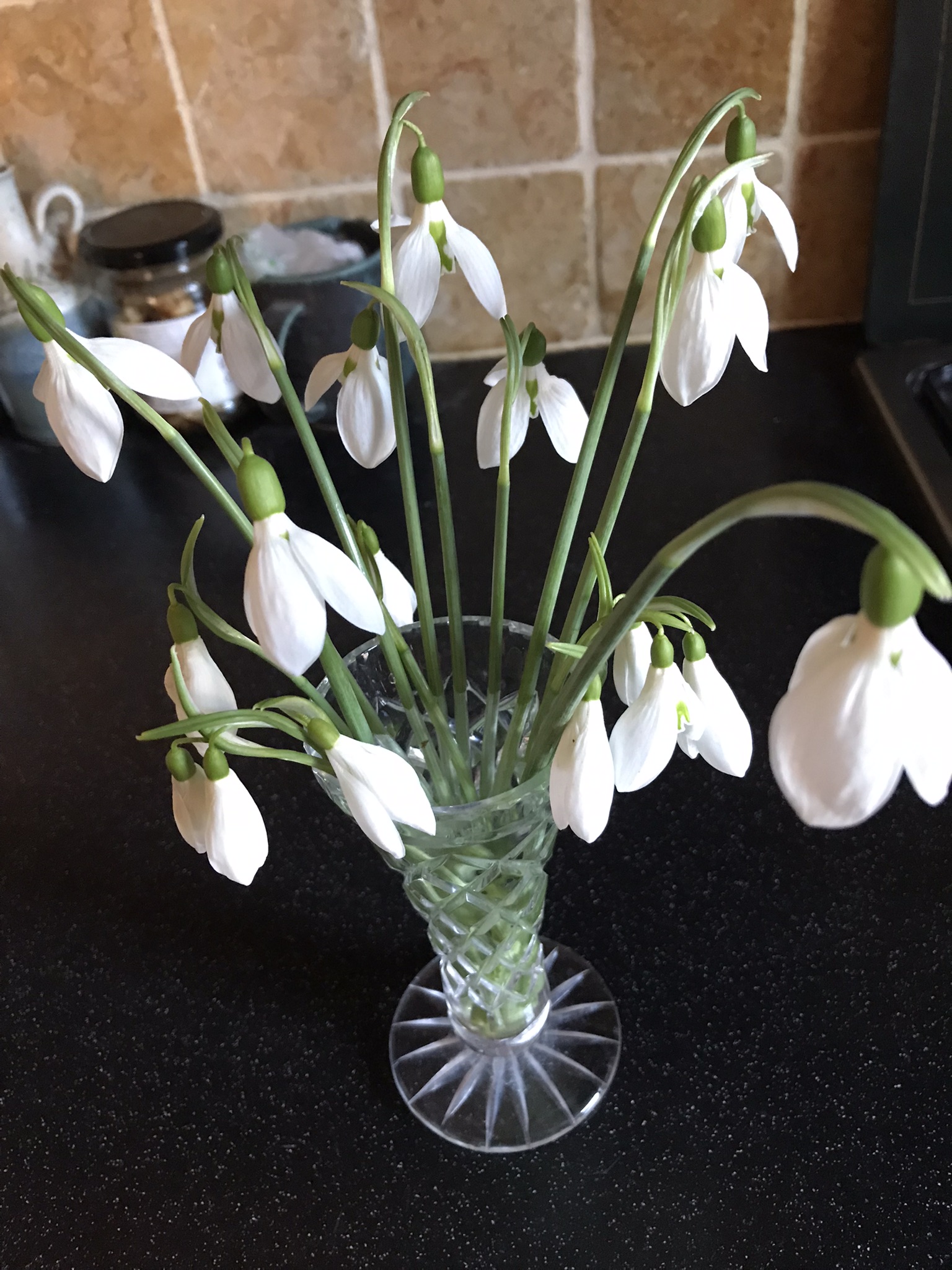
... and indoors

Home again after a short trip away.  After a series of gales, the weather has settled down and is currently dry and intermittently sunny; good gardening weather, so it’s back to work – there’s plenty to do!

It’s also unseasonably mild this weekend, so much so that I had to take my gardening jacket off this afternoon while working outside. The early snowdrops are in full flower, and the first hellebores are out.  I found a few ladybirds sunning themselves on the blackcurrants, and a bumblebee flew past at one point.  The robins are singing lustily, with a pair showing a wary tolerance of each other on the patio, and a pair of woodpigeons were mating in the apple tree.

Ladybirds on the blackcurrant bushes

This weekend was the Big Garden Birdwatch.  I ‘watched’ two days running, with very similar results on each occasion, both a good reflection of our usual bird visitors, including the bullfinches and a goldfinch.  A song thrush showed up also; it had been around a couple of times recently, and I was glad to be able to record it.

The gales did little damage to us, other than dislodging the trellis screening the dump corner.  The trellis had been very precariously propped up for a few years now, so its collapse wasn’t a surprise.  It had been acting as a support for the honeysuckle, which in turn supports a white-flowered clematis.  Both of these were in need of tidying up, so I cut the honeysuckle free from the trellis, which has been repositioned nearby (also rather precariously), and pruned the clematis back to low-growing strong buds.  There was an enormous amount of weak or dead top-growth to remove – but I didn’t prune it last year, and probably not the year before that … in fact, I’m not sure when I last pruned it, so it’s hardly surprising!  And now it, and the honeysuckle, no longer have anything to support them, other than a few thick sticks pushed randomly into the ground.  The next gales will probably bring the whole thing down again, and I’ll have to find another solution!

The cold spell knocked back the broad bean plants, but they have recovered and are throwing up secondary shoots from the base.  The garlic is also coming up, and there is lamb’s lettuce (corn salad) and lots of rather tatty chard, but otherwise the veg plot is not very productive at the moment.  I took advice from a gardening website and cut and stored the remaining radicchio heads before the cold hit in early winter, and was a bit dubious as to whether this would work; however today I took the last radicchio out of the summerhouse where it had been seeing out the cold weather, and once the (very dead-looking) outer leaves had been removed, there was a healthy head inside.  A tip to note for next winter!

The last radicchio, stripped of the dead bits


Wednesday, 17 January 2024

New Year flowers

2024 started wet.  After a few weeks of very rainy weather, the ground was sodden; there were (and still are) the inevitable floods in the usual flood-prone places, but fortunately we’re on much better-draining ground.  The downpours eased a day or two into the new year, and we’re now having a week of dry, cold and frosty weather (to be replaced by milder temperatures and more rain and gales at the weekend).

Viburnum x bodnantense 'Dawn'

I managed to get outside briefly to do my usual New Year’s Day flower count, which produced a measly 9 plants.  There were the five stalwarts: winter jasmine (Jasminum nudiflorum), winter honeysuckle (Lonicera purpusii), Mahonia ‘Winter Sun’, doing its best to live up to its name, despite the dismal weather, viburnums (both V. tinus ‘Gwenllian’ and V. x bodnantense ‘Dawn’) and rosemary.  But the cold spell earlier in the winter has knocked back nearly all the plants that sometimes have a bloom or two hanging on from the previous year’s flowering, except the Vinca major in the front wall, which has a couple of flowers on it.  There were some early spring flowerers that had got their act together in time: two primula plants by the entrance to the drive, and the snowdrops (Galanthus elwesii) by the pond.  And some meadow grass, which flowers pretty much all year round, weather permitting; but that was all.  As usual, there were a few ‘nearly there’s: the hellebores by the terrace, and a speedwell plant in bud; a reminder that 2024 flowering is already under way!  I’ve already crunched a few daffodil shoots underfoot at the side of the lawn, and marked them off to remind me to tread more carefully there.  There are even tulips (‘Exotic Emperor’, an early variety) nosing up through the compost, and orchid foliage showing in the grass.

Nearly there: hellebores in bud

I’m looking towards the Big Garden Birdwatch later this month and keeping an eye on what species we have visiting, apart from the usual suspects.  We have at least five blackbirds battling it out over the apples, in competition with a fieldfare; three bullfinches (two males and a female) have been hanging around, and occasional goldfinches and a chaffinch.  A kestrel was being seen off by a crow the other day, and three buzzards did a fly-over of the garden this afternoon.

Sunday, 31 December 2023

Rhubarb rhubarb

Back in November, I posted a list of jobs I wanted to get done before the real cold kicked in.  The weather continues to be mild, but very wet and windy most of the time, and there have been few days recently that have offered decent gardening conditions.  Boxing Day was dry, however, and allowed me to work outside.  Of the jobs on my list, I’ve managed the really essential ones, which is something.  There are still weeds in the veg patch and it still needs mulching, but that can be done in the New Year.  And there are still bits of the long hedge that need cutting back, and it’s too late now to finish that (although I can do some of it in March as things warm up, weather permitting); I’ve decided that I need a taller stepladder to be able to reach the top safely (it will be a belated Christmas present to myself).  It will also be useful when pruning the apple tree.

All the bulbs are now planted, including the tulips ‘Angelique’ and ‘World Friendship’ lifted from last spring’s pot plantings.  They’ve gone into the bed by the terrace.  It was a task precipitated by my finding the corpse of a poor little vole in the greenhouse – it seemed to have climbed, or fallen, into a deep jug that was left on the floor and had been unable to climb out again.  It was tipped out into the planting hole dug for ‘Angelique’, with the bulbs on top.  Some natural fertiliser.

Starting work on rhubarb no 1

I’ve also tackled the maincrop rhubarb plant that was in need of dividing.  If I thought that the osteospermums were hard to dig up, that was nothing compared to the rhubarb.  It has been in place for many years and was very large (bigger than it looks in the photo), but its productivity was falling off and it definitely needed splitting.  Easier said than done.  The roots were enormous, and deep, and I’m not sure I’ve actually got all of them out.  Fortunately the clump proved to be part rotten, and I was able to chip a couple of pieces with the beginnings of buds from the outside of the clump for planting further back in the bed (it produces huge leaves that are prone to covering up the path), and I managed to dig out some of the tough grasses there to make room for them.  The rest of the plant, or as much of it as I could tackle, was unceremoniously ripped up and left on the side for the robin to check over for worms.  Tidying them up is a job still to be completed, but the main task is done.

Rhubarb no 2 - 'Timperley Early', already in growth

The early rhubarb plant alongside, ‘Timperley Early’, true to its name, is already showing new growth!  And down in the undergrowth by the pond, I see that the first snowdrops (Galanthus elwesii) are out – a good week or two earlier than I would have expected.

Galanthus elwesii

Happy New Year!

Saturday, 23 December 2023

Deck the halls

Although temperatures have been mild, it has been very windy recently, and occasionally a bit wet; not good gardening weather.  But it’s Christmas, and the halls have to be decked with boughs of holly (and ivy, and yew, in this house at least).

The wreath that I created in 2020 has been hanging, dry and dusty, in the greenhouse since its previous outing three years ago.  I pulled out the bits of greenery (brownery, by now) that remained, and quite a lot of the dry moss; there’s plenty more where that came from, in the lawn!  So: much scratching in the lawn, to produce a good amount of wet moss, which was tied in with garden twine.  I used yew as the base this time – the leylandii that I used in 2020 produced too much of a ‘bad hair day’ effect, and the yew is a little more tidy-looking.  A few bits of variegated euonymus and some Iris foetidissima berries for colour, and a bow made from silver ribbon, and the job was done.  There are no good hanging points on the outer doors, so it’s suspended from the garden gate (the basis is an old wire coathanger, and the hook goes over the top bar), where it is withstanding the gales remarkably well.

By mid-December the birds have usually stripped the holly tree, but every year we try to preserve some of the berries for decoration.  We cut a few sprigs and put them in water in the summerhouse, away from birds and mice, which works fairly well except that the leaves tend to drop off.  This year I fixed my two CherryAids – white sleeves with Velcro fastenings along their length, and tie ends, designed to protect cherries from the birds (I’ve used them successfully on the blackcurrants in the past) – over a few holly twigs on the tree; a number of the berries fell off, but when I came to remove the sleeves the other day, there were quite a few twigs with berries inside – I must do that again next year.  The berried twigs have been used to decorate the paintings in the hall and dining room.

Mantlepiece

Instead of a Christmas tree, I decorate the library mantlepiece with ivy and little gold decorations, and make a fake swag down the stairs; the greenery is real, but there’s no moss or other water-holding material in there – it’s all held together with garden twine, a wing and a prayer, and decorated with a few small decorations and red bows, which have twist ties at the back that serve to hold things in place and cover up bald patches and sticking-out ends.  It’s all very Heath Robinson, but it works well enough!


Merry Christmas!

Wednesday, 13 December 2023

Sitting tenants


Roots all the way down

It should have been a straightforward job.  Lift osteospermums from the big pot, and re-pot them; remove compost (or most of it) from the big pot; plant tulip bulbs in big pot; top up with fresh compost.  The osteospermums, however, had other ideas.

They were the progeny of a plant bought many years ago and left in place in the front garden (during a previous phase of the front garden’s design) for several years.  When that area was redeveloped, into a mostly gravelled area, the plant was lifted and cuttings taken, which became a staple of planting in various pots.  The flowers are white daisies with a dark ‘eye’ which open in sun, and very adaptable; they go with most other plants and this plant at least is, as osteospermums go, pretty hardy.  They are also easy to propagate, as the stems produce new roots where they touch the soil or compost.  And that, it seems, was the problem.

These ones had been put in the big pot at least two years ago, along with a previous set of tulip bulbs.  The bulbs had not survived, as tends to be the case with tulip bulbs, and last year I left the pot otherwise empty, with only the osteos in place.  And, after two years in the pot, with no competition, they had made themselves very much at home.

I tried to move them just by hand, unsuccessfully, then got the small hand fork out.  They still didn’t move.  I tried a trowel, but couldn’t get it into the mat of roots.  Normally as a last resort I would try upending the pot so that the contents, plant, compost and all, would fall out, but this pot is just too big.  In the end I had to rip the top growth out, and chip away at the matted compost below with the little fork.  The roots had gone right down to the bottom of the pot – who would have thought that such a small plant could make so much root?

Fortunately a lot of what I pulled up had roots attached, so I potted up four pieces and put them in the greenhouse to recover.  As much old compost as I could shake out went on to the new bed, to the robin’s delight; the tulips went in, and were covered with fresh compost – job done.

Job done

Mesembryanthemums are not as hardy as the osteos, and the sharp frost a couple of weeks back has seen off those sown in the gravel of one of the camellia pots; a pity, as they were just getting going.  I might try sowing direct into these pots again, either with more mesembryanthemums or another low-growing annual, but getting the seeds in earlier.  It’s a good place for a bit of colour!

Remains of the mesembryanthemums (and a few weeds)

The weather since the last post has been milder and damp (or downright wet) on the whole; there has been wind, but the worst of the weather passed us by.  Nothing very dramatic in the forecast, at the moment at least.

Saturday, 2 December 2023

First bite of winter


December is officially the beginning of winter, and the weather certainly feels like it.  Over the past couple of days we’ve had temperatures down to minus 8C – minus 4C in the greenhouse – and not much above freezing during the day; there are some forecasts predicting snow over the next day or so, which may – or may not – come to pass.

One last 'Sam Hopkins'

We had our first big frost in late November, with minus 3C or so overnight.  The previous day I noticed that Dahlia ‘Sam Hopkins’ had put out one final flower, so I cut it to put in a vase with some nerines.  By the next morning, the dahlias were well frosted, so were dug up and the tubers put in the garage to dry off, for storage over the winter.  The frost has also finished off the last nerine flowers, but the plants will be fine where they are.  There was one last bud on rose ‘Gertrude Jekyll’, but it too has been frosted.  In contrast, Camellia ‘Donation’ already has buds!

Last 'Gertrude Jekyll'

The end of the nerines


Buds on Camellia 'Donation'

Ahead of the cold, I managed to cut the remaining three radicchio heads for storage in the summerhouse; we’ll see if they survive there.  The last two lettuces ‘Merveille de Quatre Saisons’ were also cut so that the hearts could be kept in the fridge, and a rather makeshift cover put over the ‘Salad Bowl’ heads in situ, consisting of some wire netting and a piece of tattered fleece.  I doubt if that will have been enough to save the lettuces, but it was worth a try.

Makeshift covering

Even in cold weather, the garden jobs continue.  Most of the tulip bulbs have now been planted in pots.  I had planned to put ‘Orange Emperor’ in the pot that contained its white cousin ‘Exotic Emperor’ this past year, but when I started to remove the compost I realised that ‘E E’ was sprouting again.  Past experience suggests that they may not flower too well, but I topped them with fresh compost and left them in place, and the orange bulbs went into a different pot.  ‘Ballerina’ and ‘Doll’s Minuet’ also went into (separate) pots.  A mix of blackcurrant-purple ‘Havran’, red ‘National Velvet’ and pink ‘Dreamer’ were packed into the smaller of the patio large pots.  ‘Dreamer’ is a new variety, only six bulbs and quite expensive, but allegedly producing two or more flowers per bulb, so I’m hoping that it will balance the other colours effectively.  I still have to plant ‘Black Hero’, red ‘Uncle Tom’ and orange (flushed purple – aptly described as ‘sunset shades’) ‘Prinses Irene’, which are destined for the big patio pot (once I’ve removed the white osteospermums that are in there currently). 

Some of the seeds in the greenhouse are showing signs of germination – the cornflowers, and even a very few tiny seedlings of ammi.  Nothing as yet from the nigella – even though this is fresh seed – or calendula.  They are all covered, for protection from mice rather than the cold, but they won’t like the very low temperatures; I hope the seedlings just sit it out and eventually grow on rather than damping off.

The garden birdlife isn’t caring too much for the cold either.  The berries on either side of the drive – cotoneaster, hawthorn and firethorn – are in much demand from the sparrows, robins and blackbirds, and the food put out on the patio is attracting those birds as well as Lefty the woodpigeon, starlings, dunnocks and blue and great tits.  The cooking apples are still on the bench and table on the terrace, and there’s usually a blackbird or two and a robin pecking busily at them; further down the garden, those apples still on the tree are being eaten by tits, more blackbirds and the Scandi-avians.  There are at least three robins scrapping over ownership of the territorial rights to the food, and, remarkably, a dunnock that is prepared to chase the patio robin away; normally it’s the other way around, with the dunnock just shrugging its metaphorical shoulders and coming back once the robin has gone, but this character not only stands up for him or herself but is asserting its dominance of the patio.

Even before the cold started, my gardening work was almost always accompanied by an inquisitive robin.  But one day I was watched at close quarters by a goldcrest; it was aware of me, but was too busy checking out the osmanthus for insects to be much interested in my doings.

Wednesday, 22 November 2023

A thing of shreds and patches

No, not W S Gilbert’s Wandering Minstrel, but my gardening trousers.  Or, to be precise, my ex-gardening trousers.

Having been brought up to make do and mend, I’ve always gardened in clothing that has reached the point of being no longer fit for other purposes.  Scruffy clothes that will no longer do for polite company but are ‘fine for the garden’.  So it goes against the grain actually to spend money on something to wear in the garden, to put on just to get wet and muddy.  But last year I had to ditch my gardening jacket, an old grey puffer jacket that did a good enough job at keeping the cold at bay even after it parted company from its lining; finally the outer fabric ripped, and the padding started to fall out, making it really no longer practicable as gardening kit.  I had no other comparable garment ready to be downgraded to replace it, and a local outdoor-wear shop was doing a deal on cheap padded jackets, so I spent a whole £30 on a new outer layer – and I have to say that it does the job really well.  I’m trying to remember to put it in the washing machine from time to time to stop the fabric from deteriorating; too easy just to hang it up again after every spell in the garden!

I dallied for a while with the idea of using the old jacket to create an old-clothes scarecrow, perhaps one that could have planting pockets inserted in it (I’ve seen it done), but decided that it was going to be too complicated and would probably fall apart.  Instead, the old jacket was washed and sent to recycling, where I hope it was shredded and turned into something practical.

End of the road

My trousers have also now reached the end of the road.  Originally a very respectable pair of soft denim jeans, eventually their zip started to split and, needing something to take over from my previous gardening trousers (a black cotton pair from Gap), I demoted them to garden use.  They were roomy enough to allow me to wear a pair of black cotton leggings underneath when I needed extra insulation; the elastic waistband of the leggings is sagging but the jeans held them up, and the leggings provided suitable modesty when the jeans’ zip finally gave up completely.  However, the fabric of the jeans has now started to split across the leg and, while ripped jeans may be a valid fashion statement in some quarters, in a damp and dirty garden they’re just not a good idea.  So I’ve gone (online) shopping.

The new trousers, specially designed for gardening, cost considerably more than the £30 jacket, but they’re warmer and more practical than the jeans, they come highly recommended and first impressions are good – I just need to remember to keep them washed so that they last longer than my jeans!