Saturday, 20 July 2024

More munching

Two days of sun and heat, and now we’re back to more rain.  And the molluscs are still eating; a row of seedling lettuces in the veg plot, to replace the first planting that is now starting to bolt, disappeared virtually overnight.  I had also cleared out a long plastic trough that contained nothing but weeds, and replanted it with some of the same batch of lettuces; they were munched a bit (I found and evicted two snails and a large slug found hiding under the lip of the trough), but a line of Vaseline laced with salt around the top put paid to that, and they’re now recovering.  The brassica seedlings - broccoli and cabbages - have been planted out under netting, and are mostly surviving so far, although the netting is obviously not slug-proof!

Scrump-able raspberries

The blackbirds have taken the gooseberries (I made no attempt to stop them), but interestingly don’t seem to have made much attempt to steal raspberries.  The raspberry bed is a mess, frankly, and needs overhauling this winter, but usually I have to net the plants to get anything off them.  This year I’ve done nothing, and the rasps are fruiting freely with very little bird damage – although there are slug/snail trails over some of the fruits!  The plants have suckered into the near end of the veg plot and into the blackcurrants (which have no fruit worth mentioning, and also no bird protection), as raspberries tend to do.  Sometimes I think those plants have the best-tasting fruit.  When I was a child, there was a piece of waste ground running along behind some nearby gardens, and raspberry plants had suckered out of the gardens into the edges; I used to enjoy scrumping for raspberries there, which were often small but wonderfully sweet (and, although nobody objected, there was the allure of forbidden fruit).  I still like searching in the long grass and weeds for the unintended fruit, although I really ought to dig the plants out.

Alpine strawberries

On a warm afternoon a couple of days back, I noticed a flock of sparrows quartering the corner of the veg plot.  My first thought was that they were after the alpine strawberries – there had been minor signs of bird damage – and then that they were picking flowers off the row of peas.  But then I noticed a blackbird pecking at the edges of the septic tank in the lawn, and realised that the garden’s ants nests had broken open and the ants were flying out – there’s often one or more nests in the veg patch paths.  The greenhouse was also crawling with them, and the sparrows were sitting on the roof picking them off as they flew out.  Better that than going for my strawberries and peas!

Peas, in flower


Wednesday, 3 July 2024

The munchers


Lobelia - gone

Late June managed a week or so of warm weather, and now it’s back to damp and cool conditions as the jet stream has shifted again.  One consequence of the wet is the number of slugs and snails in the gardens, and my seed-sowing has suffered as a result.  I had a lovely set of lobelia seedlings ready for planting out – the best trayful I’ve ever managed – and overnight, there they were, gone.  They had been in bud and just about to bloom, so something had had a good bellyful.  I’ve nursed the remnants back to the regrowing stage, but it remains to be seen whether there’s time for them to flower this summer.  They’ve been replaced by three plants from the supermarket; needs must, sometimes.

Beans - before the slugs got them!

Likewise my climbing beans.  My first sowing, of ‘Moonlight’, ‘Blauhilde’ and borlottis, succumbed to a snail; I resowed the latter two, and got a small number of plants from them, but after they were planted out they were gradually demolished by molluscs (I assume molluscs, although the prodding and poking of the blackbirds is still under some suspicion).  My remaining Blauhilde seeds were sown in situ, and so far are doing ok, although like the lobelia they may not do much before autumn sets in.  Interestingly - but puzzlingly - a nice row of lettuces ('Merveille de Quatre Saisons') nearby are completely untouched.

Lettuces, untouched

The little blighters have also been at my courgettes and radicchio.  There’s still time to sow more of the latter, to supplement the three or four survivors of my originals that were planted out, but the courgettes are going to be a mixed lot.  One of the ‘British Summertime’ plants is doing well and already fruiting, the other has been grazed and may have lost its growing point, and ‘Defender’ is only just hanging on in there.  Another ‘Defender’ seedling was found growing in a discarded pot – I had given up on it germinating – and I’ve popped it into one of the tulip pots, where it’s doing ok for the moment.

I’ve harvested the shallots and garlic.  The shallots’ foliage started dying off, so I lifted them; they’re on the small side, but they’ll do.  The garlic isn’t great but, again, it will keep me going.  ‘Gardeners’ Question Time’ recommended a garlic spray to deter slugs and snails, which got me brewing up some of last year’s cloves as a plant treatment, but I can’t say I noticed any improvement; maybe it wasn’t strong enough?  And Strulch, although touted as a slug and snail deterrent, has no effect.

Peas ('Early Onward') under netting

A trellis for 'Alderman'

Not everything is going badly.  I have two lots of peas, ‘Early Onward’ which were sown in situ and grown on under netting until they were well established, and ‘Alderman’ which, like the beans, had to be resown after mollusc intervention, but which are now growing away nicely.  Neither set is flowering yet, but should do so soon.  And broad beans, after a slow start, are cropping well (the early ‘Aquadulce Claudia’) and coming along promisingly (‘Imperial Green Longpod’), with no blackfly this year; the ladybirds have obviously done their work well.

Ladybirds - making little ladybirds on a beet leaf

Nice clean broad bean plants - no blackfly

There are various brassicas in the greenhouse waiting to be planted out when I can create a suitable space for them where they can be netted against pigeons and butterflies – not that many of the latter have appeared so far this year.

On the other hand, there are plenty of pigeons.  Lefty disappeared a few weeks ago; younger birds took over his territory, and he didn’t seem to want to fight them.  We’re sure he’s still around in the area, and he may come back in the autumn as he has done in past years, but he’s old and no longer the scrapper he once was.  We got fed up with woodpeckers (great spots) eating their way through the fatballs, so I put a squirrel guard on the feeder which made it more difficult for them to get in there; unfortunately it prevents the very few blackbirds and robins who were agile enough to cling to the feeder from eating them too, but the tits (blue, great and coal) seemed positively to enjoy the extra protection and brought their youngsters along to feed.  (Something had made a nest in the birdbox, but there was no sign of it having been used; the moss wasn’t cupped, and there were no indications of shell or dead nestlings.  Had one of the parents been killed?)

Tits on the fatballs (and robin picking up the droppings!)

I've been ripping up grasses and other weeds that are about to set seed, and made fair inroads into the very overgrown area at the end of the fruit cage area.  It was the first time in some weeks that I'd managed a good look at the fig tree, and I was pleased to find a few decent fruits on it; I hope we get some warm weather to ripen them!

Figs

While working in that area, I was startled by a partridge suddenly appearing under my feet and running off.  It turned out that it was a female that had been sitting on a clutch of eggs in the long grass, completely hidden from view.  She didn’t return, and after a couple of days the eggs vanished – a fox, most probably, had made a good meal of them.

Partridge's nest


Monday, 17 June 2024

Harvesting weeds

The builders' sack

One of the difficulties of no-dig gardening is the amount of compost needed to keep the soil in good heart.  There’s no way I can produce enough from my two ‘dalek’ bins and the hotbin (which, after a slow start in spring, I’ve finally got up to a decent temperature); one ‘dalek’ is always slowly cooking away while the other receives kitchen waste and such garden material as I can stuff into it, prior to the contents being transferred to the other bin for longer-term ‘cooking’, but they’re not large enough to produce the necessary volume of compost.  Last year I trialled using an old white plastic builders’ sack which originally arrived with a load of stone chippings for the drive, with reasonable success given the rough nature of much of the material I put into it, and this year it’s back in use, giving me a lot more space in which to compost stuff.  So – I need more stuff to compost.

Charles Dowding, the no-dig guru, runs various courses including one on how to produce compost (in volume).  One of the participants on one of these courses got so enthusiastic about the business of producing compost that he declared that he now regarded his garden as primarily a source of composting material.  My initial reaction was mild horror, but on reflection, I could see the point.  And … I have a garden full of weeds – so why not use the weeds to make compost?

I’ve always put some of my weeds in the compost bins, of course, but the bins don’t reach the sort of temperatures that would destroy seeding flowerheads or perennial roots, so a lot of weeds go into the council waste bin (or, whisper it, over the fence into the field behind if they’re weeds that came into the garden that way in the first place).  But in fact flowerheads should be fine as long as the seeds haven’t matured, and it’s not too onerous to cut off the roots (and any seedheads) and compost the rest. 

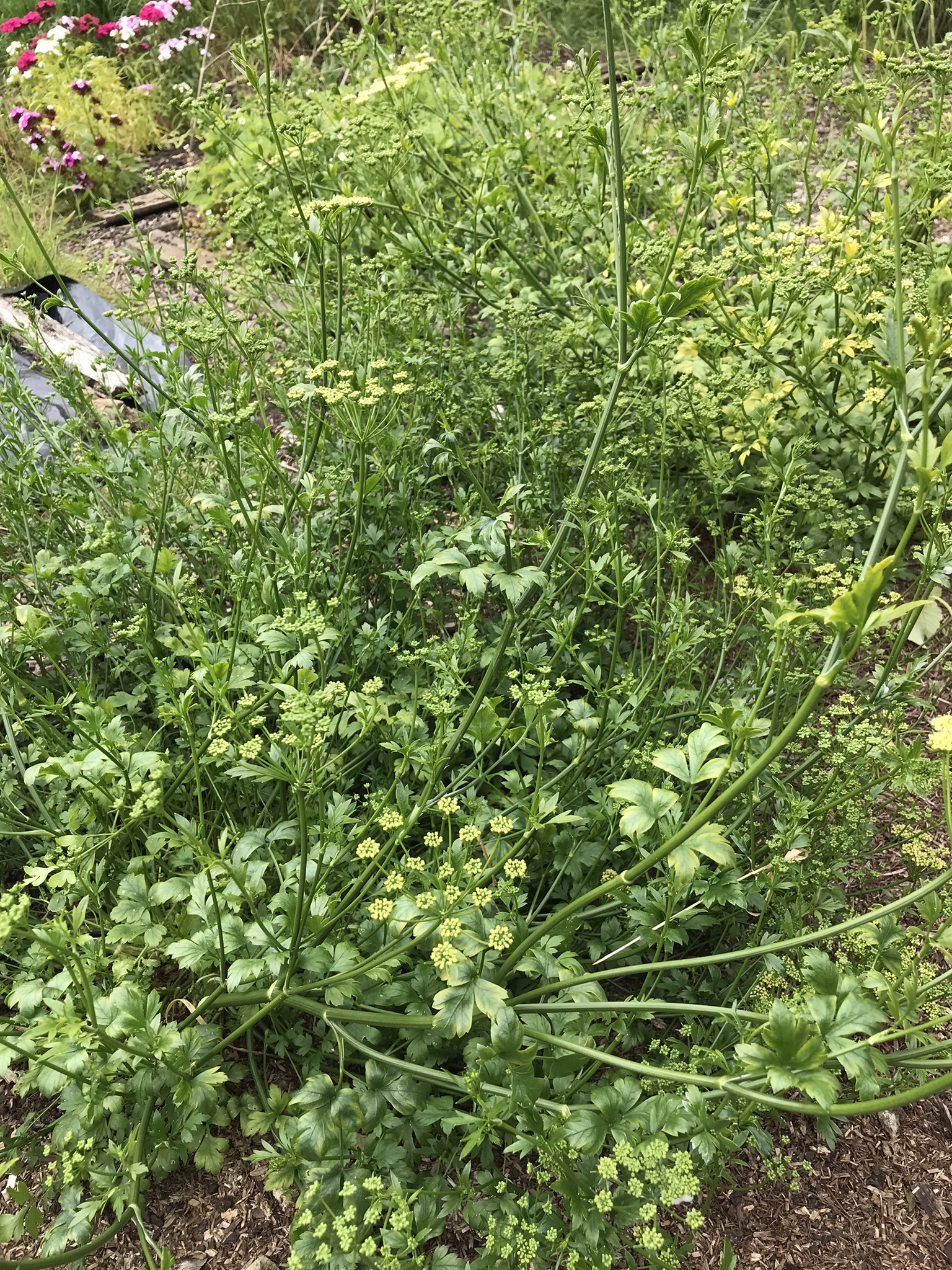
Some plants are too small or spindly to be worth the bother, but I’ve been pulling up the chunkier weeds such as ground elder and woundwort – both flowering but not yet seeding – for chopping up and adding to the compost bins.  There are also garden plants going into the mix; the very large and substantial parsley and leaf beet plants that are about to flower, for example.  I’m leaving one plant of each to collect seed from, but they are now too elderly for kitchen use and need removing.  They’re producing a great volume of green matter for composting.  Woody material – an essential addition to any compost mix – is less easy to come by, but prunings from my ‘Mary Queen of Scots’ rose, which keeps flopping across the path, have also been added; it’s not a very thorny rose, and the new growth is easy to cut up.  I also scavenge for any other shrub prunings to add, along with the odd bit of small cardboard.  Material that I can manage to cut up into fairly little pieces goes to the hotbin, but the rougher stuff is heading for the builders’ sack, and I’m hoping for a decent amount of home-produced compost this winter!

Parsley starting to flower ...

... and over-large leaf beet plants!


Tuesday, 4 June 2024

Pottering

The Bank Holiday weekend wasn’t exactly warm, but there was enough dry weather to get some useful gardening done.  We haven’t had much heat yet this year, but enough to make us believe that there might be some to come eventually.  Right now, it’s wet and windy (again).

The warmer weather, of course, meant that I had to do some watering of pots, which prompted me to attend to my collection of small plants sitting around waiting to be found a permanent home.  There are usually quite a few of these, although I rehomed several of the duplicates (divisions and cuttings, mostly, taken as insurance against losing valuable plants in the garden) by taking them to the village plant sale.  (And for once I didn’t bring too many new plants back.)  There are three problems with having ‘waifs and strays’ in little pots: they need watering more frequently than larger pots, they tend to collect weeds in their compost that can outcompete them, and – because they are usually sited on the paved area around the back door – as they grow they can get their roots down through the pot and into the cracks between the flagstones.  They then become immoveable without fatal damage to their roots, a problem that beset my potted wallflower, which was intended to accompany tulips in one of the big pots but had to be left where it was.  It flowered profusely, and I’ve taken cuttings in the hope of growing it more appropriately next year!

The wallflower

Since then I’ve spent some time re-potting the plants I want to keep, and grouping some in slightly larger pots, which makes it easier to keep them watered.  A fern which has been sitting in the same pot (and compost) for a good few years was split in two: one half potted up with a Carex ‘Evergold’ (I think – an unlabelled plant sale purchase) and some miniature Dianthus ‘Siberian Blues’ (more pink than blue, to be honest, but pretty), and the other half with Phormium ‘Tricolor’ and a trailing purple-leaved sedum.  Neither pot is particularly colourful at the moment, but they will fill out in due course – and they, and the pots they are now in, can be left undisturbed through the winter.  A rather neglected silver thyme got a new pot and a sunnier position on the patio, which it seems to be appreciating.  And the sweet peas were planted in a large pot against the house wall where they can climb to their hearts’ content.  (They are the autumn-sown sweet peas; the spring ones never germinated.  Why not?)

Fern, dianthus and carex, newly repotted


Sweet peas 'Fire and Ice', 'White Leamington' and 'Matucana'

Of last year’s plant sale purchases, most have been planted out in the new bed, as described in a previous post.  One, Coreopsis ‘Golden Joy’, succumbed after planting; I wasn’t too unhappy about that, as it was a brassy yellow and frilly to boot, whereas on reflection I would have preferred something more delicate.  I duly replaced it with some anthemis (I think it might be ‘Sauce Hollandaise’ – it was another unlabelled plant sale purchase from some years ago), which is much more elegant.  Likewise I was rather relieved that Salvia ‘Hot Lips’ didn’t survive the winter; it was an impulse buy, but on reflection not really something I felt I could live with as it’s a rather unforgiving shade of pink.

The window box has been replanted for the summer.  The miniature daffodils haven’t yet died back fully, so the whole planting was lifted out and squeezed into a plastic trough (roughly the same size) to sit it out until it’s safe to dig out and dry off the bulbs.  The new planting is a bit of a mixture of my ‘waifs and strays’: a bronze carex, a fuchsia, a variegated ivy, a small salvia, and a few Cosmos ‘Xanthos’ and Lobelia ‘Cambridge Blue’, the last three grown from seed.  This planting 'needs to mature', as they say, but shouldn't look too bad in due course.

The dahlias are still sitting around in their small pots waiting to be found homes for the summer.  This is likely to be in more (large) pots rather than in the oregano bed, which hasn’t yet been fully cleared.  The big pots are mostly vacant and waiting to be reused; the tulips that were in there over spring have mostly been dug out and discarded.  I owe an apology to the potful of orange tulips which I had assumed had been sent in error as ‘World Friendship’; on examining the plant label I see that they were actually ‘Ballerina’, so exactly as they were meant to be (except for a single pink interloper that came up among them!).  I have a feeling that ‘Ballerina’ might be reasonably perennial, so have kept those to die back naturally with a view to replanting them somewhere.  I’ve also kept the ‘Exotic Emperor’ and ‘Orange Emperor’ tulips undisturbed in the hope that they will reflower next year.  Rather than leave the pot containing the former as bare compost, I sowed the contents of various old packets of flower seed in that pot, thinking that most of them wouldn’t germinate, but in fact there’s a good number of seedlings coming up, including some nasturtiums that I was certain were too old to do anything.  The results might be colourful to say the least, but should be fun! 

Tulip 'Ballerina' - with pink interloper!


Thursday, 23 May 2024

Granny's bonnets

May has been rather warmer, on the whole, with some really pleasant days (and a few thunderstorms and the odd downpour, which are keeping the garden green).  The tulips are now past, with ‘Black Hero’ maintaining a bit of a last stand until a few days ago, when they were removed and binned.  Alliums are now taking over in the garden, and also aquilegias, the old-fashioned ‘granny’s bonnet’ types.

Granny's bonnets in the grass

My first aquilegia acquisition, many years ago, was one that had been supplied to the nursery as ‘Nora Barlow’ but clearly wasn’t; I liked it anyway, and bought it.  It was followed shortly after by an Aquilegia alpina, a blue-flowered species.  These two cross-pollinated, as aquilegias tend to do - they're promiscuous plants - and between them produced seedlings with colours varying from pure white (now lost, sadly), pale pink, darker pink, blue, purple and near-black.  Some are bi-colours.  They are mostly in the dogwood bed which is seriously overrun with weeds – grass, herb bennet, goosegrass, woundwort, the spreading pink geranium, the usual undesirables – but they hold their own there.  They’re a lovely range of colours, and I enjoy seeing them; they attract the bees too.


One is a rather fine two-tone pink with white edges and stamens, but very short; I hope it can be persuaded to grow a little taller!  I shall collect and sow seed from it and see what comes up.

Sometimes I cut them for vases indoors, but they’re not ideal cut flowers; they tend to drop petals and pollen messily all over the place.  Vases in the house at the moment are of the much better behaved lemon snapdragon that is flowering profusely in the greenhouse.

Yellow snapdragons


Thursday, 2 May 2024

Brightening the spirits

May already, and the weather is no better.  Rather depressing, to be honest.  The great British obsession with complaining about the weather is at full throttle, with everybody saying that it has been a poor spring.  The meteorologists tell us that temperatures in April were actually slightly above normal, but with rainfall slightly above average – on top of a very rainy few months before that.  The April figures were distorted by a couple of quite warm days early in the month, but since then it has continued fairly cold, with chilly winds, and whereas there is often a short spell of a week or so of warmer weather at some point in spring, we haven’t had that so far.  And there has been relatively little sunshine, which always makes a difference, even if the weather is on the cool side.  Nothing much better in the forecast.

Cheerful - but not 'World Friendship'

So a few potfuls of tulips making a cheerful splash of colour to brighten the spirits is especially welcome.  Even if it’s not quite the colour I was expecting! – the ‘World Friendship’ tulips (so-called), which should have been a graceful soft yellow, have come out orange with a slight pink flush.  The other pots seem to contain what they were meant to contain.  The mix of ‘Dreamer’, ‘National Velvet’ and ‘Havran’ is good, but really ‘Havran’ is too dark a contrast; a brighter purple would have been better, as ‘National Velvet’ is quite a dark red tulip.  The big pot has ‘Prinses Irene’ and ‘Uncle Tom’, which are a good match in height, with ‘Black Hero’ which is lovely but noticeably taller; ‘Havran’ would have done better there.  It would also be a good partner for ‘Prinses Irene’ (orange) and ‘Doll’s Minuet’ (magenta), if I’m brave enough to put them together next time!

'Dreamer', 'National Velvet' and 'Havran'

'Doll's Minuet' in front of 'Prinses Irene, 'Uncle Tom' and 'Black Hero'

The apple cordons are in flower, with green alkanet flowering blue among some of them – another cheerful contrast.  At the other end of the row, the lily of the valley started to bloom in time for May Day.  And the roses won’t be far behind: ‘Mary Queen of Scots’ is already out.

Blue-flowered green alkanet under the apple cordons

The chilly weather doesn’t seem to be putting off the pollinators; a pair of bumblebees were on the apple cordons the other day.  Butterflies are also starting to appear.  A male orange-tip was about yesterday, and a speckled wood a couple of weeks ago.

Bumblebee on the apple flowers


Monday, 15 April 2024

A dry weekend


A few dry days – at last – over the past weekend allowed us to get on with jobs in the garden, especially the first cut of the lawn.  The cowslips are in full flower so that area was left uncut, and the grass around the plum tree was also left to allow the orchids to flower later in the year; but the garden always looks tidier with the main part of the grass mown.

Ahead of the mowing, I dug into the pile of old grass clippings (not dealt with for about three years, I think) and moved some of it under the apple cordons, to help keep the weeds down.  I’m slowly working my way along the row, removing weeds and grass as I go, and pondering what to do about the soil in front of the cordons.  I’ve hit upon a solution, which may or may not be a wise move.  There are a lot of self-seeded oregano plants in the garden, especially in the old herb bed where I’m planning to plant out the dahlias this year; I’ve been reluctant to get rid of the oregano as it’s pretty in flower, and useful in the kitchen, but moreover it attracts huge numbers of butterflies and bees in summer, which are very welcome.  So I’ve started moving some of it to the apple bed, which is in full sun and ought to suit.  Am I creating another problem for myself, with the oregano taking over under the apples?  I’ll need to be ruthless about cutting it back, even though the seedheads attract goldfinches in winter; I won’t be able to allow it to seed, and I think I’ll have to renew it periodically to stop it becoming too woody.  We’ll see.

I also found a couple of bags of old leaf mould and rotted sawdust, and spread them on some of the veg beds.  The birds enjoyed this; there were blackbirds, a thrush, goldfinches and a wren picking over the area once I moved away.  There is a lot of nesting activity at the moment; the sparrows are collecting grass, and the thrush has been picking up mud from the pond for her nest.

Tulips 'Dreamer' - and 'National Velvet' ('Havran' in bud in front)

The tulip pots are continuing to brighten up even the dull days.  The ‘Dreamer’ pot is developing nicely, and, despite what I said in my last post, the dark pointed tulips are in fact ‘National Velvet’; ‘Havran’ is not yet in flower, just in bud.  In the biggest pot, ‘Prinses Irene’ is starting to come out, with the much taller ‘Black Hero’  and shorter ‘Uncle Tom’ still to come.  The first of the ‘Doll’s Minuet’ is out, and the more I see of this tulip the more I like it; the colour is glorious, and the petals twist outwards in a very elegant way.  I’m thinking that it might work as a partner for ‘Prinses Irene’ in a future planting, perhaps with a dark tulip to provide contrast, and to damp down the colour clash; while orange and pink is a combo that I would normally back away from in horror, the darker markings on the backs of both tulips combine well, and the effect would be – how should I put this? – striking.  Shocking, even - but certainly colourful!

Tulip 'Doll's Minuet'

Tulip 'Prinses Irene'

After the dry weekend, the weather has turned showery and windy again, and quite chilly.  In fact we’ve just had a brief snow shower …