Monday, 18 August 2025

Feast or famine II

Apart from a showery spell a couple of weeks ago, the weather has continued dry (we’re now in Heatwave 4, although the past few days have been more cloudy and breezy than hot).  The garden is parched, and although little has died prematurely in the veg plot, nothing is actually growing very much.  I have some seedlings (radicchio, cima di rapa, a late cabbage or two) ready to go out, and will have to water assiduously to keep them alive.  There are warnings that vegetable supplies may be impacted, and that, because berries and other wild fruits are appearing early, wildlife may run short of food this autumn and winter.  Although I've been picking blackberries across the lane, I'm happily leaving a good number for the birds and other denizens of the hedgerow.

Pears ,,,
,,, and apples

It has been an excellent fruit year.  The plum crop (now long gone or laid down as preserves, see below) was large, the apples are prolific and we have a few of the best pears our two little trees have ever produced.  Even the fig, in its over-shady position, has done well.  Down at the bottom of the garden, the wild damson trees – probably suckers from the plum tree, which was probably grafted onto a damson rootstock – rarely produce enough fruit for us to bother with; the fruit is small and very sour, and really only fit for use in flavouring liqueurs, in the manner of sloe gin, and you need a fair quantity of them to do that.  This year, though, there’s a good number of them.  We recently unearthed a long-forgotten bottle of home-made damson gin in the cellar, 2011 vintage, which has turned out to be delicious with its 14 years of bottle age.  There’s a bottle of cheap gin in the house, bought so that we could preserve some of the plums, so the rest of it has gone to make more damson gin.  I doubt if we’ll manage to keep it for 14 years though!

Damsons - ready for the gin!

I had carefully netted my cabbages to prevent butterflies from laying their eggs on them.  In the end, it has been the dry weather that has finished off the cabbages rather than the butterflies, helped by the presence of a red ant nest in the soil of that bed.  When I passed by yesterday, there was a frantic fluttering under the netting – a wren had somehow got in there and was trapped.  How did it manage that?  I lifted the netting and let it out, and it flew off with a loud chirp.  The netting was put back in place.  Later on, I passed by again, and – there, under the netting, was the wren.  So I let it out again.  And later still – yes, the wren was back.  I gave up and left the netting half off the bed, but still lying on its supports; the remains of the cabbages are so unappealing that no butterfly is likely to lay eggs on them.  The wren spent several hours in its little tent, fluttering busily around and apparently picking something (flies?) off the underside of the net; this morning, at breakfast time, it was in there again, working hard at finding whatever is attracting it.  Perhaps it’s feeding itself up in anticipation of a hard winter?

Wednesday, 13 August 2025

Freebies

I admit to being a bit lazy about weeding – but sometimes I deliberately leave a weed seedling to see what develops, and occasionally it’s worth it.

The edge of the gravel drive usually has a good number of ‘unintentional’ plants seeded into it.  A few are desirable – nigella and parsley, from plantings in the adjacent bed – but a lot are not.  There’s a good number of out-and-out weeds, but also a few buddleja plantlets.  My buddleja is a big old thing, with flowers in a reasonably good purple-blue, though there are better modern cultivars and I’m not inclined to propagate this one, even though it seeds itself quite a lot in this garden - I use the old seedheads and prunings in the compost bins and plants germinate from that.  Recently quite a large buddleja plant appeared in the gravel, and I haven’t bothered to pull it up – in the hope that it might flower, and (irrationally) turn out to be a better colour than the existing plant. 

White buddleja

It has indeed flowered – and it’s white!  Probably a seedling of next door’s white buddleja plant.  I’m hoping that it might be transplantable, with a little care; most weeds in the gravel don’t have deep roots, and there’s no obvious reason why this would be any different.  I’ll leave it until the late autumn and try to move it then; with a lot of watering and decent conditions, it might survive.  Then I need to decide where to put it (not many good places for it …)!

Panicum flowerhead

Another ‘unintentional’ plant is in the pot with Hosta ‘Krossa Regal’.  At first it looked rather like the young hosta leaves, and I paid it little attention, but as it developed I realised that it’s a grass.  Not just any grass; it has broad, chunky leaves.  A panicum seedling.  The only panicum that I’ve had in the garden is one of the cultivars with an explosion of little seedheads, rather like a miniature firework, which looks good in flower arrangements, so I left it alone.  The first flower-head went into a little vase with some dahlia flowers and a few sprigs of Dianthus ‘Siberian Blues’ (which is actually pink …), and it looked good on the table for a celebratory weekend!

Monday, 4 August 2025

Seed gathering

I mentioned in a recent post that my peas had dried up while we were on holiday.  I harvested the dry pods, from varieties ‘Early Onward’ and ‘Douce Provence’, anyway, looking for peas to sow next year – and found that nearly all the pods had suffered pea moth damage.  Not a pretty sight.  There were a few peas that were unaffected, and, making the best of a bad situation, I’ve saved them for future use – and put the pea moth caterpillars out on the patio for the blackbirds and sparrows to feast on.  Interestingly, the climbing pea ‘Alderman’ was less affected, at least by the moths, although there had been damage from the sparrows perching on the climbing frame to eat the flowers!  I was able to salvage some broad bean seeds from the early bean plants, again for sowing next year; these were variety ‘Aguadolce Claudia’, although I also grow later-cropping ‘Imperial Green Longpod’ and broad beans cross-pollinate, so these seeds may not produce plants that are suitable for very early sowing.  In any case I’ve decided that autumn-sown broad beans aren’t worth the trouble in this garden, and sowing them in late winter should give me reasonable results.  We’ll see.

Peas and beans

The earliest-sown lettuces are setting seed in the veg plot, and I’ll collect some from them when they’re ready.  The radicchio plant is still in flower, but looking at the old flowerheads I can’t see usable seed; maybe I need to look more closely!  However a couple of dill flowers with seed are drying off well in the greenhouse.

Dill flowers drying off

Having started on seed-collecting, I’ve been going round other plants that I’d like to propagate.  Last year the weather was too wet and cold for viable seed to be produced; my favourite Cosmos ‘Xanthos’ flowered, but the seedheads were too wet to do anything with, and I ended up buying a new packet of seeds.  This year I’ve collected and dried a nice little envelope-full of fresh seed, and am having a go at doing the same with the tall pink variety C. bipinnatus ‘Dazzler’ that has been brightening up the old herb bed.  The ‘Xanthos’ seedheads ripened nicely in the dry of the greenhouse, and I’m hoping ‘Dazzler’ will do the same.

Cosmos bipinnatus 'Dazzler'

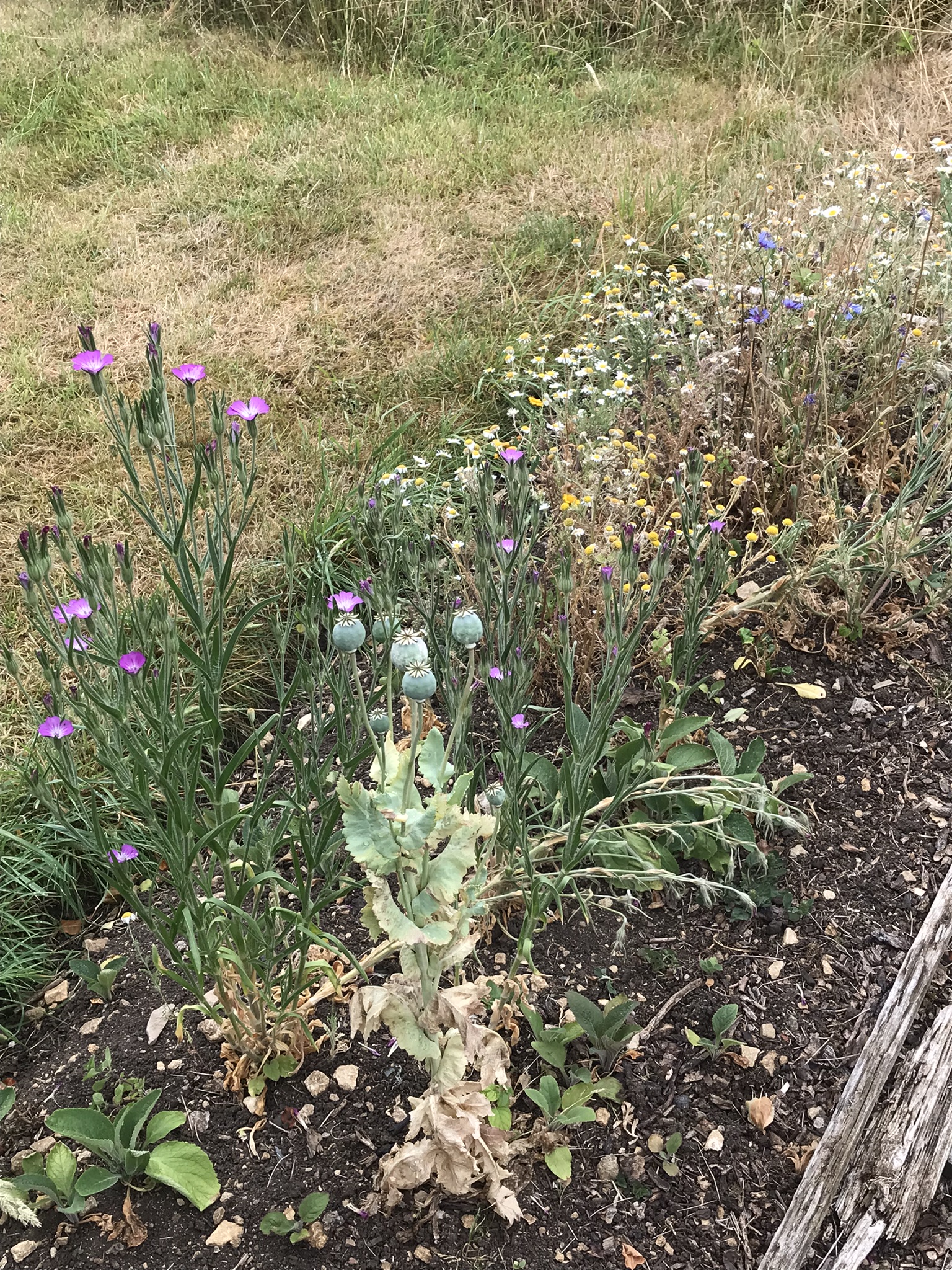
I liked the pink corncockle plants in the rather experimental wildflower patch (most of which has now flowered and died off), and have picked some seedheads in the hope of growing more next year, in a flowerbed among ‘proper’ plants, where they won’t look too out-of-place.  Likewise I’ve gathered seed from the calendula and cornflower plants in the tulip pot.  

I’m on a bit of a roll.  Next up will be to take cuttings of other plants for next year!

Following on from the views we’ve been enjoying from the summerhouse, the fox has been back in the field again, possibly in search of the juvenile pheasants which are roaming the countryside at the moment.  When we spotted a cat hunting in the field, then making a hasty retreat towards our garden, we thought that the fox was on its trail – until we noticed a young pheasant determinedly pursuing it through the grass.  The cat presumably wasn’t taking any chances with that big beak.

Sunday, 27 July 2025

Views from the summerhouse


Thanks partly to the good weather this summer, we’ve been eating meals in our summerhouse at the bottom of the garden.  It’s positioned so as to give a view back towards the house, but also to allow a good view through the window across the field behind and out over the valley beyond, where we can see buzzards and red kites soaring above the trees and watch swallows swooping across the field in pursuit of insects.  There’s a large hawthorn tree growing just over the fence but overhanging the summerhouse, a field maple next to it and various holly, elder and ivy undergrowth behind us, and a dense growth of damsons (actually plum tree suckers), ash and other bushes further along the boundary.  It all provides ideal cover for nesting and feeding birds and other wildlife.

The near edge of the field is poorly maintained by the owners, but this year a neighbour has scythed the nettles down, providing a clear view into the field.  Over the past few weeks we’ve been able to watch woodpigeons, crows and juvenile pheasants (the latter brought in specifically to be shot over winter – why??) scavenging in the grass, but also four-legged visitors.  A young fox was circling the field one day with one eye on us, probably with a view to coming into the garden in search of fallen plums (they love plums, and the grass underneath the tree was looking slightly trampled …).  Our favourite sightings were of a young hare, lolloping down the field, and, separately, of a beautiful big, brown adult hare calmly grazing fairly close to the inner fence and probably able to see us quite clearly.  It didn’t seem bothered.

As long as we stay inside the summerhouse, quite a lot of wildlife doesn’t appear to mind our presence.  A pair of woodpigeons regularly stroll past the open door in search of food or nesting material.   The bushes nearby are home every year to wrens and robins, and we have youngsters of both species appearing daily close by while foraging for breakfast.  The ripening plums are attracting a lot of insects, which in turn are bringing families of blue and great tits, and there’s a flock of young goldfinches looking for seeds.  Today a juvenile goldcrest joined the party!

The birds seem to have had an excellent breeding season, and are still feeding their last brood.  In recent days we’ve also seen sparrows and blackbirds with youngsters in tow.

At this time of year we normally get a green woodpecker combing the lawn for ants, but this year it has brought a friend, the pair of them making double the usual noise when disturbed!  A nuthatch, or perhaps two, has also been around, tapping away at nuts at the bottom of the garden and coming to the patio for a drink.

Ladybirds on the centaurea

The insect explosion has included a great many wasps, but also ladybirds; it has apparently been a bad year for aphids, but I can’t say I’ve been much bothered by them (perhaps the ladybirds have dealt with them).  Butterflies are also much more numerous this year, and early; as well as the usual species, a pair of little blue butterflies (common or holly blues probably) have been fluttering round the garden, and I spotted a hummingbird hawkmoth one day.  Wonderful what some warm weather can do!

Tuesday, 15 July 2025

Heat and drought

Back after two weeks in a rather hot Central Europe, to a garden that has been not a great deal cooler and is looking dry after three heatwaves and very little rain.  A hosepipe ban has just been announced – whereupon it has rained, though not nearly enough to refill the reservoirs.

A kind neighbour did an excellent job in our absence of watering the tomatoes and keeping the pots alive, though the plants in the ground have had to fend for themselves.  On the whole they haven’t done too badly.  The peas have mostly dried up and one or two ornamentals are looking the worse for wear, and the lawn is decidedly crunchy underfoot, but actually the garden is surviving and looked passably respectable for the village open gardens day (by my drawing visitors’ attention to the wildlife aspects of the plot rather than the conventional aspects of gardening).  When I spotted one visitor taking a photo, I realised that there was a reasonable amount of colour if you looked in the right places!  The dahlia pots looked good, and the Verbena bonariensis and some pinks masked the fact that much of the foreground planting (the geum and fading penstemons) needed deadheading; in 31C I hadn’t felt much like getting out there with the secateurs to sort it out!

A reasonable amount of colour

The Echium vulgare ‘Blue Bedder’ in one of the tulip pots had flowered well, and attracted interest from visitors.  And my little wildflower patch has its good points (I’m not sure I’m going to keep that for another year, though!).

'Blue Bedder' and surrounding pots

Wildflower patch

Some of the veg plot isn’t looking too bad; the climbing bean plants, with dill in front, are doing fine, though the dried-up peas need clearing (and there’s a stray radicchio plant next to them which is flowering).  The garlic (very small) and shallots (satisfyingly large) have been lifted and put in the greenhouse to dry off, and I’ve started clearing the broad beans.  A late explosion in the ladybird population is dealing with the blackfly!  I was surprised how many of my lettuce seedlings had survived the heat; before we left, I pulled up several of the little strawberry plants which were flagging badly (they don’t do well in drought) and popped lettuce in their place, and they’re coming on quite well.

Strawberry plants flagging - and about to be pulled up

Radicchio in flower

Beans and dill

Dried-up pea plants, with a nice row of carrots

There’s a new pest, melon-cotton aphid, in this country, affecting buddlejas; mine has the characteristic leaf mottling, but apparently it’s not fatal.  The plant is already in flower, much earlier than usual because of the heat, and attracting butterflies, which seem more plentiful this year.

Mottly buddleja leaf

After today’s (nicely steady) rain, the forecast is for temperatures to climb to low-to-mid twenties (centigrade), with some showery days ahead.  I’ll be tidying up the garden as the weather permits!

Saturday, 7 June 2025

Seeing red


Geum 'Mrs Bradshaw' in the patio bed

A pop of red does seem to brighten up a garden.  This is the time for the big blowsy poppies down by the summerhouse, but also the Geum ‘Mrs Bradshaw’ is making its mark in the (not-so-)new patio bed, contrasting with the blue penstemon which is the main attraction there; a little white comes from a white thrift (Armeria maritima) and Dianthus ‘Mrs Sinkins’, both peeping out from under the purple sage, and a couple of self-seeded foxgloves complete the picture.

Lily 'Cherry Joy'

Then the lilies are just starting.  I have a potful of dark red ‘Cherry Joy’, bulbs won in a raffle and planted up two or three years ago; they’re not scented, but they’re bright, prolific and – unlike a lot of lilies – they hold their flowers upright so that you can see them.  My scented lilies are in bud but will flower a little later.

Rose 'Gertrude Jekyll'

Foxglove bed

There is plenty of pink-and-white as well, from the roses and the foxgloves, which I’ve allowed to take over one of the shadier veg plot beds.  The aquilegias are now coming to an end, and the dame’s violet (Hesperis matronalis) plants are replacing them, colour-wise.  The peony ‘Sarah Bernhardt’ is just starting.  The red take-over won’t last long.

There have been some pops of red in the garden wildlife too, and not just the three robins which have been squabbling over the fatball feeder as they collect scraps for their youngsters (at least one of which has been to the patio).  Last night, before it became totally dark, I spotted a shape moving around under the big apple tree, which is shedding surplus fruit into the lawn (the so-called June drop).  The shape looked black, but in full light it would have been redder, because as it approached the house I could see that it was a large dog fox with a very long tail.  It made off through the flowerbeds.  That certainly explains some of the larger droppings that we see from time to time on the lawn.  It probably has a taste for (very underripe) apples.

And a few mornings back I opened up the greenhouse and noticed that some canes, that had been stacked in a corner, were lying on the ground.  This sort of thing is usually an indication of intruding wildlife; I assumed a mouse, since the temperatures overnight had been too low for the roof vents to open and allow a bird inside (and the door had been closed).  When I went to reach for some things lying on the gravel bed, I saw the flash of red before I spotted the black and white feathers – there was a greater spotted woodpecker under the staging, head under wing and fast asleep.  An adult male, as it had the bright red patch on the back of its head.  I can only think that it had been in there when I closed up the night before and had made the best of it by getting some shut-eye.  I wasn’t particularly quiet about my approach, and when it didn’t move at first I wondered if it was dead, but before I could pick it up it came round and shot into deeper cover.  I eventually persuaded it towards the open door and it made off, presumably quite relieved at being free again!

Thursday, 22 May 2025

The (un)tidy garden


They say that the best way to make you tidy your home is to invite guests.  The same is true of gardens.  I’ve rather rashly agreed to open my garden for a village event this summer, which has focused the mind on getting gardening jobs done; fortunately the weather has continued dry, which has allowed for a lot of outside work (despite an intermittently chilly wind from the east or north-east).

The wisteria

It's a pity that the opening isn’t for a few weeks yet, despite all the work that remains to be done, as the garden scents have been at their best recently: the wisteria on the patio, the rugosa rose in the bottom bed, and the yellow antirrhinum in the greenhouse have all been wafting their perfume around the garden, especially on the warmer days.  I hope that the other roses might still be in flower on the day.

Rosa rugosa

The yellow antirrhinum - a great survivor!

On the subject of the yellow antirrhinum – which is as prolific as ever: the windowbox has been planted for summer, with a mixture of pink felicia, little plants of Fuchsia ‘Hawkshead’ (cuttings from my main plant), an osteospermum and some Cosmos ‘Xanthos’.  And a plant which I had thought was my tender fuchsia, one of the large-flowered varieties; but as it has developed, I see it’s an antirrhinum, probably self-seeded into the fuchsia’s pot while it was wintering in the greenhouse.  So what happened to the fuchsia?  Dead, probably.  I hope the windowbox colour combination works.

Windowbox - the antirrhinum on the right!

Talking of colour combinations, the pot of Tulips ‘Prinses Irene’, ‘Havran’ and ‘Doll’s Minuet’ was a bit of a disappointment; only two of the latter flowered, rather spoiling the point of it all, though the colour contrast worked quite well.  The forget-me-nots were less successful with these shorter tulips than with the taller ones in the larger pot; the short tulips were rather buried among the forget-me-nots.  Something to remember for next year.  The contents of the mixed tulip pots are now past, and have been dug up and sent to the green waste bin.  The dahlias will go into those pots in a few days, once the weather warms up slightly (which it is forecast to do, bringing some welcome rain).

A bit of a disappointment

Some of my ‘waifs and strays’ in little pots have been planted out, mostly in the old herb bed (which still needs some weeding round the edges), although the seedlings grown last year from my bi-coloured aquilegias have found a home around the edges of the (now fully weeded) raspberry bed, at least until I can evaluate their flower colours. 

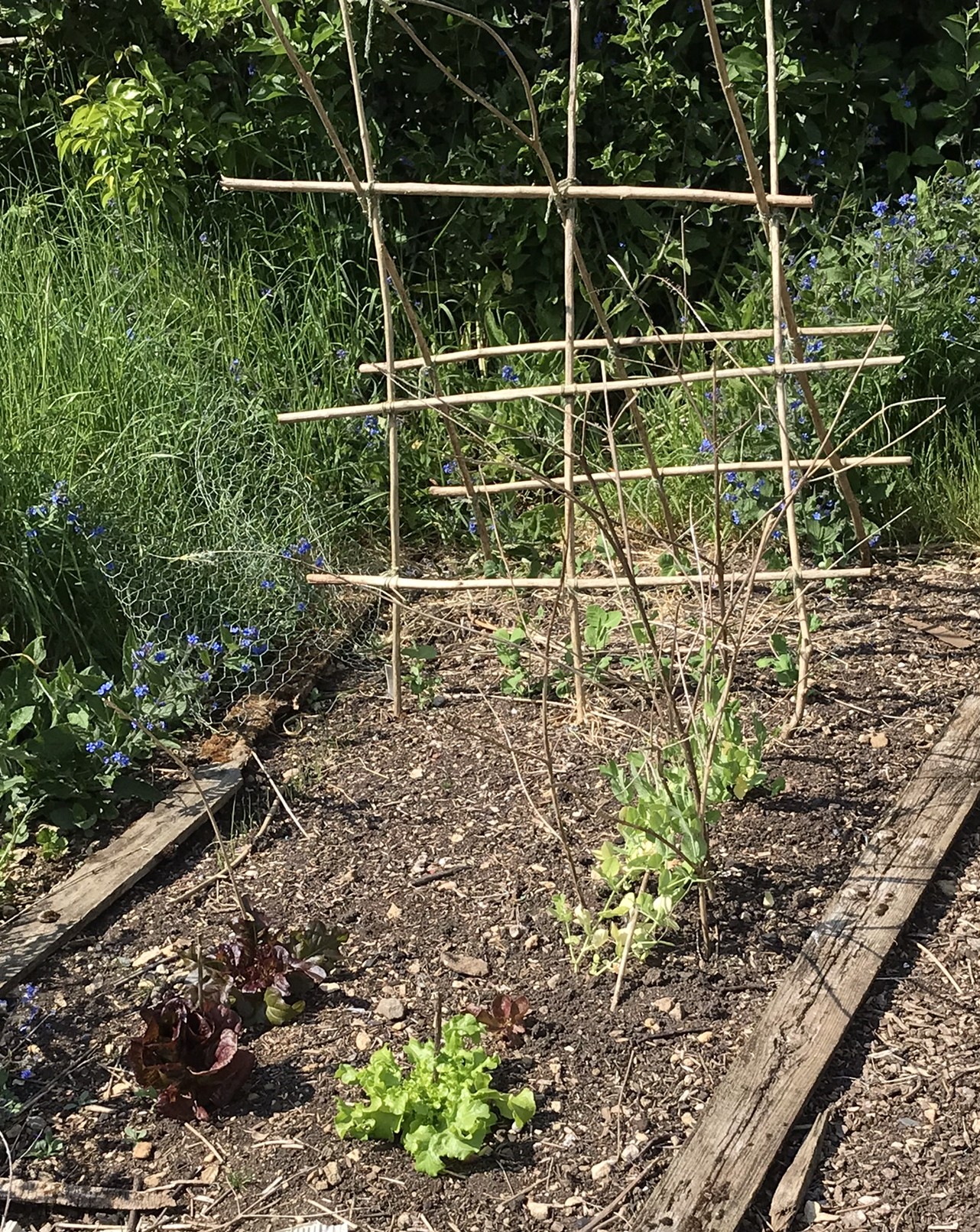
The veg plot is taking shape too.  There are two patches of broad beans, now in flower; three varieties of pea, ‘Early Onward’, ‘Douce Provence’ and the climber ‘Alderman’, as well as a few mangetout plants grown by a neighbour and donated in return for my surplus tomato plants; leek and carrot seedlings in the ground, and cabbage, broccoli and kale seedlings ready to be planted out once the old plants have been composted and the beds vacated.  The leaf beet has seeded itself everywhere, and there will be plenty to cook this year.  There are lettuces, and also a couple of radicchio plants, survivors of last year’s slug attacks, which have grown from the roots and appeared among the seedlings!  The courgettes are now being hardened off for planting out once the last of the cold nights is past.  There are still some very wild areas round the edges, but things are improving.

Peas, beans and a radicchio among the carrot seedlings!

More peas, mangetout, lettuces and leek seedlings (and weeds behind)

My ‘get out of jail’ card for the garden opening is that I’m going to bill it as a wildlife garden, which it is (at least partly), and I’m hoping that the orchids will be out.  The wildlife probably won’t be much in evidence while the garden is busy, though we see plenty of it at quieter times.  There are at least three blackbird families, goodness knows how many sparrows, and probably three robin pairs.  The great tits have raised a brood in our nestbox, and there are blue tits and wrens in the shrubby areas.  The rat that had been visiting kept a low profile after I threw a (very small) stone at it, and apparently succumbed to the neighbours’ poisoned bait.  But we have three hedgehogs visiting – not always amicably (there have been fights!) – in order to drink from the saucers on the patio every evening, and to fossick around in the undergrowth.