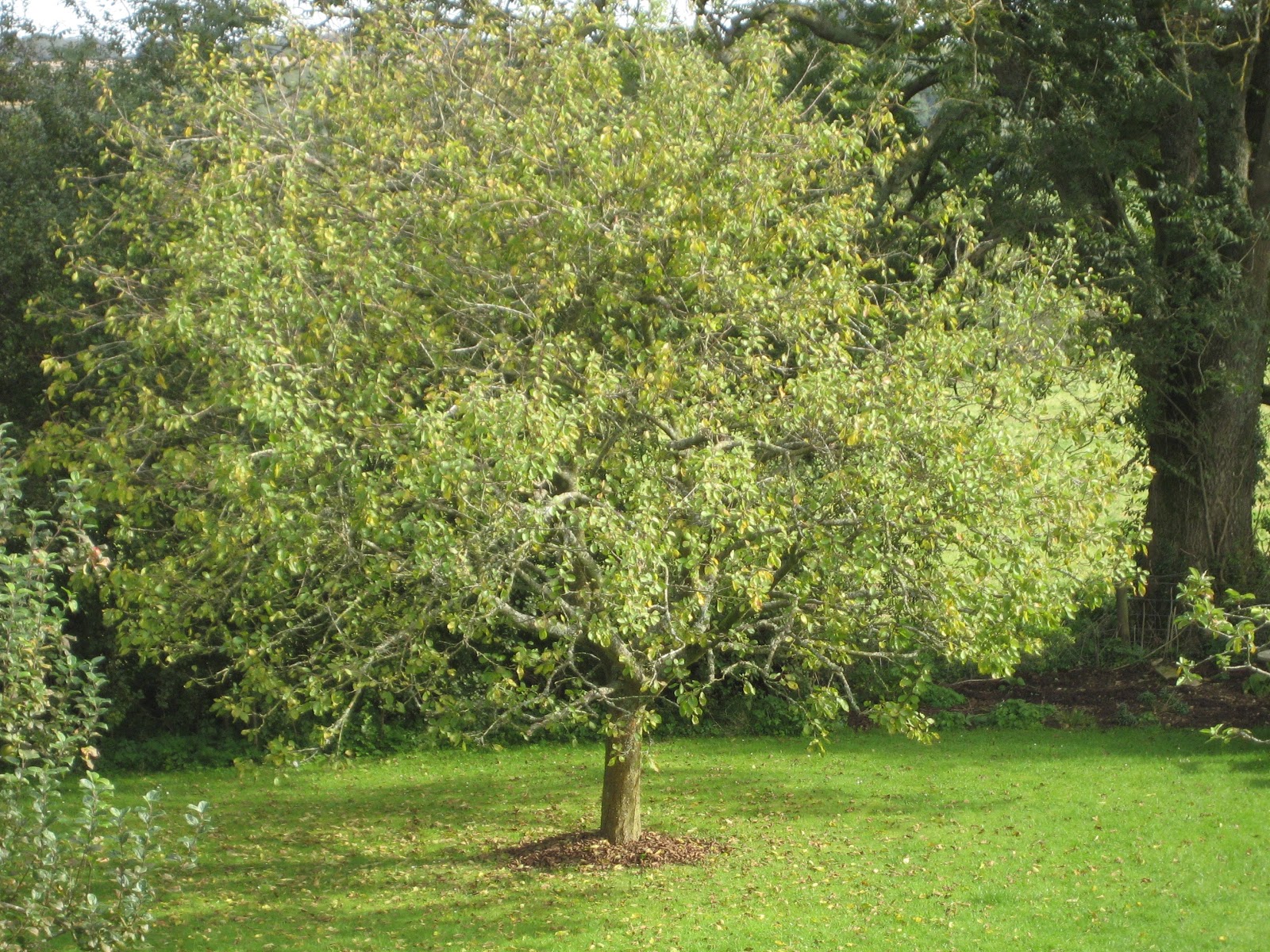
Monday, 19 November 2012

Autumn colour


The autumn colours are now just passing their peak.  Out and about, the beech trees have been a lovely burnished orange-brown, with smaller trees green-gold.  In our garden, the colour is mostly from the cotoneasters, both the red leaves (which are looking a bit pink in these pictures, I don't know why) and the berries.  The berries are left by the birds until fairly late, although a female blackbird has been in the big cotoneaster regularly.  I've swept up the fallen leaves and tried not to get too many berries in there; they self-seed dreadfully.

Every time the big ash tree drops a few twigs I can't help wondering if it's ash blight; but it has had dead bits for as long as we've been here, and ash trees are notorious for dropping sometimes quite big branches.  Let's wait until spring and see.  Maybe it'll turn out to be one of the immune ones.  However I can't help hoping that its many progeny around the garden aren't immune.  Ash is another bad seeder; you oftne don't notice until suddenly you spot a five-footer coming up through another shrub.

Still on the tree front, the hazels have catkins already; isn't this a bit early?  But they add to indoor flower arrangements.  Not that there's much to arrange: winter jasmine, winter viburnums, the yellow chrysanths.  The cyclamen have given up, and there are only odd single blooms around the place (including a 'Mousseline' rose).

Rather damp Saturday, lovely bright Sunday but a very frosty night in between.  Milder this week.

Bits of the holly tree, with berries, have been cut for Christmas, before the frosty night and the inevitable bird influx.  Sure enough, chilly Sunday morning saw a fieldfare in the apple tree, where he spent all morning demolishing a large apple, in the sun.  The green woodpecker, still around from time to time, will not be pleased - the apple tree is his haunt.  A pheasant spent the morning on the summerhouse roof; two females were inspecting the veg garden on Saturday.  The smaller birds are showing more interest in food put out for them, and my weeding in the garden on Sunday was much appreciated by the robin.

Sunday, 11 November 2012

Spring pots

A fine, sunny, not-too-chilly weekend, and the tulip order has arrived, so time to pot up the pots for spring.  I always forget what I've put in them, so, for the record (and this will be more for my use than for your interest!)
- the big pot at the bottom of the garden: Heuchera 'Prince' (a bit dark, but heucheras do furnish a pot), a (very pot-bound) seedling hebe and two euphorbia myrsinites, with some violas that never got planted out this summer (and which may never do anything at all now!).  Underneath, are a few crocus 'Blue Pearl', some 'Tete-a-tete' daffodils and three double tulips - Angelique, Black Hero and Uncle Tom.  I hope the east winds are kind to them.
- two pots on the patio: in the tulip pot is Tulip 'Professor Roentgen', a whopping big parrot tulip, and in the slightly smaller pot is 'Orange Princess'.  Both have a bronze sedge (another good pot-furnisher, the product of a parent plant self-seeding) and some orange pansies.
- two long-tom pots on the patio with alliums: one has A caeruleum, the other A amplectens 'Graceful', both with crocus 'Blue Pearl' on top.

There.  No excuse for forgetting next year.

Flowers still very sparse in the garden, but the marigolds are hanging on in there, and the yellow chrysanthemums are showing good buds (some of which are opening indoors as I type).  The winter jasmine is starting up, and the cyclamen (which I keep forgetting to mention because they're a bit out of sight) are still in bloom.  Apart from the winter viburnums there's not much else of note.  Leaves continue to fall, with the apples mostly still holding on to theirs, and the buddleia and winter honeysuckle still to drop. 

The bird picture hasn't changed much either; tits around when I put seeds out for them (and a big scrap between two small tits - coal and/or marsh tits - this morning), partridges skulking in corners and panicking if you get too close.  A possible sighting of a fieldfare flying over today, but none seen in the garden.  Both sorts of woodpecker too.

Weather is due to turn wet again - but it is mid-November so can't complain too much.

Wednesday, 7 November 2012

Ashes to ashes?

Much despondency about the news concerning the fungal disease killing ash trees across Europe, and now being found in the UK.  Ash is the predominant tree around here, and the loss of them would be huge.  There are three mature ashes on the boundaries of our garden, although only one is actually ours.  That one, at the side of the drive, I would miss but we could live without it (and it's not a particularly strong grower).  The one in the neighbours' garden that overshadows the vegetable garden can be a nuisance and doesn't provide much shelter, so I wouldn't be too sorry to see it go.  The major loss would be the big one across the fence in the field; it dominates the garden, where it's the main feature.  Birds love it and it protects us from the worst of the east wind.  There has been talk of not sweeping up fallen leaves, but it's really a necessity (there are a lot of them!) and, as they're pretty sodden, I don't expect that spores will be disturbed too much.  Anyway it might be the last time I'll be able to make leafmould in this quantity ....

A damp and murky weekend turned into a bright and cold start to the week, with a couple of quite cold nights (ice on the pond), but the past couple of days have been a little milder.  Still few flowers, other than the winter viburnums and the last couple of nerines; there are the last of the marigolds and some flowers on the big hellebore, but the winter honeysuckle and winter jasmine are not in bloom yet.  The dogwood stems are showing red now that the leaves have fallen from them.  The main plant has layered itself a foot or so away, which is actually a better position, so last winter I cut back the main part of the plant quite drastically, leaving the new part to take a starring role; I wouldn't much mind if it took over from the original plant, which is crowding out one of the roses.

Despite the cold, the birds aren't clamouring for food.  The robin, dunnock and some sparrows come to feed, with the occasional blackbird, but crumbs can lie there for most of the day untouched, and the seeds aren't being eaten as quickly as formerly.  There's obviously a reasonable amount of food around.  We're keeping an eye on the holly tree; there aren't as many berries as usual, and starlings are taking the top ones, so we will cut some of the lower branches for Christmas as soon as there are signs of birds feeding on them (and certainly if the redwings show up as they can clear the tree in a weekend).  I still haven't seen a fieldfare or redwing, although there's cold weather in Scandinavia so they must be here by now.

14 partridges on the lawn one morning! - with a pheasant lording it over them all.

Mr Mole seems to have been deterred by me stamping on the lawn where he had been digging (no molehills there, but you could feel the loose earth under the grass).  Still haven't worked out how to put the bedding sand back under the flagstones.

Wednesday, 31 October 2012

Sun elsewhere

Definitely not the Cotswolds
Back home after a week away in warmer climes, with a backdrop of some very different plants for a change - definitely not the Cotswolds, but I'm including a couple of photos here as they'll be the last summery colour for a while!

The weather here at home was murky when we left, and apparently remained so for a few days before the cold snap set in.  It brought early snow to parts of Europe (the Alps, when we flew over them on the homeward journey yesterday, had a good covering of snow) but only one frost here.  The weather is now chilly and damp, and windy, and likely to remain so for a couple of days at least.
 
The ash trees have now shed all their leaves - it looks as if every ash tree at this end of the village dumped its leaves in our driveway! so that was today's clearing-up job.  The apple trees and the shrubs are still hanging on to theirs.  The flowers are in late-autumn changeover: little left of the summer/autumn display but with the winter flowers not yet out (although the winter jasmine is nearly there).
 
Today's leaf-clearing was accompanied by the clacking of a fieldfare somewhere near.  If late autumn comes, can fieldfares be far behind? but none seen on the apple tree yet.  The green woodpecker was seen making a hasty exit from the apple tree, though.  The apples are small this year, though the cooker did manage one that was over a pound in weight (and would have been more if the woodpecker hadn't been at it!).  A couple of rotten ones left out on the patio were much appreciated by a blackbird today, and a couple of hen pheasants were skulking in the shrubs (apparently hiding from today's shoot) but otherwise there weren't many birds about.
 
A mole has been busy.  Normally we don't get any beyond the bottom of the garden, but one has reached the house; the back-door paving has obviously obstructed his excavations, but he has worked his way along the line of the gap between paving stones, throwing up a lot of bedding sand.  I'm not sure how I'm going to get that back into place!

Sunday, 21 October 2012

Falling leaves

Well, the next day was indeed brighter, with a warmer sun.  Applying my usual test - it was warm enough to have lunch outside on the bench.  Since then, there has been a little rain, some wind and some cool sunshine.  The wind brought down a reasonable amount of twigs from the ash trees, and toppled the hazel wigwam supporting Tutankhamun, so he has been pulled up (since the cooling weather would mean he'd be on the way out anyway) and composted.  Next year I must pinch out the young plants properly so that they don't get top-heavy - there was a lot of growth up beyond the top of the wigwam.

The wind has also brought down more leaves, especially today.  Yesterday was completely calm, and so quiet that you could hear the fall of a leaf; but this morning a lot of ash leaves had come down and they continued to fall all day.  There will be good leafmould for next year.  However, as the big ash tree gradually turns bare, it's clear how few seeds there are; this is good in terms of fewer unwanted seedlings all over the garden, but a sign of the bad summer.  Apparently horse chestnuts are also in short supply.

Not much change as far as flowers are concerned; just a few final ones on various plants, although the new Michaelmas daisy has a nice bright lavender-purple flower on it, with maybe more to come.

The blackbirds, who haven't been much in evidence lately, have started reappearing (or maybe they're migrant incomers).  Robins (at least two), dunnocks, a wren and lots of sparrows also around, and today a pair of nuthatches were on the seed container, and a gt spotted woodpecker on the nuts.  Also the marsh tits, which is nice.  The green woodpecker continues his interest in the cooking apples.  I keep listening for the sound of fieldfares, but none yet ...

Saturday, 13 October 2012

October Chill

Plum tree, first weekend in October
Mid-October, and the leaves are falling.  The plum tree, whose leaves normally start to turn as soon as the fruit is finished, has only started shedding leaves properly in the past couple of weeks; there are still quite a lot of leaves on the tree even now. 

Nights have continued to be mostly chilly, with a couple of air frosts in the past week, and the other trees have started to shed leaves too: the hawthorn has lost nearly all its leaves, and the big ash tree is dropping quite a lot.  The other ash trees are further behind (as usual - I wonder why?).


Double rainbow this afternoon
The weather picture has mostly been sunshine and showers, the sun often pleasant when it's out but definitely autumnal, and noticeably cooler in shade.  Today, after a cold night, the sun was bright but not warm and, when the showers kicked in, it was quite nippy - in fact we had a hailshower in the afternoon.  A lovely double rainbow though.  Last weekend I managed a quick lunch outside; today I can't say I was tempted.  Tomorrow is supposed to be brighter.

Despite the chill, there are still a few flowers out: the phlox is still in bloom, the perennial cornflower and Japanese anemones have flowers, as does the rose 'Blush Noisette', and sweet pea 'Tutankhamun' is only now slowing down.  Sedum 'Autumn Joy' of course is still at its peak.  There are a couple of self-sown marigolds in the vegetable patch, and the cyclamen under the holly tree.  The nerines are still doing well, and the schizostylus, which I had given up on as it is almost entirely swamped by the euphorbia 'Fens Ruby', has put out a flower spike.  The chrysanthemums are sitting stubbornly in bud, but the Michaelmas daisy is showing a touch of purple.  There are even a few flowers on the big hellebore, and one or two cowslip flowers in the lawn.

A couple of new additions: a new, dark pink, camellia in a pot in the front garden, and an end-of-season bargain chrysanthemum, a huge russet red one, in another pot on the patio.  The latter is seriously potbound, but I took some root cuttings which seem to be flourishing, so I think I've done well there.  Note for next year's planting: it will need to be paired with red/orange/yellow flowers, and/or possibly dark heucheras as long as they don't have too pink stems.  Don't put it near the sedum.  In the pot by the window, the heuchera/dark purple osteospermum/penstemon 'Sour Grapes' combination is working well (now that the orange dahlias are long gone!) but needs some brighter pink in the mix.  And down at the bottom of the garden, I'm very pleased with the bacopa - two plants have almost covered the surface of the big pot, flowered all summer and are still going.  (Pot plantings are on my mind because the order for next year's tulips has just gone in.)

The weather isn't yet cold enough for the birds to feed with great urgency.  The blackbirds are taking berries
Maybe brighter tomorrow
(although it has been a bad year for berrying shrubs), and the bread put out on the patio is mostly attracting sparrows, the robin and the dunnocks (and, from time to time, the fieldmouse).  The green woodpecker is around occasionally, mostly after the cooking apples, and I've seen a nuthatch on the ash tree.  Tits continue to come to the feeders, and the long-tailed tits have been about - the other morning they were in the plum tree and on the peanuts.  We seem to have a little group of three partridges who come in regularly, and pheasants have started to return - probably because the shooting started last weekend and it's safer in here!

One red admiral butterfly today - probably the last of the season.

Sunday, 30 September 2012

Mistaken identity


Where did August go, not to mention September?  Quite a lot to catch up on.  Rather a mixed August, weather-wise: not particularly cold, not particularly hot, occasionally wet, overall a bit mixed.  September started well, with a pleasantly warm and sunny week, but has turned autumnal: chilly nights, some lovely sun with intermittent showers and getting windy.  It’s the early mornings that remind you that the year is drawing on, with condensation on the outside of windows at breakfast-time from late August and a bit of a nip in the air.  Amid the showery weather recently there have been a couple of lovely days (like yesterday), with some quite warm sun, but more October-sun than September-sun.
I’m feeling rather foolish about one of my plants.  It was given to me years ago by a colleague who was a keen, if not specially knowledgeable, gardener, and I’m sure she told me it was a pink-flowered pulmonaria.  Not being particularly familiar with pulmonarias I never thought to question this, although the leaves were plain green and rather coarse – I took this to be the price one had to pay for pink flowers (although frankly I would have preferred a blue one, but this was a present and I couldn’t say no).  It’s attractive enough and has flourished, to the point of being a bit invasive.   Then a few weeks ago I got an email from a gardening website which I’ve used in the past, offering end-of-season bargains – and there was a picture of my pulmonaria.  Unmistakeably the same plant.  Except it’s a comfrey.  Symphytum ‘Hidcote Pink’ to be precise.  Ooops.

Not a pulmonaria

In my defence, I should say that it's on the compact side for a comfrey - only 9ins or so high. Actually, comfrey was on my wishlist when I first planned the garden, and I can’t think of a better place for it in the garden, so at least some of it will stay.  It’s effective ground-cover and the flowers are pleasant.  I will make room for a proper pulmonaria, though!

There have been a few more flowers in the garden this August.  Partly this is because the phlox and Lilium henryii flowered so late and partly because of new plantings such as the echinacea and clematis.  The chrysanthemums and Michaelmas daisies haven’t done anything yet; maybe they need more sun?   There are still a couple of late foxgloves and, remarkably, one of the posh aquilegias had a couple of flowers into September.  And now the nerines are coming out; they’ve been a bit shy in recent years, but the extra feeding seems to have done the trick as there are over a dozen flower spikes this year.

Cheerful but unfashionable
The chilly nights have done for the planting in the window-box.  For the second summer running I had put in Livingstone daisies (Mesembryanthemum); cheerful, colourful and undemanding, if rather unfashionable.  I like them.  Cold autumn weather finishes them off, though, so today they went in the compost bin and pansies, with ‘Tete-a-tete’ narcissi underneath and a couple of undersized seedling bronze sedges, went in instead.

I’ve also finally pulled up most of the self-seeded oregano in the vegetable patch to flower (I hope I got it out before it seeds further); there has been concern about bees not having enough to feed on, and they’ve been enjoying the oregano hugely, so I left it in as long as I dared.  For a while the vegetable patch looked very attractive in a wild, cottage-garden way, with oregano, foxgloves, linaria and deschampsia.  The buddleia has done well, and attracted a lot of butterflies; apparently they hatch in the second week in August and, bang on time, along came lots of peacocks and red admirals, with a couple of tortoiseshells and a painted lady as well.  Other buglife has been affected by the weather, though – hardly any ladybirds this year and virtually no wasps.
Peacock butterfly on the buddleia


Birdlife, though, has continued to be good.  The house martins seem to have gone a couple of weeks ago, and the swallows too (although I saw a lot of them on the phone lines in a neighbouring village today).  We had also had visits from a warbler, though he has probably gone too now.  Lots of sparrows (they were still feeding at least one youngster at the start of the month), a good number of blackbirds, at least a couple or robins and the same for dunnocks.  Blue and great tits are about, and occasionally a family of long-tailed tits; a pair of marsh tits have also been on the seed container, as has a nuthatch.  We’ve had a solitary partridge hanging around, although small groups of them are now appearing from time to time.  And a green woodpecker has been hoovering up ants from the lawn.  Other wildlife has been around too: a grass snake in the pond and a fieldmouse on the patio, both last weekend.  The mouse - perhaps the one that appeared at hay-cutting time? - was stealing the crumbs put out for the birds.  As long as he leaves my bulbs alone ...