Tuesday, 27 March 2018

Jostling for attention

We're not safe from cold weather yet - there is still the risk of a little snow in the coming days - but spring is definitely on its way, and with it the need to get on with all the jobs that are jostling for my attention.  The pond, which was getting clogged with weed, has been cleared up a bit; I've decided to leave a full overhaul until the autumn, to minimise disruption to the wildlife (as it was, I fished out, and returned to the water, several newts, including babies).  One major job that's now out of the way is pruning the buddleja.  It's a very mature shrub, and the operation always produces lots of prunings; I like to make as much use of these as possible, and dealing with them takes a couple of days.  Strong, long, straight stems are used to make beanpoles and stakes.  Branching tops are put aside for use as supports for peas and other small plants that need propping up.  Fragile, twiggy bits are used to make a path through the fruit bushes; these are conveniently alongside the buddleja, which makes things a bit easier, but I have to start by clearing up the twiggy remains of the previous year's path.  The cleared area gets a layer of old cardboard (flattened-out old boxes etc) - this rots into the ground over the year - and on top of this I throw down the twigs and walk on them to crush them.  It's a rough-and-ready sort of path but it works well enough.  The soft prunings - the leaves, old flowerheads and some of the very smallest twigs - go in the compost bin, and to accommodate them I always need to clear out the bin whose contents have been rotting away over the winter and re-fill it with material from the other bin, mixed with the prunings.  Reflecting, as I did so, on how I was going to use the rotted compost, I remembered that it's nearly time to prepare a trench for the runner beans, so a bagful was used to get that job done too - and that required digging out some couch grass that was colonising that bed.  And, looking up from the bean trench, I noticed that another stone has fallen out of the top of the wall behind the apple cordons; I had been planning to do some repair work there this winter, and it would be useful to get it done before the apples start producing shoots and before the lily-of-the-valley, which also lies in front of the wall, appears.  I might tackle that over the Easter weekend, weather permitting, as well as lifting, splitting and teasing the weeds out of the crocosmia.  And that's only a few of the jobs that are shouting "me, me" whenever I look out at the garden.

Meanwhile there are even more jobs needing doing in the greenhouse.  Normally by this time of the year I've started a lot of my seeds off, but so far only the tomatoes, aubergines, peppers and chillies are sown (on a windowsill indoors, and doing well so far; and a pot of basil seeds has just joined them).  The dahlias have now been potted up, or at least those that have survived the winter in good enough condition to grow on; in addition to 'Bishop of Auckland' and 'Ambition' (quite a few tubers of these now),  and 'Sam Hopkins' purchased last year, I now have tubers of the fashionable 'Cafe au Lait' (bought from the supermarket, a snip at 4 for £7).  Greenhouse planting should now be a little safer; I think I have identified, and blocked up, the mouse's entry point.  There's a very small gap between the greenhouse frame and the wall against which it stands (it's a lean-to), which I had blocked with scraps of bubblewrap (I was thinking of draughts, not rodents); the bubblewrap filling has disappeared.  I've replaced it with some more substantial bits of plastic (old yoghurt pot lids) which are not so removeable.  Sorry, mouse.

Some of the plants in the greenhouse, especially those such as the penstemons and osteospermums that were brought hastily in to protect them from the Beast, are now being stood outside during the day, and the cold frame propped open; it will soon be time to wean plants off the relative warmth of indoors and make space for the new seedlings.  The temperature in the greenhouse has dropped to low single figures several times this winter, but it can't be too bad in there as there are buds on some of the fuchsias and flowers on one of the osteospermums.  It's only the forecast of frosts in the next few days that is stopping me from taking the bubblewrap down; I tend to leave it up too long, and of course it reduces the light levels in there.

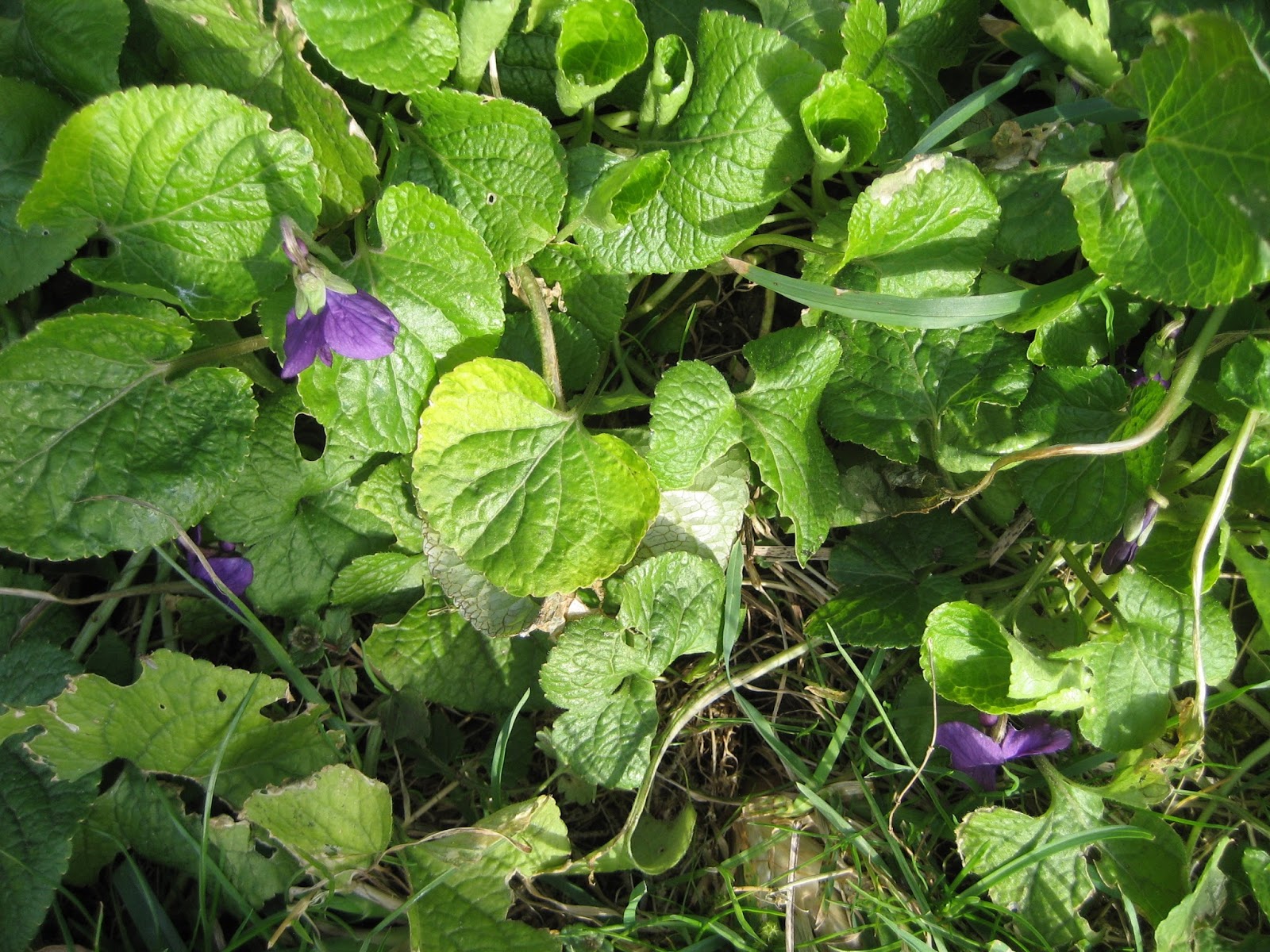
Colour is very slowly returning to the garden.  The big daffs are starting to bloom; the lesser celandines in sunny spots are coming out (they are actually weeds but acceptable ones); and a few slightly battered violets are showing among their leaves.  Two of the orchids in the lawn have also put their leaves up, so they have been protected from trampling and, eventually, mowing.  The hellebores look quite good; the one by the hedge has produced a self-sown offspring with white freckled flowers, so I may try to move that to a better place.
Lesser celandines - any colour is welcome at this time of year!

Big daffs starting to come out under the plum tree

A few sweet violets


Having said last week that I hadn't seen any signs of nesting, the very next day there was a sparrow gathering grass, and a day or two later a hen blackbird had a beakful of moss and a crow flew over carrying a stick.  The sparrows are jack-in-the-box-ing in and out of the hedge, pigeons are canoodling in the plum tree, dunnocks frisking at each other and chaffinches chasing off rivals.  The insect world is livening up too: a small ginger bee and a bumblebee have been about (the latter enjoying the crocuses), and the first butterfly of the year - a male brimstone, as usual - appeared at the weekend.

On the down side, one of our male pheasants has been killed - two wings and a bit of connecting bone were left on the lawn yesterday.  It looked like a sparrowhawk job.  I don't think it was my friendly pheasant, as one answering his description is still around, and seeing off rivals.  I wonder if his fondness for standing under the shrubs is partly that he's protected there from aerial assault?

Tuesday, 20 March 2018

MiniBeast

And, after the Beast from the East, we've had the MiniBeast: the same thing again but not so severe.  The weather started to warm up encouragingly in the post-Beast thaw, although even the more comfortable temperatures and rainfall took a week or so to get rid of all the snow.  Then last weekend the wind turned back to the east and brought more wind, low temperatures and snow; again, the actual volume of snow wasn't all that great but it formed small drifts in places, and froze to give us icy roads for a couple of days.  Conveniently for those who had to get out and about and into work, it was again the weekend that was the worst.  Three days on, the roads are clear again, although there are still significant patches of snow where drifts built up against hedges and walls, and in places out of the sun.

Still snow on the lawn

The wildlife seems to take it all pretty much in its stride, especially these past few days where the cold snap has been fairly brief.  As soon as the temperatures start to rise the birds seem to perk up, start singing again and get on with life; I haven't seen any actual signs of nesting yet, though a few birds have toyed briefly with bits of grass, as though they were aware that they would soon be wanting this stuff.  The sparrows are popping in and out of the leylandii hedge, so I would guess that they're choosing suitable nest sites in there; it's a real sparrow condominium.  I've put some wire netting loosely round the nestbox, enough to allow access by nuthatches or bluetits but not (I hope) the woodpecker.  A peek inside showed that something has been in there (there were droppings in the bottom), probably as a winter roost - but it will soon be a des res for a nesting pair.

One of the male pheasants has been about quite a lot.  He likes to stand in shelter among the shrubs, and is happy to wander about near me when I'm working in the garden.  In the snow yesterday he scraped out a spot in the lee of a euonymus so that he could stand out of the wind but warm up in the sun.
Spot the pheasant, hiding ...

Crocus chrysanthus 'Cream Beauty'
The plants bounced back from the first lot of snow and will do so again this time.  The little 'Tete-a-tete' daffodils in pots started to bloom after the Beast, and they, the crocuses and the hellebores seem to have survived the latest freeze.  The big daffs are still only in bud, and they will have been knocked back by the weather; but colour is starting to come back slowly to the garden.  I managed a small posy of pulmonaria and viburnum, the only flowers suitable for cutting at the moment.  A vase of supermarket tulips is going over, but I find that tulips mostly age well; even when they are faded like old tissue paper and on the point of falling apart, they still have interesting colour and shape.

Helleborus x hybridus
Crocus tommasinianus 'Whitewell Purple'
Narcissus 'Tete-a-tete'

Pulmonaria and viburnum
Tulips - fading but still decorative


Between the freezes I managed to get a few garden jobs done.  A sunny day was spent pruning the apple tree, with the pheasant poking around below and a buzzard circling overhead (and helicopters going to and from Cheltenham races passing by).  The autumn-sown broad beans had had a high failure rate, so the empty spaces were filled with sowings of 'Imperial Longpod' and I added a double row of the same alongside; and the shallots were planted, with some fleece on top to allow them to get roots down before the birds can get at them.  The garlic is coming up nicely, including one of the elephant garlic bulbs which has finally put up a shoot (something had nibbled the top of this, so an old inverted hanging basket has been put on top to protect it).  The leeks don't seem to have done well, though; quite a few have disappeared.  Other jobs included cutting the old leaves off the epimediums to allow the flowers to show, removing spent flower stems on the sedums, Lilium henryi and the Big Yellow Thing (bupthalmum is its proper name, but BYT is easier) and some belated tidying of rose bushes.  Outstanding jobs include pruning the buddleja, which was looking a bit sad after the first lot of freezing so I thought it best to leave it for the moment; and potting up dahlias and other things in the greenhouse; the forecast is for temperatures to remain a little below normal, but I'm hoping that the greenhouse will be warm enough to get them going.


Sunday, 4 March 2018

Emma and the Beast

Road to nowhere
So the 'Beast from the East' finally bit.  The east of the country bore the brunt of the first onslaught of snow mid-week, while we got away with the low temperatures but dry weather; but then the Beast met Storm Emma coming up from Iberia bringing damp air, and the result was a substantial dump of snow - lovely dry powdery stuff, quite unlike what we usually get.  It also brought gale-force winds which swept the snow into drifts; the actual snowfall probably wasn't much more than a few inches, but the drifting was impressive - open areas such as the fields were left with relatively little snow (and our patio and paths were almost completely free of it) while it piled up high in the roads, to hedge-top height in places, cutting the village off for the most part (a very few brave souls with 4x4s made it out via the back lanes).  Four days later the main road to the village is still blocked, although temperatures started to rise yesterday and it's all now thawing.  There is still a reasonable depth of snow on the lawn, especially where it had drifted (over 2ft in places).
Snow on the lawn

There's a pond somewhere under there ....
The strong winds blew some of the fine, powdery snow through the narrow gaps around garage doors and greenhouse windows; several villagers have found little piles of snow in their garden buildings, including me.  I was a bit bemused to find it snowing lightly inside the greenhouse!  I put some newspaper over the heater to protect it, but some snow gathered behind the bubblewrap and built up on some of the lettuce seedlings (which are to be discarded anyway, because of the mouse).

At least some of the wildlife made advance preparations against the cold.  One day a little woodmouse spent quite some time gathering crumbs put out for the birds and taking them under the patio door steps.  Is he the Beast from the Greenhouse, I wonder?
The Beast from the Greenhouse?


The wind, once it picked up, made it difficult to put out crumbs for the birds - they just blew away - so the apples and fatballs were the mainstays of my bird-feeding.  Various blackbirds enjoyed the apples, as did a mistle thrush which commandeered one apple, sitting by it all day and chasing off all comers.  A song thrush appeared once, only to be seen off by a blackbird, and a fieldfare called by too.  There were some very anxious-looking dunnocks, trying to warm their feet by standing on one leg at a time and tucking the other up, and scavenging for any scraps of food they could find.  A greenfinch and bullfinch also came - the bullfinch enjoyed a bath this morning - and so did a marsh tit, the first I've seen for a year or so.

There hasn't been a lot of gardening done lately, for obvious reasons!  I need to prune the apple trees and the buddleja, but not in this weather.  Before the snow I did manage to sow my tomatoes, aubergines, peppers and chillies, which have been germinating on a radiator indoors and are now starting to shoot.  At this rate it will be a while before I entrust them to the temperatures in the greenhouse.

Monday, 26 February 2018

Forewarned and forearmed

Pots tucked up
Some pots in the greenhouse
February has been wet rather than particularly cold, or so I'm informed; for much of it we have been away.  (Despite the warning about not leaving the new greenhouse heater "unattended for long periods", it was left on unattended for nearly three weeks and hasn't exploded.)  Since our return last week it has been chilly but dry, and the forecast for the next few days is for a very cold spell with the risk of snow, brought in by winds from Siberia.  The more excitable elements of the media are billing it as "The Beast from the East", and certainly the Met Office is warning about the dangers of cold and windchill (of as much as -14C) as well as snow disruption; although having just returned from similar temperatures in Norway, I'm not inclined to get too worked up about it.  Forewarned is forearmed, however, and I remember the similar-sounding bitter spring of 2013, so all the usual precautions of laying in food and fuel have been taken, as well as tucking the garden up as best I can.  Most of the pots have been grouped together, against the house wall where possible, to protect them from the wind and the effects of drying (any snow doesn't matter); the compost is looking quite dry as it is but I don't want to water them too much so that the roots don't freeze.  Some old garden fleece has been draped over them to give a little protection.  Small pots have been moved into the greenhouse and cold frame, as have all the borderline-hardy things (penstemons for example).  Fingers crossed!

Crocus 'Blue Pearl' (look closely ....)
The snowdrops and aconites are all still out, as are the hellebores (not so many of them now that the ones self-sown into the old path have gone), and the early crocuses have coloured (though I haven't seen any actually open yet).  The 'Cream Beauty' ones in various pots have come through well, although there aren't so many 'Blue Pearl' in evidence, only a few in the front garden and a couple pushing through the tatty heuchera leaves in the big pot.  C. tommasinianus 'Whitewell Purple' is showing down at the bottom of the garden, but they need sun to open and they're rather in the shade down there; I must find them a new home as they're lovely, cheery things.  The daffodils are still in bud, with those in the front garden furthest ahead, but given the weather forecast we probably won't have any in bloom for some time yet.  The self-sown pulmonaria over by the wall is flowering, though sadly its leaves are looking very much the worse for the wear and don't set off the blooms very well.

Pulmonaria (variety unknown)
With the weather having turned colder I've tried to be more regular about putting out food for the birds.  The fatballs continue to be popular, including with the long-tailed tits which, being only tiny, presumably really need a reliable food source.  We've had four of them in the past few days, feeding together and also trying to land on the false glazing bars of the patio doors (they really can't work out why they can't get a grip).  Keeping an unfrozen water supply is trickier; today we had two woodpigeons sitting on the birdbath looking disconsolately at the ice, until Lefty chased them off (he wanted a drink, too, but there was none to be had).  Plastic bowls of water last a very few hours until they, too, freeze over.  I've been putting out apples from the greenhouse for the blackbirds, one on the patio and one by the front of the garage where I can watch them from the kitchen window; the apple store is diminishing but should last a good few days yet.  The greenhouse mouse is still nibbling them, and it has had a go at the chitting potatoes too; it looks as though it has given up on those, but the lettuce seedlings have all been nibbled down and I should really discard them for hygiene reasons, along with the other salad leaves.  Most of those have been little damaged - mousey doesn't appear to have a taste for bitter things like rocket and mustard - but he has probably been trying them out so they ought to go too.  I'm annoyed about the lettuce but the other leaves were already past their best anyway, and I will shortly need the space that they've been occupying when I start potting up the dahlia tubers.  It may be cold out there, but it's already time to start seed-sowing so I need to find room for all of that!  I just need to find a way of preventing the mouse from eating those too.....


Sunday, 28 January 2018

Watch the birdie ...

Big Garden Birdwatch weekend, and this year's total was one of my best ever.  The usual suspects turned up, mostly in pairs except for the sparrows (7) and starlings (I recorded them as 12, although there were probably at least twice as many; they had been feeding in a big flock in the field behind us, but were startled by something into taking refuge in the big ash tree).  The coal tit turned up, as did the wren; there were 3 mistle thrushes (probably a pair and an interloper - there was a bit of a scrap) and, to my delight, the goldcrest.  I didn't report the red kite, which appeared a little later, circling over next door's garden.

Although spring is still some way off, the birds are wasting no time in getting ready.  The robin has paired up, although with a mate from elsewhere, not the skinny robin from further down the garden (which occasionally sneaks up to the patio for breakfast when the others aren't looking), and there's a lot of birdsong, mostly robins but also thrushes and the occasional blackbird.  The weather has been rather milder, except for last weekend when we had something of a snow day (only an inch or so of very wet snow which didn't last long), with occasional murk and rain and still windy from time to time; this weekend has been quite mild, and I've had the greenhouse door open during the day.

The relatively mild weather is bringing on the bulbs very well.  The snowdrops and aconites are all out, and the first crocuses and hellebores (H. x hybridus) are showing colour.  There are some daffodils in bud, although experience suggests that they won't actually flower for a few weeks yet, however promising they may look.  The comfrey is also starting to bloom, and there's a fine crop of hazel catkins; the early rhubarb shoots are showing, and at last the autumn-sown broad beans and garlic are starting to come through (I did put them in very late).
Winter aconites

First crocus: 'Cream Beauty'

Double snowdrops
I'm still hunting for the mouse in the greenhouse.  I took everything out other than the plants (having checked that there's nowhere for the mouse to hide amongst them), and satisfied myself that there is no rodent living in there.  I still don't know how it's getting in and out - there's no tunnel and no gap that it could get through - but it obviously is.  I can only assume that it's being beamed in and out by Scotty.  At least I'm confident that it's not going to be shut in; I only hope that it doesn't decide to make a nest in there.  The heating situation has fluctuated a little; the heater, whose thermostat was becoming erratic, finally packed up with a small bang (fortunately I was standing next to it at the time so could unplug it quickly, and also fortunately the weather was relatively mild at the time); its replacement also had a malfunctioning thermostat so was taken back to the shop; and now I've got one that is more expensive but seems to be doing the business very effectively.  My only concern is that the instructions insist that you shouldn't leave it unattended 'for long periods', whatever that means: do they think I'm going to sleep in there?


Saturday, 13 January 2018

Hide-and-seek

There's nothing like having a visitor to focus the mind on a good tidy-up.  It was a visitor that prompted me to tackle tidying up the greenhouse, though not quite in the usual way; this wasn't preparation for a visit, but an attempt to find the visitor.  The cooking apples are stored in the greenhouse, and I noticed that something had been nibbling them.  With the obvious exception of the door - which is kept closed at this time of year, other than for very short periods for airing - the greenhouse has no way for intruders to get in; I can only think that something (probably a mouse or vole) has got in when the door was open, finds it a frost-free and safe home with food provided, and has made itself at home.  It looks as though something has been shredding the edge of the bundle of fleece, which would make very comfortable bedding.  But despite having gone through the contents of the greenhouse, I can't find the perpetrator; it's still in there (more apples being nibbled), but I can't think where it's hiding!  My main concern isn't the apples, which are destined to be fed to the blackbirds anyway, but that the mouse will be trapped in there and unable to get out.  A complete emptying out of the greenhouse may be the only way to find it.

Pheasants and partridge
The first couple of weeks of the year have been mostly grey and damp, with some strong winds (Storm Eleanor), chilly but not very frosty and with some fog.  There is colder weather in the forecast.  The mist cleared at times to show a little sunshine, before creeping across the fields again at dusk.  Despite the chill the birds are starting to display signs of spring: there has been more singing, and the robins are starting an uneasy relationship over the food on the patio, presumably with a view to pairing up in due course.  Other bird visitors have been a pair of chaffinches, a female greenfinch (and there's a male around somewhere too), a female yellowhammer and a goldcrest; a wren is about regularly, and a goldfinch appeared today.  The other day a dozen collared doves appeared from somewhere, picking up the droppings from the seed feeder; and five male pheasants and four partridges came in to hide from the local shoot.  Lefty the woodpigeon and his mate are also regulars.  I don't know if they are responsible for the untidy nest in the hazel tree which was revealed by the falling of the leaves in autumn; it doesn't look like the most secure construction and I didn't expect it to last long, but it survived the recent gales, so perhaps it's better built than I thought!
Nest in the hazel tree

Thursday, 4 January 2018

A stern talking-to

I’ve stopped making New Year resolutions other than the general “must do better this year” ones; anything more complicated never lasts more than a few days.  This past year I’ve been trying to keep the “must do better” more firmly in mind as I go about my gardening business, and giving myself a stern talking-to as required.  It hasn’t always worked, but I am listening to myself more and more and taking action at least sometimes!  The conversations with myself generally fall into a few specific categories:


1. Weeds
A weed is a plant in the wrong place.  Even if it’s an otherwise desirable plant that would be welcome if it were in the right place.  Get them out, or move them elsewhere.  Yes, even the useful plants.  Yes, that includes the alpine strawberry plants that have been providing little desserts all autumn, and the oregano, even though it attracts bees and butterflies.  There are too many of them and they’re taking up space that ought to be used by other plants.  Decide where you want them and put them there, and weed out the rest; don’t let them colonise other places.  (I’ve been a little better at this during 2017; several plants have gone into the green waste bin.)  You also need to get on top of the lily-of-the-valley that is spreading out from its foothold in the veg plot; get digging!  And what are you going to do about the hypericum that has self-seeded under the osmanthus; keep it, move it or ditch it? – make up your mind!

2. Paths
And on the subject of the strawberries and oregano: they are particularly undesirable when they are in the middle of the veg plot paths.  If they’re in the way in the veg beds, they’re even more in the way when they’re growing in the path and you have to step on the beds to go around them!  Get them out as a priority, and weed the paths so that you can use them properly.  The whole point of a path is that it's a clear space for you to walk on.

3. Be ruthless!
Another aspect of ‘plant in the wrong place’ is the overall planting plan, which contains too many shrubs that have outgrown their welcome.  You planted them far too close to begin with, and many of them are now 20 years old and far, far bigger than you ever envisaged.  The time has come to decide whether to remove some altogether, and to be stricter about cutting back and shaping the others.  You’ve been talking for years about taking out the big philadelphus that hardly ever flowers, but the problem is that it’s jammed in between other big shrubs and you can’t get in there to do anything about it!  The neighbouring Viburnum tinus ‘Gwenlian’ that was damaged by the snowfall recently is a good place to start; cut it hard back (take cuttings first if you must, since it is admittedly a good plant, but where else in the garden would you put additional plants?), then get in there with the pruning saw and do some radical removal.  There are about six big shrubs in that area in a space that a sensible gardener would hesitate to plant up with two, so decide what you’re going to keep and get rid of the others.  And make a decision about the brachyglottis (what used to be Senecio greyii); it has become woody beyond all reasonable hope of redemption, even if the sparrows do love it as a safe place to hang out in, so take it out altogether.  Ok, so you’ve taken cuttings of it, but think very hard before you plant any of them, unless you’re going to keep them well trimmed; after all, you don’t actually like the flowers, so cutting them off wouldn’t be a problem.  Both it and the viburnums could be kept within bounds if you’re rigorous about cutting them back.  And there are other shrubs that need reducing in size (the aucuba, both the osmanthuses, the Buddleja alternifolia ….).  Thinking about the space occupied by the brachyglottis: it’s a space that needs a smallish (NB: smallish! Don’t get carried away) evergreen or evergrey, so a well-shaped brachyglottis would be a possibility, or perhaps one of the hebes, or even another Viburnum davidii.  But only one of those, mind you; don’t even think of squeezing in two or more!

4. Get those jobs done
You’ve been telling yourself for months that you ought to do some discreet tying-in of the columnar yews to prevent their branches from falling outwards as they grow.  And what happens?  We’ve had two big falls of snow, pulling the branches down, and now one of the yews is out of shape.  You still have time to fix it, but get it done before we get more snow.  Likewise the two Viburnum tinus with the branches broken by the snow.  Yes, you will have a lot of prunings to get rid of, but needs must.  And don’t put off lifting and dividing the iris in the pond; yes, it’s a horrible and difficult job, but it will become more horrible and more difficult if you ignore it.  It won’t go away.

5. Labelling
Actually you have been better at this in the past year.  You have finally learnt that you won’t remember which bulbs you have planted in that pot unless you label it, and that you won’t necessarily recognise the contents of small pots, especially in winter if they’re deciduous.  You’ve got labels, so use them!  And, since the pack of labels is running low, get yourself some wooden ones instead and reduce the amount of plastic you’re using in the garden, even by just a little; it all helps.

6. Keep talking to yourself in 2018 - it does work, sometimes!