Friday, 30 April 2021

End of April update

What a difference two days (since my last post) can make.  It's still cold - and April is now officially the coldest for 60 years, with a frost somewhere in the UK on every April day - but it has finally rained.  Yesterday was properly wet, while today we were treated to a couple of significant hailstorms.  May starts tomorrow, but it is still going to be cold (possibly for much of the month, if the forecast is to be believed).  I hope there is some warmth soon, so that I can move my aubergines and peppers off the windowsill and out into the greenhouse!

Hail on the lawn ...

... and another lot on the way

The rain has helped raise the water level in the pond, which was almost dry; the birds have enjoyed being able to bath in it again, and with the ground nicely dampened they are also finding it easier to seek out food.  Our bereaved female blackbird has apparently struck up a new relationship with one of the local males; she has been gathering nesting material and taking it into the top of the long hedge.  The new nest is just opposite our patio doors, so we might be able to track what develops there.

Another female blackbird has been feeding a youngster down at the other end of the veg patch, and occasionally they come up towards the house.  Yesterday they were right up near the raspberries; mum went off to search for food under the big gooseberry bush and, after a little indecision, youngster decided to follow her.  It was a good move, as it turned out; only seconds later the female sparrowhawk flashed by (and flew off empty-taloned, fortunately).  Little blackbird wouldn't have stood a chance if he hadn't been inside the thorny gooseberry bush.

A new vaseful of flowers from the garden to brighten up the house: big red tulips (variety unknown), doronicums, honesty and centaurea montana.


Wednesday, 28 April 2021

Coming and going

Daffodils - just going

There has been a lot of coming and going in the past few weeks, with a lot to do in the garden, plants fading and being overtaken by others and plenty of birds coming and going too. 

My comings and goings have been to do with trying to keep on top of the various garden jobs at this time of year: weeding, sowing, pricking out, potting on and, given how dry it has been, watering.  April, unusually, has been very dry: apart from the light snow showers earlier in the month, there has hardly been any precipitation here for weeks, and coming and going with the watering can has been necessary.

The weather this month has also been mostly sunny but an easterly wind has kept it decidedly on the chilly side.  The cool temperatures (low teens centigrade/below 60F most days) have kept the daffodils flowering for longer than usual, though they are now going over, at that stage where they provide welcome colour from a distance but, when viewed close to, are too obviously on the way out to be suitable for cutting for the house.  They are being superseded by the tulips.  The first of these to flower were the little red ones in the front garden, which came out in the last days of March, but the first of the tall ones were the ‘Couleur Cardinal’ which were planted out years ago into the end of the veg plot and have provided a vaseful of colour each year since.  They were closely followed by ‘Apricot Beauty’, a new variety for me (I’m trying to grow at least one new variety every year); it isn’t quite my idea of apricot, being quite pink without much of an orangey flush, but it is lovely.  ‘Exotic Emperor’ was next, an old favourite and always a cheerful early potful.  ‘Orange Emperor’ is also out, as is yellow ‘World Friendship’, and the two big pots with mixed varieties are just starting to come into flower.  

A vase of 'Couleur Cardinal'

'Apricot Beauty'

'Exotic Emperor'

Other colour is also starting to appear, especially around the summerhouse end of the path by the long hedge – doronicums, honesty (Lunaria annua) and a few of the red tulips that are dotted through the planting down there.

Path by the long hedge

On the wilder side, the cowslips in the lawn are coming into bloom, though the sparrows have been pecking at the flowers; and the unintended patch of them on the verge outside our drive is going from strength to strength.

Cowslips in the verge

If the gardener has been kept coming and going recently, that is even more true of the birds here.  A few of them have literally been coming or going, on migration.  ‘Going’, probably, were two male bramblings (a colourful finch which overwinters in the UK) spotted in the plum tree ten days or so ago, and another yesterday; I’ve seen bramblings here before, but they’re definitely unusual visitors for us, probably stopping off on their way back to Scandinavia for the summer.  My Scandinavian readers might be seeing them make landfall after crossing the North Sea soon!  ‘Coming’ were two male blackcaps, probably en route for somewhere more sheltered than our garden; we occasionally see them early or late in the season, again probably on passage, but they never seem to hang around.  I’ve also seen one house martin and D has seen swallows, so our summer visitors are gradually arriving.  I wonder what they’re making of the cold.

The resident birds are busy nesting and raising youngsters.  The blackbird family who were nesting in the hedge seem to have come to an unhappy end.  Dad had been feeding their one survivor from the first brood while Mum incubated the second, but one day we found little one cheeping forlornly for food, and a sad little pile of male blackbird feathers on the lawn.  We tried to put out food for youngster, but he wasn’t sufficiently advanced to sustain himself.  Mum took over feeding duties, even though she had started gathering small worms presumably for the next lot of nestlings, but little one hasn’t been seen for several days and Mum is no longer gathering food, so we assume that she has had to abandon her nest.  Another male has moved into her territory and she is mostly keeping out of his way.  Another possibly abandoned nest is our birdbox; blue tits had been going in and out, but one day they had a full-on, stand-up fight with a pair of great tits down there, and I haven’t seen any activity at all since then. 

On a more positive birdy note, Lefty the lame pigeon has been picking up nesting material with his mate, and at least two pairs of robins are actively taking food to their nests; one of them, presumably my friend from earlier in the year, has become quite tame, following me around when I’m weeding.  Another pair of robins spent one day busily taking nesting material into a hole in the neighbours’ garage fascia, but I haven’t seen them there since; either found somewhere better and moved on, or just being very low-key in their movements?  A young collared dove appeared in the apple tree today, and a wren has been paying visits to the greenhouse, probably in search of spiders (he’s welcome to any that he can find in there as long as he can find his way out again!).  And a rare visitor, a marsh tit, has found our fatball container and has paid at least a couple of visits to it; I hope he makes it a regular pitstop.

Thursday, 8 April 2021

Seven daisies

According to an old saying, you know that spring has come when you can fit seven daisies under your foot.  There’s at least one clump of daisies in the lawn that fits the bill, and indeed we have all the other signs of spring here – plants growing, birds nesting and the usual unpredictable spring weather.

Snowy April morning

March ended with a couple of days of warmth – T-shirts for working in the garden! – which extended into the first day or so of April, but it has been downhill since then.  Chilly temperatures by day, despite often blue skies, and the odd frost by night, cold wind from the north and occasional showers of snow or hail, culminating in a thin layer of lying wet snow on Tuesday evening and night.  It is only early April, after all.  The forecast is for below-average temperatures for another week or two at least.

Spring flowers: Doronicum caucasicum

The spring flowers are blooming in spite of the cold: lots of daffodils, with the doronicums and brunnera adding more colour.  In the grass verge just outside our garden is a cheerful little patch of snowdrops (now past), cowslips and primulas; I planted the snowdrops there many years ago but the others have come of their own accord, and very welcome too.

Flowers in the verge

The warm weather brought out the first butterflies – a male brimstone, a peacock and a small tortoiseshell.  The cold will have been a shock to them.  The birds seem to be able to go with the flow at this time of year, even when they have little ones.  The blackbirds nesting in the long hedge are feeding at least one fledgling (there may only be the one as both parents seem to be giving it their full attention), and there have been other cheeping sounds coming from the hedge, so I think some of the sparrows may have hatched too.  A pair of bluetits have been showing interest in the nestbox.  A variety of birds have been coming to the pond to bathe and drink, although the water level is very low (it has been a dry winter and spring here, and I’ve had to water all the pots recently); besides the usual garden residents we’ve had a pair of coal tits, goldfinches and, pleasingly, a greenfinch, which used to be common here before the outbreak of trichomonosis that killed so many of them, and we haven’t seen one for two or three years.  Other unusual sightings the other day were of three red kites having an aerial standoff, and a heron flying low over the garden on Sunday (checking out the neighbours’ pond?).  And one day the local woodpigeons held a convention in the field behind us; I counted 60 before they spotted me and flew off.

Other wildlife is also active: the first hedgehog droppings have appeared on the lawn, and a fox seems to have called by.  I found a dead pheasant (such are the delights of country living) tucked neatly between the wall by the gas tank and the semi-wild shrubs growing there; pheasants don’t normally keel over so tidily by themselves, and I guessed that this was the result of a fox’s successful hunting expedition (too much shopping to carry home all at once?).  Usually I would attempt to bury dead wildlife found in the garden, but digging a hole deep enough for a pheasant wasn’t going to be easy, so I left it where it was.  And next morning it had gone; I assume the fox had come back for his shopping.

Given the cold, I won’t be doing any outdoor sowing or planting for a few days at least.  There are plenty of seeds sown in the greenhouse and cold frame, plus the really tender ones indoors germinating on the radiators and growing on on the windowsills: aubergines and peppers, with tomatoes newly germinated and courgettes sown yesterday.

Spring is also a time for new perspectives, and last week’s hard landscaping work has given me scope for re-thinking some planting ideas.  The newly re-laid patio and its adjacent paths, together with the clearing of some of the plant and weed growth alongside, give much clearer lines to that part of the garden, and I can see why gardeners are advised to sort out their hard landscaping before thinking about planting; I’m already considering new planting ideas (a clump of daffodils at that corner?  Some low-growing geraniums along that edge?). 

Newly re-laid patio

The garden birdlife was less sure about the work, although the blackbird enjoyed the digging.  All the plant pots had to be moved (and have not yet been put back), as well as the birdbaths, which were left unfilled (and no breakfast crumbs left out either).  Once it was all complete, the birds appeared a little suspicious of the new arrangement and hesitant about returning; Lefty the lame woodpigeon seemed to miss the terracotta shell which holds drinking water, his favourite drinking spot, but once it was reinstated he deigned to come back to feed.  The cold weather and the resumption of food put out on the patio will have encouraged them to overcome their disapproval!

Friday, 26 March 2021

Greening up

Winter honeysuckle
March has been on the cool side, often turning chilly towards evening, though there have been no real frosts for a couple of weeks now; we’re still waiting for any proper warmth, but the natural world has suddenly decided that it is spring, as if it had just been waiting for the equinox.  Over the course of a very few days I noticed that some of the deciduous shrubs had put out their new leaves.  One of the earliest shrubs to leaf up is always the winter honeysuckle; it has flowered well this winter, pumping out scent and attracting the early bees, but now the flowers are being superseded by the bright green leaves.  Like so many of the shrubs in the garden, it has outgrown its allotted space, developed much old wood and layered itself; if I can find the time, I need to get in there with the saw and garden fork to sort it out.

Other plants that have started to green up include the gooseberries – bare and brown one day, and almost the next, bright green – followed quickly by the other soft fruit.

I’ve been doing some manual ‘greening up’, of the lawn near the greenhouse.  It has had a few bare patches for a while now, the result of my intermittent attempts to weed out some of the creeping potentilla, an innocuous-looking little plant which has a tap-root up to 30cm/1ft deep and throws out long runners through the grass and into the flower beds, if allowed.  My attempts to curb its enthusiasm aren’t having much success (and are leaving their mark on the lawn).  Then last year we had to have the drains relaid, and the lawn still bears the considerable scars from the work.  Next week we’re having some hard landscaping done, including a small area of hardstanding next to the summerhouse; as it happens, that area, currently part of the lawn, has some of the most weed-free grass in the garden, and it seems a pity to have it dug up and carted away by the workmen.  I’ve been lifting turves from there and trying to bed them into the bare patches by the greenhouse.  There’s still a short stretch needing to be done – I’ll have to find some more decent-quality lawn elsewhere! – and I suspect that the newly laid area is going to be rather lumpy and uneven for a while, but it does look a little better than it did.

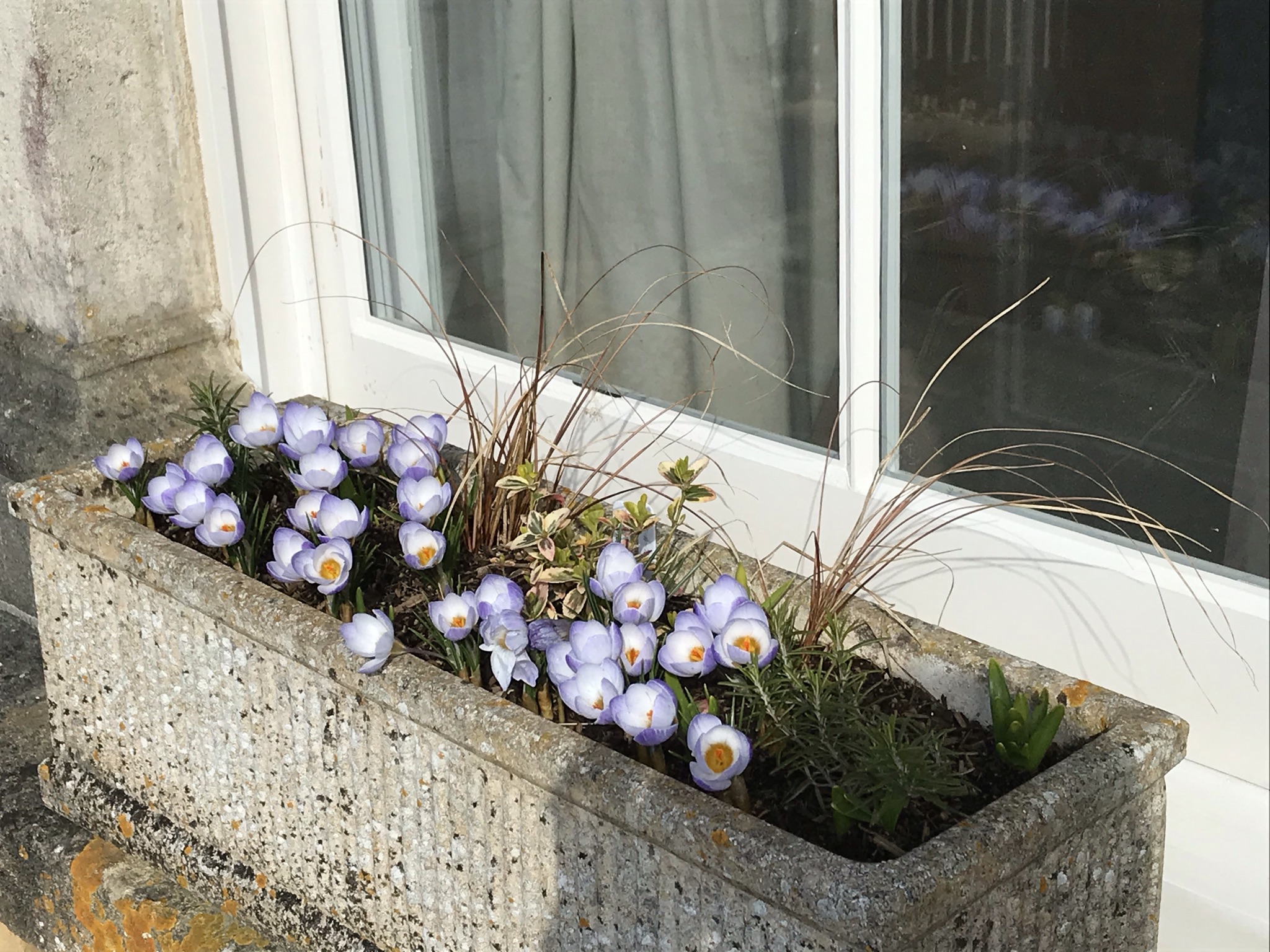
The other predominant colour in the garden at the moment is yellow – the daffodils are at their peak, and the doronicums are starting to bloom.  I’m still waiting for the little daffs in the window-box to flower, though the ‘Blue Pearl’ crocuses are doing a good job of brightening up the window.  And yesterday I was stopped in my tracks half-way across the garden when I caught the scent of violets on the breeze; the sprawling and untidy patch of violets in the bottom border is in bloom.  It’s amazing how such a tiny flower can pack such an olfactory punch.  A small posy is now on the table indoors.

'Blue Pearl' crocuses in the windowbox

A posy of violets

The birds are also moving into full spring mode.  The sparrows and robins are collecting nest material and taking it into the long hedge, where the blackbirds already have a thriving nest; Mr Blackbird has been gathering little worms and grubs to feed their first nestlings (he particularly appreciated my lawn-digging).  One, and possibly two, coal tits have been about; we occasionally see one on the seed feeder, further down the garden, but this one has discovered the fatball container and has been coming to the patio to bathe.  I hope they’re nesting nearby.

And on our weekly shopping trip yesterday we saw blackthorn flowering in the hedges, and the first lambs in the fields.  The weather is forecast to be on the chilly side for a while yet – the proverbial ‘blackthorn winter’ – but spring is definitely coming!

Thursday, 18 March 2021

Plants in the wrong place

A weed, of course, is a plant in the wrong place.  There are quite a few plants in the wrong place in the garden, including this lovely little clump of miniature daffodils, currently brightening up the far corner of the vegetable garden.  I forget when and why I put them there – probably for lack of any other suitable spot at the time – but they’re not weeds, and I'm happy for them to stay there.

Sally Nex, writing in the RHS magazine this month, has taken a novel approach to weed removal.  She has reclassified her weeds as ‘wildflowers’, and all of a sudden – a weed-free plot.  Having a very wildflower-y lawn, I can go along with that; our lawn isn’t a model of perfection by any means, but it is never treated with chemicals, is very colourful between mowings, and boasts a fine colony of cowslips and three species of orchid, which we mow around.  Some of the lawn weeds, especially couch grass and creeping potentilla, make a nuisance of themselves by creeping into adjacent beds, where I try to deal with them as best I can; but not all of my ‘plants in the wrong place’ are actually wildflowers.

Take the alpine strawberries (variety ‘Baron Solemacher’) and the oregano.  Both are definitely ‘plants’ not ‘wildflowers’ – I introduced them into the garden – that took to growing prolifically in the veg plot (and elsewhere).  I like both plants very much; as well as being useful in the kitchen, they’re attractive to wildlife, especially the oregano, which is enjoyed by butterflies when in flower and by goldfinches when seeding.  They used to pop up uninvited in places where I never intended them to grow, and I allowed and even encouraged them since they were highly desirable plants.  Things came to a head when they colonised some of the veg plot paths, and I found myself walking on the veg beds so as not to trample them.  Something had clearly gone wrong there.  When I considered why I was taking this lopsided view, I realised that I was tolerating them because neither plant had a dedicated place where they were supposed to grow: the strawberries did have two very small beds in the veg plot (one of which had fallen out of use), but since the berries are very small, I needed more plants elsewhere to produce a decent crop, and the herb bed where the oregano was supposed to live had not really worked out and had been repurposed for other plants.  Both have been weeded out of the paths, and I’m now considering dedicated quarters for them in future.

One of my latest weeding jobs has been removing them from the raspberry patch.  Crawling around under the raspberry canes and trying to winkle out the weeds hasn’t been one of my favourite jobs, so it doesn’t get done every year, but this year it has suddenly become easier.  I’ve noticed in recent seasons that the raspberries are not doing as well as they once did, and this year about half of the canes haven’t produced any stems, leaving big bare patches in the bed.  The plants were in the garden when we came here, 30 years ago (already!), and I’ve been considering replacing them for a while, so I think the time has come.   My plan is to let the remaining canes fruit and then to dig them out, clear the whole bed, and replant, with a mixture of the traditional summer-fruiting and the newer autumn-fruiting varieties.

I’ve now cleared the part of the bed with no surviving canes, removing the weeds as I went.  Both the couch grass and the horrible potentilla had made inroads from the lawn into the patch, but not very seriously; it was mostly the oregano and alpine strawberries that needed to be dealt with.  They actually work very well as underplanting for raspberries; they don’t get in the way of the canes, they suppress weeds by covering what would otherwise be bare soil and, being edibles, they’re a sensible planting in the fruit patch.  I may well reinstate at least the strawberries when I replant the bed (the oregano can be a bit too invasive and is less easy to dig out); a few of the plants I removed have been temporarily bedded in a spare corner for that purpose.

Actually the further half of the raspberry bed has been out of commission completely for a few years, and that also needs clearing.  There’s a lot of ivy, but there’s also a large clump of Iris foetidissima.  I’m tolerant of the iris, because the un-showiness of its flowers is offset by the fine shiny leaves and the bright orange seeds in winter, both good in flower arrangements and cheering in the garden.  It is actually a real native wildflower, but it mostly appears in gardens because someone has planted it or because it has seeded in from another garden.  So is it a ‘wildflower’ or a ‘plant’?  Either way, it is going to be removed; it’s happy to grow in deep shade and in poor soil (and does so elsewhere in the garden), so having it in a sunny(ish) place and in good soil is a waste of a good garden situation.  (Thinking about it, that’s also true of the alpine strawberries.  Maybe I need to consider further.)

In the meantime, there is now some clear ground in the patch which can be put to good use for temporary planting.  As usual, I’ve been overenthusiastic about sowing lettuce seeds: six varieties, and because I can never bring myself to believe that most of the seeds will germinate, I have far too many seedlings coming through.  Some of them might find themselves in with the raspberries in due course.

Lettuce, just starting to germinate


Wednesday, 10 March 2021

Dogwood dreaming

Crocuses on a sunny day
After a mostly dry spell, often pleasant by day but sometimes frosty at nights, we’re now having the March winds, accompanied by light but persistent rain.  The wind is not so good for the crocuses, blooming now, and badly timed for the first small daffodils coming into flower, but the garden will welcome a bit of wet.  Although there are jobs to be done in the greenhouse, it’s a good time just to look out of the window and dream.

With the buddleja and apple tree pruned, I’ve been tackling the dogwood.  (For my American readership, I should explain that this is not your beautiful East Coast flowering dogwood – which I’d love to have in the garden, but it doesn’t do well in these parts – but the one grown for its coloured stems in winter.  It’s Cornus alba ‘Elegantissima’ to be precise, and though it does have flowers, they’re much less showy than yours.)  You’re supposed to cut it to the ground in late winter to encourage the bright new stems for next winter, though of course that means sacrificing the show of variegated foliage, which is lovely.  But I haven’t been good at pruning it for a few years, it had sent out great long shoots which arch down to the ground and root there, and as a result it had turned into quite an extensive thicket.  So, out with the saw and back down to the ground, mostly, leaving just a few taller shoots to provide foliage interest in summer.

With all the top growth removed, suddenly I have more garden to play with – and a lot more open space.  Rather too open, actually; it’s now looking rather bare, and the patio is feeling rather exposed.  The patio is to be relaid at the end of the month, and a new path put in leading off towards the long hedge, so I’ll leave it for the moment and tackle the area once the new landscaping is in place.  In the meantime – time to dream, and plan.

The first job, after a spot of weeding, will be to decide which bits of the dogwood to leave in place.  At least all the layerings that have been formed allow me to choose which to keep and which to dig out (in theory – some of them are immoveable!).  There are other plants in there to be kept, noticeably a couple of roses which have become really leggy after a few years of being sat on by the dogwood, and I was surprised to find a clematis.  This will be C. viticella ‘Etoile Violette’, which I planted a good many years ago and thought I had lost – but I’m sure I didn’t plant it quite where it’s now growing.  It must have layered itself too.  And now it no longer has a plant to climb over! – so I’ll need to create some sort of interim support for it.

(I could, and probably will, lash up a tripod of long buddleja prunings for it to climb up, at least for this year.  Last year I did something similar in one of the big pots on the patio, as a support for the ipomoeas, but I failed to tie the stems together firmly enough.  It was strong enough for the ipomoea, but I didn't reckon with the sparrows using it as a launch pad from which to bounce onto the fatball container, and it looked in a very sorry state by the end of summer.)

With the unwanted parts of the dogwood removed, I will need to make some careful decisions about planting.  The patio needs a feeling of enclosure but without actually being hedged off; the dogwood provided quite a dense screen in summer, and I want something rather lighter in texture.  Some of its stems will still be fairly tall, but I'd like some ‘see through’ plants in there as well; perhaps some of the Gaura lindheimeri that I grew last year in the bed round the corner.  They were lovely, little white flowers dancing in the breezes, but a bit too white when set against the soft yellows nearby and they looked out of place, so they're due for a move.  (White can be a difficult colour in the garden; it clashes with nothing, but doesn’t go with everything; a pure white alongside an ivory, for example, just makes the ivory look dirty.)  The gaura might do well in there, especially as the bed will now be sunnier than before, provided it tones with the dogwood foliage.  There is also some sweet rocket self-seeded throughout the bed, and also aquilegias – both with good low-growing foliage below taller, but temporary, flower stems.   Add some foxgloves too?  The edge of the patio will be tricky to get right; I’ll need to resist the temptation to go for only low planting there, otherwise it will look like a mini-hedge gone wrong.  Something substantial, but not too bushy, could be in the line-up: I’m thinking of a daphne at the moment.

In the meantime, the sparrows have been deprived of one of their favourite perches; the dogwood was next to the fatball container, and was where the small birds sat while waiting their turn to feed.  I ought to put in something for them to sit in (other than the tripod!).

Self-seeded Cyclamen coum
The landscaping work won’t disturb too many plants, at least not plants that I care about (there are plenty of weeds that will be removed!).  I hope the little Cyclamen coum that have self-set alongside the side path (which is to be relaid) survive; they’re not meant to be there, but they’re very welcome.

Wednesday, 3 March 2021

20%

The two big spring pruning jobs – the cooking apple tree and the Buddleja davidii – have been done for another year, helped by several dry days.  Both plants pre-date us in the garden, and I have to say that neither is ideally positioned in the garden, but they are where they are, they’re much too mature to move, and I have to make the best of it.

The apple tree was a lot smaller when I laid out the vegetable garden, close by.  I didn’t really appreciate just how much shade it would cast as it grew bigger, and neither did it occur to me how far the branches would spread (particularly when fruiting; the apples are big and heavy and pull the branches down low); they are now reaching over the edge of the veg plot, right at the point where I put the main entrance/exit.  The positioning of that was part of the geometric design, but not very practical; in recent months I’ve been going in and out by stepping on one of the outer beds rather than ducking under the apple tree, not ideal.

20%?
So when I started pruning this year, the first cuts were made to remove two branches that had been threatening to poke me in the eye whenever I emerged from the veg plot by the proper path.  There’s more that can be done to improve matters, but not this year.  It’s not advisable to remove too much wood – no more than 20% - from an apple tree in one year, otherwise it responds by sending up ‘water shoots’, long spindly shoots that reach for the sky and get too tall to cut back; I’ve done that in the past and don’t want to go there again.  As it is, I’m still trying to get rid of the last batch of water shoots, some of which are completely out of reach, and the only solution is going to be to remove entirely some of the branches that they spring from.  So staying within the 20% becomes a matter of judging what to take out and what to leave for next time.  How do you quantify 20% of an apple tree?  What does 20% of an apple tree look like?  I think I may have overdone it this year, so I hope the remaining 80%, if that’s what it is, doesn’t get too upset.

Last year I checked the tree regularly for unwanted buds appearing on the big branches and rubbed them out, which seems to have reduced the number of spindly shoots, so I must remember to do the same this year.  While pruning this time I took the opportunity to remove any badly placed buds as I came across them; at least then they won’t add to next year’s 20% of removed wood!  There’s too much congestion in the tree as it is.   I’ve mentally earmarked a few branches for removal next year (memo to self: take out the topmost branch pointing towards the greenhouse, and some of the northeastern side).  But the 20% rule is always going to constrain how much I can do at any one time!

This year – or more properly, last year – the tree seems to have held on to quite a lot of undeveloped fruitlets, which I’ve had to knock off.  I don’t think I’ve seen that before, and I don’t know what has caused it – or what to do about it.  There certainly was no shortage of (good) fruit.

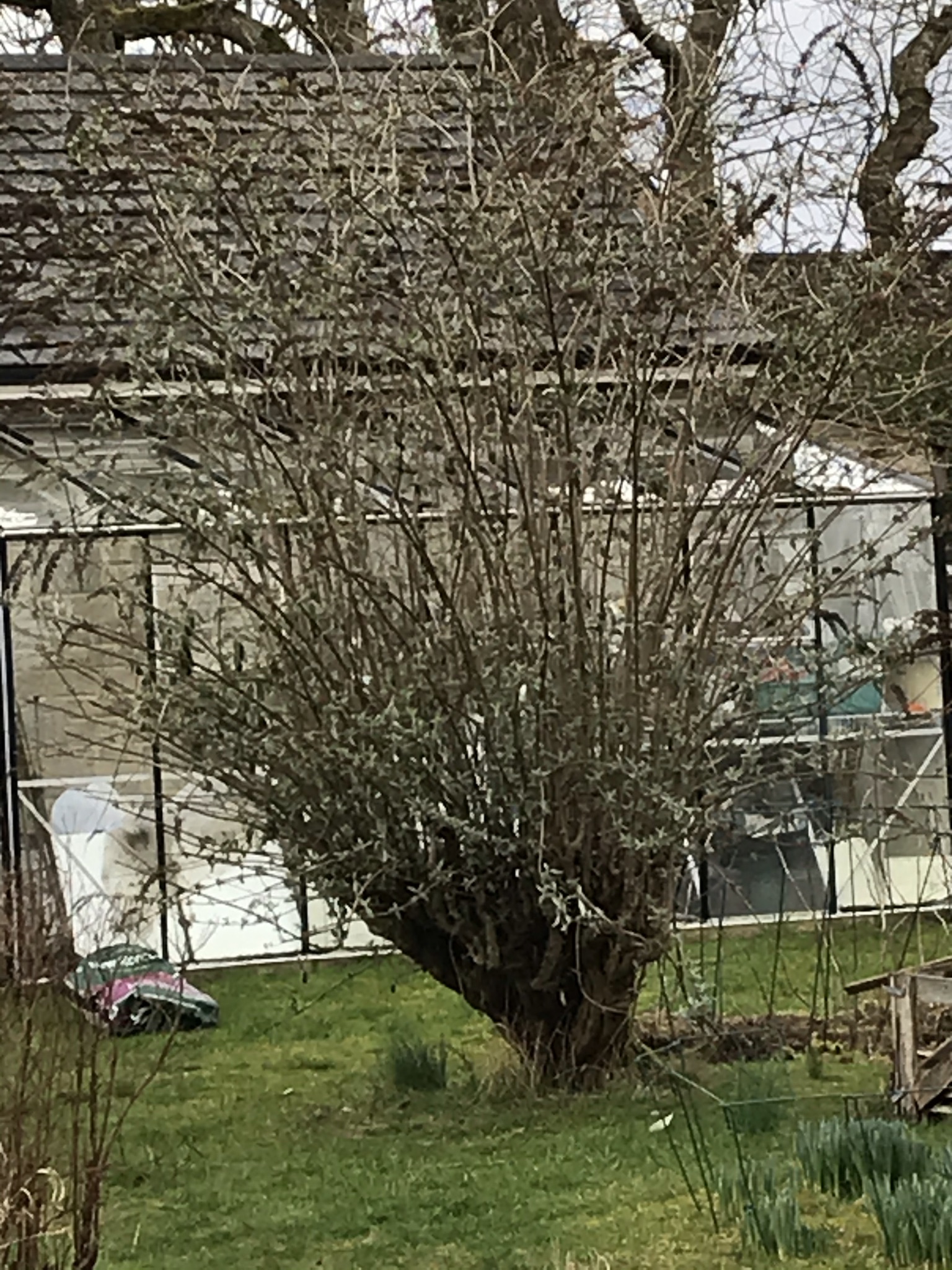
The buddleja is always a time-consuming job, not only because it’s so big but also because of all the prunings to be sorted and disposed of.  Some of these make good stakes for use around the garden, but I always keep too many of them.  The plant is very old, very woody and very large (and why on earth was it planted so close to the gooseberry bush?).  At least there is no problem about percentages of wood to remove: you remove the lot, cut as low down as possible.  In the case of this plant, that’s about waist-height, because over the years all the growth has created a woody base with a hollow centre, and nearly all the shoots come from the top of that.  This year I’ve tried to remove those shoots on the outside edge of the trunk; they tend to grow outwards (rather than straight up), which causes the plant to spread out too much, and those stems flop out over the lawn (and usually break off when caught by the wind).  We’ll see if that works.

Buddleja before ....

.... and after pruning

It’s that time of year when a wander round the garden often reveals something new in flower: a lone cowslip in this case, flowering in a corner by the summerhouse.