Thursday, 10 October 2019

When autumn leaves begin to fall


Autumn is here; the central heating went back on at the end of September when the chill and damp began to bite, and, despite occasional warmish sun, the temperatures are definitely on the way down.  When autumn leaves begin to fall, there are still things to do in the garden.

First, the leaves themselves: raking them up is only one part of what needs to be done.  The collected leaves go in the leaf-mould bins – a couple of rolls of fence netting that was left by the previous owners of the property – and, before that can happen, last year’s leaf-mould has to be taken out and used.  This was a process that made one of our robins very happy; evidently there was a lot of tasty micro-life in the bottom of the piles.  Some of the old stuff has been bagged up and will be used as mulch later this autumn, and the rest was spread on some of the veg beds in place of compost; leaf-mould lacks nutrients, but a top-dressing of 6X fertiliser should take care of that, and in my hungry soil any organic matter is useful.  Most of the leaves that have fallen so far are from the plum tree – it always drops its leaves first – but ash leaves are also starting to come down in the rather breezy weather that we’ve had recently.  The collected leaves have been mixed with some grass clippings to help keep them moist and to speed up decomposition; it’s always alarming how much room they take up, but the level drops quite quickly, making more space for the next lot.
 
While raking up leaves, I noticed some interesting little greenish-blue toadstools in the lawn.  I’ve tried to identify them, but most of the websites I’ve found seem to assume that the reader wants to kill toadstools in the lawn, or eat them (and I want to do neither).  Anyway, I didn’t find a description that fits these.
My mulched veg beds are still being disturbed by interlopers; a pheasant was caught in the act today, pecking at my spinach seedlings.  He was chased off.  Perhaps I should put the fleece covering back on.  Not that that would help my turnip seedlings, which have been munched by slugs.

It’s also time to get the bulbs, other than tulips, planted.  For once I’ve managed to plant my daffodil bulbs in pots before it gets too late.  The mixed miniature daffs (they were a job lot won in a raffle) have gone in the two big plastic tubs; these rather unlovely objects are relics of my very early gardening days, and although not very stylish they can be masked by smaller pots in front, and the little daffs cheer them up no end.  I’ve sown herb seed, dill and coriander, on top, and they’re now starting to come up; it’s late for them, but I might get a final crop before the weather gets too cold, and then they can be pulled out, leaving the way clear for the bulbs.  All my ‘Tete-a-tete’ bulbs seem to have disappeared, but I still have a lot of ‘Elka’, most of which have gone into two matching Whichford pots.

Another autumn job is clearing the window-boxes and planting them for some winter interest, and the remainder of my ‘Elka’ daffs have gone in there.  The big window-box hasn’t been very colourful this summer; the fuchsias and osteospermums in there didn’t deliver, though there were some lobelia flowers, and the little purple sedum provided additional interest.  For winter colour I’m mostly relying on foliage, with a mix of small golden euonymus plants, bronze sedge, a newly-acquired Heuchera ‘Cracked Ice’ (purple with a hint of silver shimmer), and two small Phormium ‘Tricolor’ (actually, maybe this combination is a bit too varied).  There are crocuses (angustifolia, I think) besides the ‘Elka’s for additional spring colour.  The phormiums are a bit of a risk.  Their proper name, I see from the RHS website, is Phormium cookianum subsp. hookeri ‘Tricolor’, and they’re in hardiness group H4 which is only borderline hardy here, but I’m hoping that shelter from the house will keep them from the worst of the cold, and I have other plants (all divisions of the original) if all else fails.  Today they were facing wind and occasional showers; the wind shouldn’t bother them, as like many New Zealand plants they’re very wind-tolerant.
Big window-box
The little window-troughs have had their mesembryanthemums removed – they had pretty much stopped flowering, although they’ve done well this summer – and some little violas put in their place.  These were self-seeders that had appeared between the paving slabs on the patio, so they’re a bit of a mixed bunch, but they seem to be mostly the progeny of last spring’s floriferous blue and yellow violas.  I hope they’ll provide some colour (and for free!).

It’s not quite time to pull up all the annuals.  I’m quite pleased with my antirrhinums, which are still in bloom.  They’re a plant that I’ve been a bit sniffy about in the past, possibly because I’d seen too many garish colour mixes, but having grown some better varieties I have to admit that they make good cut flowers; a vase of them, mostly ‘Bizarre Hybrids’, have been looking good for a week now.  The colour mixes are a little bizarre – I’m not too enthusiastic about the yellow and pink ones – but overall they have pleased me, and with some of the crimson and dark red/white ones (‘Night and Day’) they make a good show.  Outdoors, the dahlias are still (mostly) flowering - 'Sam Hopkins' produced one bloom and then stopped! - with the 'Bishop's Children' single dahlias looking fine and attracting bees and the last couple of butterflies (a red admiral and a comma).
Antirrhinums

Dahlias and yellow achillea

'Bishop's Children'

The birds are starting to return to the garden; a female blackbird has been coming to the patio, and a mistle thrush was in one of the ash trees earlier this week.

Monday, 30 September 2019

A monster and some interlopers

Monster courgette and friends

Back home after a week away.  Before we went I carefully checked the courgette plants and we ate all the fruits of usable size, but I wasn’t surprised to find a couple more ready for use when we returned.  What did surprise me was the monster found lurking at the base of one of the plants! – I can only assume I missed it before, although it must already have been of a fair size before our departure; hidden by the leaves, I expect.  A big lot of courgette parmigiana is being prepared for the freezer.  It was the biggest courgette I’ve ever produced, over a foot long; the small round thing on the right of the photo is a £1 coin for size comparison.

Meanwhile, down in the veg plot interlopers have been digging in my no-dig beds.  A small patch where some salad onion seed had been sown seems to have been used as a litter tray by the neighbour’s cat (yuk); the seed was old and unlikely to germinate, so I’m not too disappointed.  Other digging is probably the work of the local squirrel, who has been busily preparing for winter by burying hazelnuts in the lawn and anywhere else he can find; he started early, excavating one of my potato plants in the summer (the potatoes were ready for lifting and didn’t suffer unduly from the disruption), and he seems to have been scratching at the edges of some of the beds with fleece coverings but fortunately not getting underneath.  The only damage has been to a few asters and antirrhinums that were bedded out for cutting and were uprooted by the digging; since then, the remaining asters have been badly damaged by the heavy rain that seems to have fallen last week (and is going to fall for much of this coming week) and probably aren’t going to provide any more cutting material, though the antirrhinums and little salvias are still going strong.  And something, probably slugs, has eaten my oriental mustard seedlings on the Hill; I thought that the mustard was too strongly flavoured for them, but obviously not!

Painted lady on the buddleja
Two small tortoiseshells, chilling out on the woodpile
Other more welcome wildlife has been about.  A hedgehog was found snuffling around some windfall apples left outside our back door one evening, and I disturbed a slow worm while weeding by the apple cordons.  The birds are currently in their ‘shy’ period, probably moulting and dispersing to winter territories; the sparrows and robin, and occasional blue tits, are coming to take food but in much smaller quantities than previously.  There are three robins in various parts of the garden, sometimes tolerating one another and sometimes not, and a blackbird occasionally appears under the big cotoneaster, presumably picking up berries, but we’re mostly seeing the sparrows and woodpigeons.  One pigeon was feeding three youngsters in the plum tree yesterday.  The buddleja had been attracting lots of butterflies until the flowers petered out mid-month; up to 9 red admirals, and good numbers of painted ladies (it's a record year for them apparently) and small tortoiseshells, as well as the whites of course.  There was a comma and one peacock, but one only; in the past we’ve regularly seen half-a-dozen at any one time.  The best butterfly sightings this summer have been the marbled white and a fritillary.  We also had an emperor dragonfly which got trapped in the greenhouse for a while, and a hummingbird hawk-moth was also around the buddleja for a few days, but now that the weather is cooling down it is presumably off to hibernate somewhere.

Emperor dragonfly in the greenhouse
Dahlia 'Cafe au lait'
The wet and windy weather has knocked the sweet peas about, but they did provide a posy for this week; I’m now stopping the dead-heading in the hope of collecting some seed from them.  I’m very pleased with their performance this year; the idea of growing them in pots seems to have worked really well, as I’ve never had such good flowering so late in the year from them.  The 'Cafe au lait' dahlias have done well, 'Ambition' and 'Bishop of Auckland' less so but satisfactorily; 'Sam Hopkins' produced one flower only, and the newly purchased 'Dark Butterfly' disappeared.  The seed-sown 'Bishop's Children' flowered quite well, and the bees really liked them, so they will be overwintered for next year.


Of the other plants, the aubergines and two small peppers were harvested before we went away, and the tomato plants left to their own devices.  The aubergine plants were grown in larger pots this year but probably not large enough; the plants only produced a single fruit each, none very large.  The tomatoes, as previously reported, haven’t done well and I gave up on them at an early stage; the remaining fruits are now ripe, and the plants will be discarded once I’ve picked everything.  They’re not going to produce anything more.  The one grown in an outdoor pot did surprisingly well, and I might try that again; even though it lost its growing tip, possibly pinched off by a visiting bird, a side-shoot was pressed into service to replace it, and that seemed to do the trick.  Worth remembering.

Wednesday, 11 September 2019

The Disorganised Gardener gets a grip


A kind friend in the US – you know who you are, thank you! – recently sent me a copy of a fascinating magazine article about the restoration of a garden Stateside.  The lady who had originally created the garden had what can only be described as a very clear vision for what she wanted, to the extent of having trees pruned so that the branches were in the exact position she had in mind.  She was definitely an Organised Gardener.  Much as I admire such perseverance, focus and commitment, I have to admit that I am a Disorganised Gardener.  I am, however, attempting to remedy this.

The area I’ve been concentrating on most these past weeks is the veg plot.  It hasn’t been all that productive in recent years, for a number of reasons, including the unavailability of some of the beds (weeds or too much shade – the plum and big apple tree, and next door’s ash tree, have grown much bigger and shadier since I first created the veg patch), poor, worn-out soil and my failure to get properly to grips with crop rotation.

Crop rotation sounds easy in principle.  You have areas for beans/peas; onions and their kind; brassicas; and potatoes/roots; and each year you move each group to a new area so that any group only occupies the same patch once every four years.  I have 12 veg beds, plus two little ones, so this ought to be straightforward – three for each group.  However it presupposes that you want to grow similar quantities of each group, and it also gets complicated by the fact that not all crops go in and come out of the ground at the same time.  Some crops are autumn-planted, most go in in spring and some in summer; some are there for only a few weeks (the summer beans, for example), most for a few months and the brassicas are there for not far short of a year.  Leeks are sown in spring, are transplanted elsewhere in summer and stay there until late winter or early spring, so really need two beds at least.  Trying to match up all of these comings and goings is a bit beyond me; this year I snuck my leek transplants into the place where the broad beans had been, but that was really leaving it too late.  Then there’s the question of where to fit in the salads (anywhere you can, is the usual advice), crops like courgettes and interlopers such as flowers for cutting.  

I do keep records of what I’ve planted where, and I try hard to move each group to a new place each year, but I’m not good with succession and often find that my veg beds sit empty for long periods of time while I decide what to do with them.  When I have seedlings to plant out – I don’t sow much in situ as that never seems very successful (slugs?) – I’m reluctant to commit them to any particular place in case I find, some months down the line, that I really needed that bed as a home for the garlic or the runner beans.  It doesn’t help that not all of my little veg beds (I can’t really call them raised beds, although that was the intention; they’re not raised very much!) have been usable.  A couple – the shadiest ones – have been used in recent years as a (supposedly) temporary holding bed for plants that need to be moved elsewhere; they haven’t been properly worked, for example by adding organic matter, for quite some time and the soil is very poor as a result.  A couple of the others were very seriously overrun with weeds, mostly couch grass and big clumps of Deschampsia cespitosa, a desirable and decorative grass in itself but allowed to seed much too freely (the original plant was put there for want of a proper home and never taken out).  These two beds were part of the central area given over to four L-shaped beds grouped around a small central bed (the latter marked by the post on the right-hand side of the photos below), but however nice this looked on paper, on the ground maintenance involved a lot of zigzagging about, and I started turning them into four square beds (and removing the central one).  One of the four is the Hill (not very productive this year; sowing seeds into a steep-sided mound didn’t work too well, and the slugs seem to have discovered how to climb it), and one other bed had been successfully squared off to accommodate the garlic; but the other two sat in weedy, grassy splendour while I contemplated how to shift the gravel laid down for the path and put in some soil to turn the Ls into squares.

Step 1: weeds dug out, but corner of the L still to be filled in
Step 2: squared off, cardboard and mulch laid down
Then I got interested in no-dig.  A fellow villager uses the no-dig regime very successfully, and I thought I would give it a go, particularly for these two weedy beds.  Basically no-dig involves disturbing the soil as little as possible (so as not to upset the balance of underground microlife and to minimise weeding), instead working the ground by mulching heavily in early winter and planting directly into that; and clearing weedy ground by mulching the weeds out over winter (see https://charlesdowding.co.uk/start-here/ ).  The very tussocky grass, however, presented a bit of a problem; it would have taken a huge volume of mulch to bury it effectively (you’re supposed to use a strimmer, but I don’t have one), so I confess that I started my no-dig regime by, er, digging the weeds out.  I also needed to restore where the paths were meant to be, move as much gravel as reasonably possible there and shift soil from the little central bed into the missing corners of the two squares.  Even after the digging, I know from experience that there will still be couch grass roots in there, so the full no-dig ground-clearing process was followed: cardboard or thick paper on the two beds and their surrounding paths, then a layer of mulch (grass clippings and bought-in mushroom compost) over the cardboard on the beds, topped with black polythene (re-used from other long-ago gardening experiments).  All now tucked up until spring or summer, with occasional spots of minimal-disturbance weeding where the grass tries to poke through.

Step 3: black plastic on top - all tucked up!
I’ve started no-digging the other beds too; the one where the garlic had been has been raked over, mulched with leaf mould and bought-in compost, and spinach and the like sown for some winter/spring greens.  Another bed had a thinner layer of leaf mould (this bed had compost put on it last winter, so is in better shape anyway) and land cress, corn salad and turnips sown.  Some of these seeds are old, but if they don’t come up nothing is lost, and if they do, it’s all to the good.  I'm getting strict with myself about not hoarding old seed packets.  Likewise, to provide some more greens some late-sown brassica seedlings went in under netting – a few that had been in the cold frame already had to have cabbage white butterfly eggs and caterpillars removed from them!; they can have some mushroom compost packed around them once they’re big enough to cope.  Things are starting to look tidier, and dare I say, more organised; I hope it’s a first step on the road to better productivity!
Looking tidier
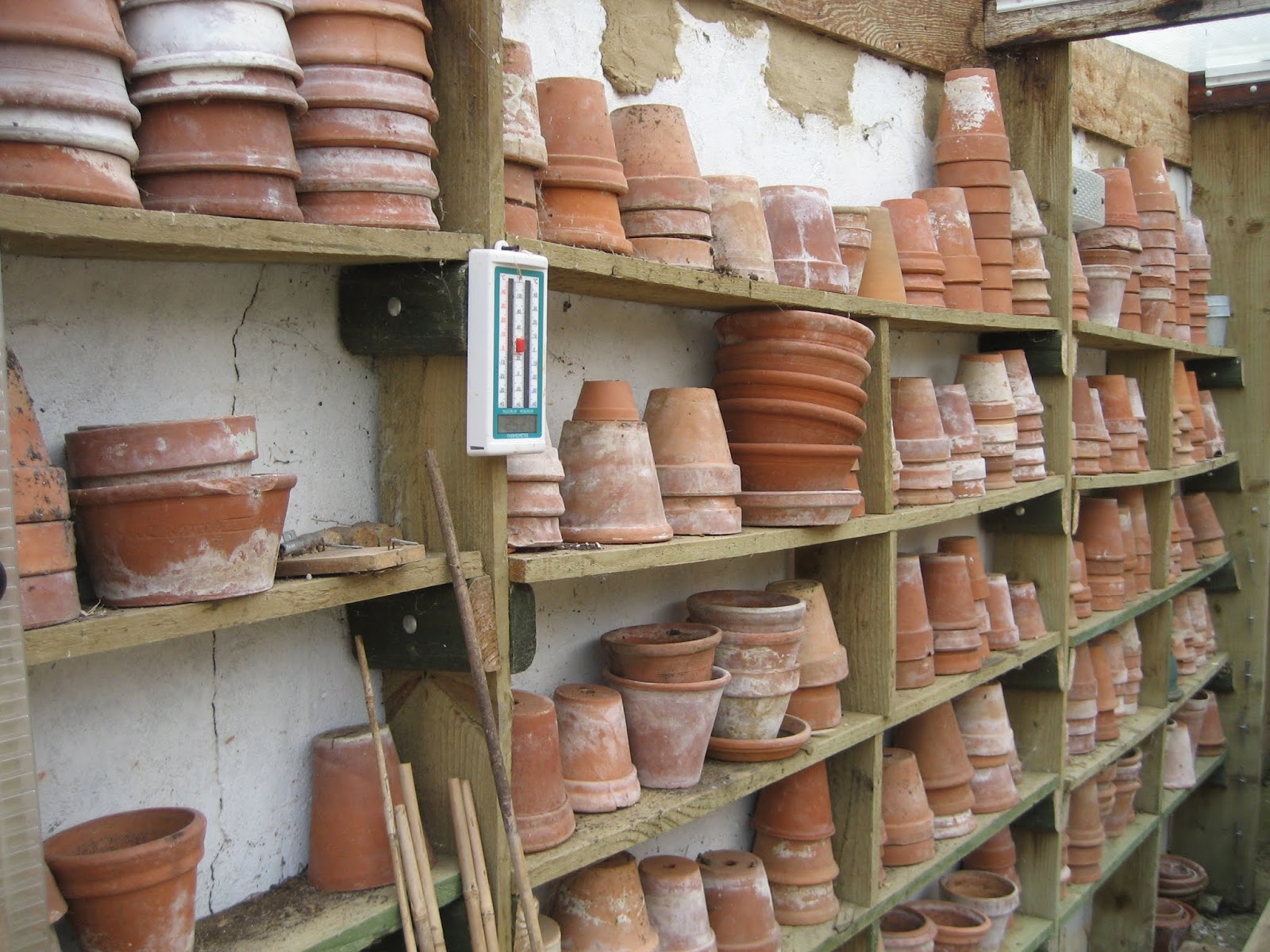
The greenhouse also needs some organisation; it's cluttered with plastic tubs (ex-fatball containers) and old compost sacks, which are very useful but perhaps not in quite the quantities I keep.  On a recent visit to Bourton House gardens I couldn't help but admire their potting shed - a model of organisation!
Bourton House's very organised potting shed